(Salt) Water Gargling as an Antiviral

Summary

Over the past year I’ve investigated potential interventions against respiratory illnesses. Previous results include “Enovid nasal spray is promising but understudied”, “Povidone iodine is promising but understudied” and “Humming will solve all your problems no wait it’s useless”. Two of the iodine papers showed salt water doing as well or almost as well as iodine. I assume salt water has lower side effects, so that seemed like a promising thing to check. I still believe that, but that’s about all I believe, because papers studying gargling salt water (without nasal irrigation) are few and far between. 

I ended up finding only one new paper I thought valuable that wasn’t already included in my original review of iodine, and it focused on tap water, not salt water. It found a 30% drop in illness when gargling increased in frequency from 1 time per day to 3.6 times, which is fantastic. But having so few relevant papers with such small sample sizes has a little alarm going off in my head screaming publication BIAS publication BIAS. So this is going in the books as another intervention that is promising but understudied, with no larger conclusions drawn. 

Papers

Estimating salivary carriage of severe acute respiratory syndrome coronavirus 2 in nonsymptomatic people and efficacy of mouthrinse in reducing viral load: A randomized controlled trial

Note that despite the title, they only gave mouthwashes to participants with symptoms.

This study had 40 participants collect saliva, rinse their mouth with one of four mouthwashes, and then collect more saliva 15 and 45 minutes later . Researchers then compared compared the viral load in the initial collection with the viral load 15 and 45 minutes later. The overall effect was very strong: 3 of the washes had a 90% total reduction in viral load, and the loser of the bunch (chlorhexidine) still had a 70% reduction (error bars fairly large). So taken at face value, salt water was at least as good as the antiseptic washes. 

(Normal saline is 0.9% salt by weight, or roughly 0.1 teaspoons salt per 4 tablespoons water)

[ETA 11/19: an earlier version of this post incorrectly stated 1 teaspon per 4 tablespoons. Thank you anonymous]

This graph is a little confusing: both the blue and green bars represent a reduction in viral load relative to the initial collection. Taken at face value, this means chlorhexidine lost ground between minutes 15 and 45, peroxide and saline did all their work in 15 minutes, and iodine took longer to reach its full effect.  However, all had a fairly large effect.

My guess is this is an overestimate of the true impact, because I expect an oral rinse to have a greater effect on virons in saliva than in cells (where the cell membrane protects them from many dangers). Saline may also inflate its impact by breaking down dead RNA that was detectable via PCR but never dangerous. 

The short-term effect of different chlorhexidine forms versus povidone iodine mouth rinse in minimizing the oral SARS-CoV-2 viral load: An open label randomized controlled clinical trial study

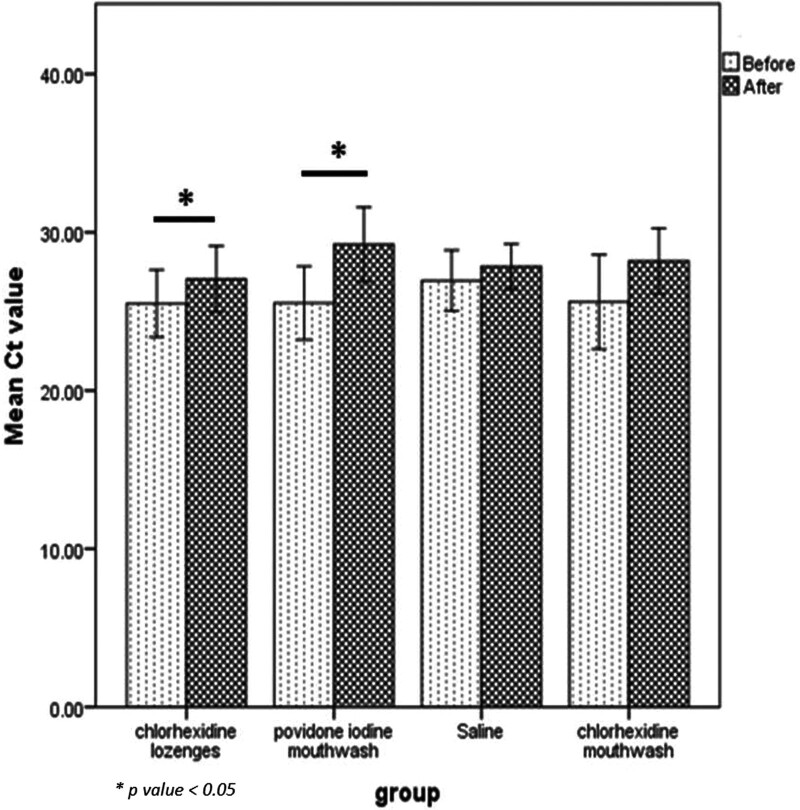
This study had a fairly similar experimental set up to the previous: 12 people per group tried one of three mouth washes, or a lozenge. Participants collected saliva samples immediately before and after the treatments, and researchers compared (a proxy for) viral loads between them.

Well, kind of. The previous study calculated the actual viral load and compared before and after. This study calculated the number of PCR cycles they needed to run before reaching detectable levels of covid in the sample. This value is known as cycle threshold, or Ct. It is negatively correlated with viral load (a smaller load means you need more cycles before it becomes detectable), but the relationship is not straightforward. It depends on the specific virus, the machine set up, and the existing cycle count. So you can count on a higher Ct count representing an improvement, but a change of 4 is not necessarily twice as good as a change of 2, and a change from 30->35 is not necessarily the same as a change from  20->25. The graph below doesn’t preclude them doing that, but doesn’t prove they did so either. My statistician (hi Dad) says they confirmed a normal distribution of differences in means before the analysis, which is somewhat comforting. 

This study found a significant effect for iodine and chlorhexidine lozenges, but not saline or chlorhexidine mouthwash. This could be accurate, an anomaly from a small sample size, or an artifact of the saline group having a higher starting Ct value (=lower viral load) to start from.

Prevention of upper respiratory tract infections by gargling: a randomized trial

This study started with 387 healthy volunteers and instructed them to gargle tap (not salt) water or iodine at least three times a day (the control and iodine group also gargled water once per day). For 60 days volunteers recorded a daily symptom diary. This set up is almost everything I could ask for: it looked at real illness over time rather than a short term proxy like viral load, and adherence was excellent. Unfortunately, the design were some flaws. 

Most notably, the study functionally only counted someone as sick if they had both nose and throat symptoms (technically other symptoms counted, but in practice these were rare). For a while I was convinced this was disqualifying, because water gargling could treat the pain of a sore throat without reducing viral load. However the iodine group was gargling as often as the frequent watergarglers, without their success. Iodine does irritate the throat, but gargling iodine 3 times per day produced about as much illness as water once per day. It seems very unlikely that iodine’s antiviral and throat-irritant properties would exactly cancel out. 

Taking the results at face value, iodine 3x/day + water 1x/day was no better than water 1x/day on its own. Water 3.6x/day led to a 30% reduction in illness (implicitly defined as lacking throat symptoms)

The paper speculates that iodine failed because it harmed the microbiome of the throat, causing short term benefits but long term costs. I liked this explanation because I hypothesized that problem in my previous post. Alas, it doesn’t match the data. If iodine traded a short term benefit for long term cost, you’d expect illness to be suppressed at first and catch up later. This is the opposite of what you see in the graph for iodine. However it’s not a bad description of what we see for frequent water gargling – at 15 days, 10% more of the low-frequency water garglers have gotten sick. At 50 days it’s 20% more – fully double the proportion of sick people in the frequent water gargler group. For between 50 and 60 days, the control group stays almost flat, and the frequent water garglers have gone up 10 percentage points. 

What does this mean? Could be noise, could be gargling altering the microbiome or irritating the throat, could be that the control group ran out of people to get sick. Or perhaps some secret fourth thing.

None of the differences in symptoms-once-ill were significant to p<0.05, possibly as a result of their poor definition of illness, or the fact that the symptom assessment was made a full 7 days after symptom onset.

Assuming arguendo that gargling water works, why? There’s an unlikely but interesting idea in another paper from the same authors, based on the same data. They point to a third paper that demonstrated dust mite proteins worsen colds and flus, and suggest that gargling helps by removing those dust mite proteins. Alas, their explanation of why this would help for colds but not flus makes absolutely no goddamn sense, which makes it hard to trust an already shaky idea. 

A boring but more reasonable explanation is that Japanese tapwater contains chlorine, and this acts as a disinfectant. 

Dishonorable Mention: Vitamin D3 and gargling for the prevention of upper respiratory tract infections: a randomized controlled trial

I silently discarded several papers I read for this project but this one was so bad I needed to name and shame.

The study used a 2×2 analysis examining vitamin D and gargling with tap water. However it was “definitively” underpowered to detect interactions, so they combined the gargling with and without vitamin D vs. no gargling with and without D into groups, without looking for any interaction between vitamin D and gargling. This design is bad and they should feel bad. 

Conclusion

Water (salted or no) seems at least as promising an antiviral as other liquids you could gargle, with a lower risk of side effects. So if you’re going to gargle, it seems like water is the best choice. However I still have concerns about the effect of longterm gargling on the microbiome, so I am restricting myself to high risk situations or known illness. However the data is sparse, and ignoring all of this is a pretty solid move. 

Thank you to Lightspeed Grants and my Patreon patrons for their support of this work. Thanks to Craig Van Nostrand for statistical consults.

There is a $500 bounty for reporting errors that cause me to change my beliefs, and an at-my-discretion bounty for smaller errors. 
Humming is not a free $100 bill

Last month I posted about humming as a cheap and convenient way to flood your nose with nitric oxide (NO), a known antiviral. Alas, the economists were right, and the benefits were much smaller than I estimated.

The post contained one obvious error and one complication. Both were caught by Thomas Kwa, for which he has my gratitude. When he initially pointed out the error I awarded him a $50 bounty; now that the implications are confirmed I’ve upped that to $250. In two weeks an additional $750 will go to either him or to whoever provides new evidence that causes me to retract my retraction.

Humming produces much less nitric oxide than Enovid

I found the dosage of NO in Enovid in a trial registration. Unfortunately I misread the dose-  what I original read as  “0.11ppm NO/hour” was in fact “0.11ppm NO*hour”. I spent a while puzzling out what this meant, with the help of Thomas Kwa, some guy on twitter, and chatGPT (the first time it’s been genuinely useful to me). My new interpretation is that this means “actual concentration upon application*1 hour/time at that concentration”. Since NO is a transient molecule, this means my guess for the amount of NO in Enovid was off by 2-3 orders of magnitude.

My estimates for the amount of NO released by humming may also be too high. I used this paper’s numbers for baseline NO concentration. However the paper I used to estimate the increase gave its own baseline number, which was an order of magnitude lower than the first paper.

This wasn’t intentional cherrypicking- I’d seen “15-20x increase in concentration” cited widely and often without sources. I searched for and spotchecked that one source but mostly to look at the experimental design. When I was ready to do math I used its increase but separately looked up the baseline concentration, and found the paper I cited.

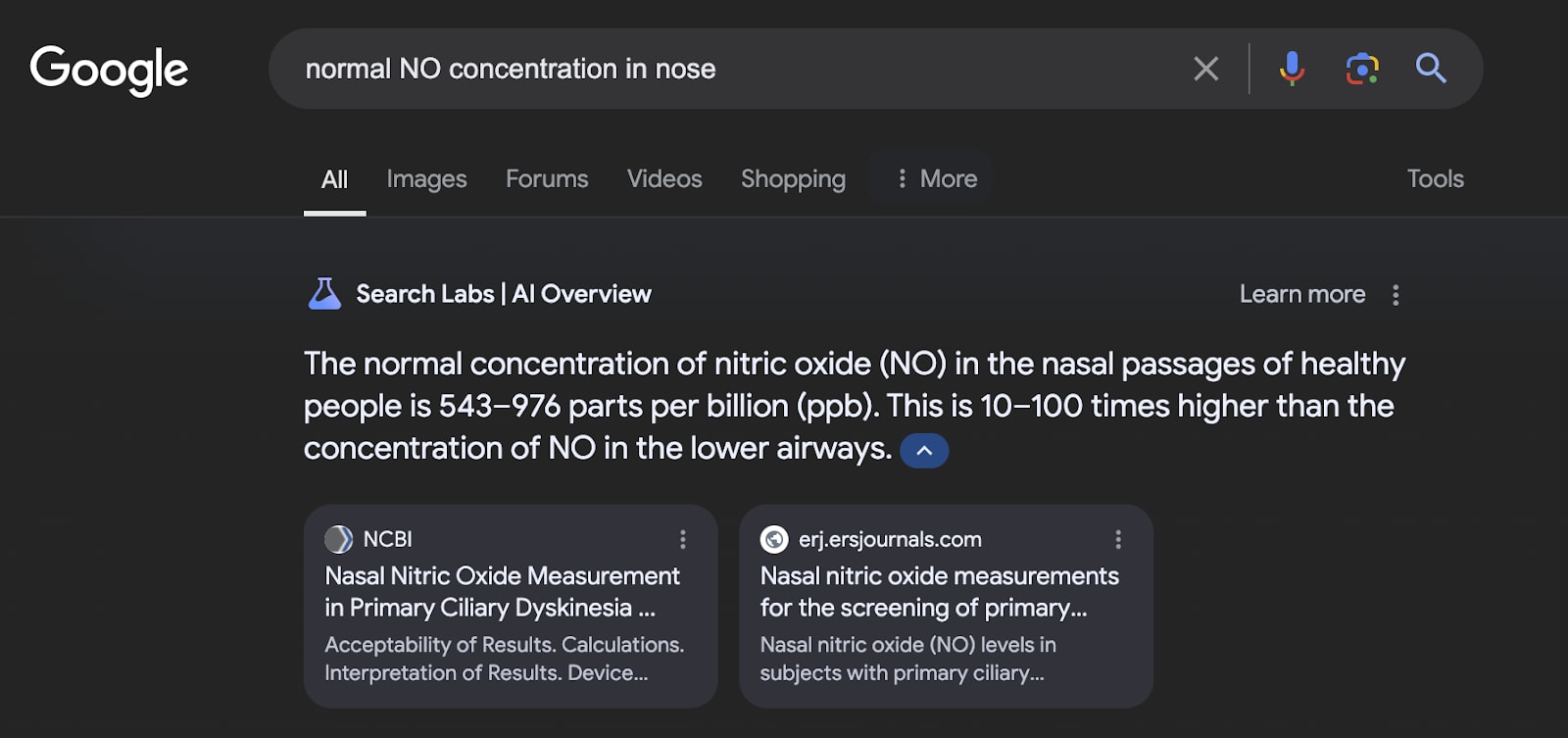
I just asked google again and got an even higher estimate of baseline nasal concentration, so seems like there is a great deal of disagreement here.

If this were the only error I’d spend the time to get a more accurate estimate. But it looks like even the highest estimate will be a fraction of Enovid’s dose, so it’s not worth the energy to track down.

Using the new values, you’d need 28 minutes of humming to recreate the amount of NO in Enovid (spreadsheet here). That wouldn’t be so bad spread out over 4-6 hours, except that multiple breaths of humming in a row face diminishing returns, with recovery to baseline taking 3 minutes. It is possible to achieve this in 6 hours, but only just. And while it’s not consequential enough to bother to look it up, I think some of the papers applied Enovid more often than that.

This leaves humming in search of a use case. People who care a lot about respiratory illnesses are better off using Enovid or another nasal spray. People who don’t care very much are never going to carefully pace their humming; and the amount of humming they might do won’t be very effective. The only use case I see is people who care a lot and are pushed into a high risk situation without notice, or who want a feeling of of Doing Something even if it is not doing very much at all.

Reasons to not write off humming entirely

The math above assumes the effect is linear with the amount of NO released, regardless of application time. My guess is that frequent lower doses are more effective than the same amount as a one off. Probably not one effective enough to give humming a good non-emergency use case though.

Another possibility is that Enovid has more nitric oxide than necessary and most of it is wasted. But again, it would have to be a lot moreto make this viable.

Conclusions

Humming hasn’t been disproven as an anti-viral intervention, but the primary reason I believed it worked has been destroyed. I will be observing a six week period of mourning for both my hope in humming and generally feeling dumb.

The fact that I merely feel kind of dumb, instead of pricing out swords with which to commit seppuku, is thanks to the little angel that sits on my shoulder while I write. It constantly asks “how will you feel about this sentence if you turn out to be wrong?” and demands edits until the answer is either “a manageable amount of unhappy” or “That’s not going to come up”. This post thoroughly tested her work and found it exemplary, so she will be spending the next six weeks partying in Vegas.

[RETRACTED] Do you believe in hundred dollar bills lying on the ground? Consider humming

Introduction

[Reminder: I am an internet weirdo with no medical credentials]

A few months ago, I published some crude estimates of the power of nitric oxide nasal spray to hasten recovery from illness, and speculated about what it could do prophylactically. While working on that piece a nice man on Twitter alerted me to the fact that humming produces lots of nasal nitric oxide. This post is my very crude model of what kind of anti-viral gains we could expect from humming.

ETA 6/6: I made a major error in this post and its numbers are incorrect. The new numbers show that matching Enovid’s nitric oxide content, or even getting close enough for a meaningful effect, takes way more humming than anyone is going to do.

I’ve encoded my model at Guesstimate. The results are pretty favorable (average estimated impact of 66% reduction in severity of illness), but extremely sensitive to my made-up numbers. Efficacy estimates go from ~0 to ~95%, depending on how you feel about publication bias, what percent of Enovid’s impact can be credited to nitric oxide, and humming’s relative effect. Given how made up speculative some of these numbers are, I strongly encourage you to make up  speculate some numbers of your own and test them out in the guesstimate model.

If you want to know how nitric oxide reduces disease, check out my original post.

Math

Estimating the impact of Enovid 

I originally estimated the (unadjusted) efficacy of nitric oxide nasal sprays after diagnosis at 90% overall reduction in illness, killing ~50% of viral particles per application. Enovid has three mechanisms of action. Of the papers I looked at in that post, one mentioned two of the three (including nitric oxide) a second mechanism but not the third, and the other only mentioned nitric oxide. So how much of theat estimated efficacy is due to nitric oxide alone? I don’t know, so I put a term in the guesstimate with a very wide range. I set the lower bound to ⅓ (one of three mechanisms) to 1 (if all effect was due to NO). 

There’s also the question of how accurate the studies I read are. There are only two, they’re fairly small, and they’re both funded by Enovid’s manufacturer. One might reasonably guess that their numbers are an overestimate. I put another fudge factor in for publication bias, ranging from 0.01 (spray is useless) to 1 (published estimate is accurate).

How much nitric oxide does Enovid release?

This RCT registration uses a nitric oxide nasal spray (and mentions no other mechanisms). They don’t give a brand name but it’s funded by the company that produces Enovid. In this study, each application delivers 0.56 mL of nitric oxide releasing solution (NORS) (this is the same dose you get from commercial Enovid), which delivers “0.11ppm [NO]*hrs”. 

There’s a few things that confusing phrase could mean:

  • The solution keeps producing 0.11ppm NO for several hours (very unlikely). 
  • The application produces 0.88ppm NO almost immediately (0.11*8, where 8 hours is the inter-application interval), which quickly reacts to form some other molecule. This is my guess, and what I’ll use going forward. It won’t turn out to matter much. 
  • Some weirder thing. ETA 5/25: Thomas Kwa points out that the registration says “0.11ppm*hrs” not “0.11ppm/hr”. I’m on a tight deadline for another project so haven’t been able to look into this; it definitely seems like my interpretation is wrong, but I’m not sure his is right. I’ve reached out to some biology friends for help.

How much nitric oxide does humming move into the nose?

Here we have much more solid numbers. NO concentration is easy to measure. Individuals vary of course, but on average humming increases NO concentration in the nose by 15x-20x. Given baseline levels of (on average) 0.14ppm in women and 0.18ppm in men, this works out to a 1.96-3.42 ppm increase. More than twice what Enovid manages.

The dominant model is that the new NO in the nose is borrowed from the sinuses rather than being newly generated. Even if this is true I don’t think it matters; sinus concentrations are 100x higher than the nose’s and replenish quickly. 

Estimating the impact of humming

As far as I can find, there are no published studies on  humming as an antimicrobial intervention. There is lots of circumstantial evidence from nasal vs. mouth breathing, but no slam dunks. So I’m left to make up numbers for my Guesstimate:

  • Paper-reported decline in illness due to spray (0.9) 
  • Proportion of effect due to NO (0.33 to 1)
  • Adjustment for publication bias (.01 to 1)
  • Adjustment for using prophylactically rather than after diagnosis (0.75 to 2.5) (set this to 1 if you want to consider post-diagnosis use)
  • Bonus to humming due to higher NO levels and more frequent application (1 to 5) 
  • I capped the results so they couldn’t suggest that the effect size was less than 0  or greater than 1, and then applied the nasal-infection discount. 
  • Proportion of infections starting in the nose (because infections in the throat should see no effect from humming) (0.9 to 1) (set this to 1 if you believe the spray effect estimate already includes this effect)

From that I get an estimate of effect of 0 to 0.98, with an average of 0.67. This is of course incredibly sensitive to assumptions I pulled out of my ass. If you prefer numbers from your own ass, you can enter them into my model here. For comparison, microcovid.org estimates that masks have an efficacy against of 33% (for thick, snug cloth masks) to 87% (well-sealed n95s). 

How to hum

Here is what I’ve advised my elderly parents, and will use myself once I find a way to keep it from activating the painful nerve damage in my jaw:

  • This really is normal humming, just be sure to exhale entirely through your nose.
    • If you google “how to hum” you will mostly get results on singing exercises, which I think are suboptimal. This very annoying video has decent instructions on how to hum with your lips sealed. 
    • Higher pitch (where the vibration lives more in the nose and less in the throat) should be more effective, but making it easy to do is probably more important.
    • You only need to do one breath per session, after that you face diminishing returns.
  • Once per hour is probably overkill, but it’s also easy to remember. Alternately, pick a trigger like entering a room or opening Twitter.
    • A beta reader asked if it was worth waking up in the middle of the night to hum. I’m still not a doctor, but my immediate reaction was “Jesus Christ no”. Sleep is so important, and once per hour is a number I made up for convenience. However if you happen to wake up in the middle of the night, I expect that’s an especially valuable time to hum.
  • The less time between exposure and humming, the better. Since you can’t always know when you’ve been exposed, this suggests humming during and after every high risk event, or making it an everyday habit if you find it cheap.
  • How long after? For Enovid I made up a plan to use it for one full day after the last high risk period, which my very crude math estimates gives your body an extra day to ramp up your immune system. 

Are there downsides?

Everything with a real effect has downsides.  I’m struggling to come up with ones that won’t be immediately obvious, like vibrating a broken nose or annoying your spouse, but I’ve been surprised before.

One possible source of downsides is that the nitric oxide was more valuable in the sinuses than the nose. This doesn’t worry me much because sinus levels are 100x nasal levels, and judging from the exhalation experiments sinus levels completely recover in 3 minutes. 

The barest scraps of other evidence

This (tiny) study found that Bhramari Pranayama (which includes humming) reduced sinusitis more than conventional treatment. But the same size of 30 (per group) and lack of a no-treatment group makes this hard to take seriously.

There appeared to be a plethora of literature that nasal breathers had fewer respiratory infections than mouth breathers. I wouldn’t find this convincing even every study showed a strong effect (because it’s over such a long time period and impossible to track causality), so I didn’t bother to investigate. 

Some dude may or may not have eliminated his chronic rhinosinusitis (inflammation of nose and sinuses) that may or may not have had an infectious component by humming, which may or may not have worked by increasing nasal nitric oxide. He used a very different protocol that to my eye looks more likely to work via sheer vibration than by nitric oxide, especially because a lot of his problem was located in the sinuses.

Reasons to disbelieve

  1. If my model is correct, humming is the equivalent of finding a paper sack full of hundred dollar bills on the ground. Both the boost from humming and the immune function of NO have been known for decades; medical research would have to be really inadequate to produce so little data on this. 
  2. All of the data on the impact of nasal nitric oxide is on covid; maybe NO is less effective on other viruses.
  3. If nasal nitric oxide is so great, why did evolution give us the nasal NO concentration it did?
    1. I love me a good evolution-based argument, but I think they’re at their weakest for contagious diseases. Relative to the ancestral environment we have a much easier time finding calories to fuel our immune system and diseases with which to keep it busy, so we should expect our immune systems to be underpowered. 
  4. If humming has any effect outside the nose, it has got to be tiny. 

Conclusion

Hourly nasal humming might be as effective as masks at reducing respiratory infections. The biggest reasons to disbelieve are the paucity of data, and skepticism that society would miss something this beneficial. If you’re the kind of person who looks at an apparent hundred dollar bill on the ground and gets excited, humming seems like an unusually good thing to try. But if the pursuit of loose bills feels burdensome or doomed, I think you should respect your instincts.

I have an idea for how to generate more data on humming and respiratory illnesses, but it requires a large conference in winter. If you’re running a conference with 500+ nerds, in your local winter, with a majority of attendees coming from locations in local winter, I’d love to chat. You can reach me at elizabeth@acesounderglass.com.

Betadine oral rinses for covid and other viral infections

Before we get started, this is your quarterly reminder that I have no medical credentials and my highest academic credential is a BA in a different part of biology (with a double major in computer science). In a world with a functional medical system no one would listen to me. 

Tl;dr povidone iodine probably reduces viral load when used in the mouth or nose, with corresponding decreases in symptoms and infectivity. The effect size could be as high as 90% for prophylactic use (and as low as 0% when used in late illness), but is probably much smaller. There is a long tail of side-effects. No study I read reported side effects at clinically significant levels, but I don’t think they looked hard enough. There are other gargle formulas that may have similar benefits without the risk of side effects, which are in my queue to research.

Benefits

Math

One paper found a 90% decrease in salivary viral load after mouthwash use (which probably overestimates the effect). Another found a 90% reduction in bad outcomes, with treatment (in mouth, nose, and eyes) starting soon after diagnosis. I suspect both of these are overestimates but 1. 90% reduction is a fantastic upper bound to have 2. Neither of these looked at prophylactic use. A third study found a significant reduction in viral DNA after usage, but did not quantify that by viral load or outcomes. 

I feel like if povidone iodine was actually that good we’d have heard about it before. OTOH mouthwash formulations are barely available in the US, and most of these studies were in Asia, so maybe it went to fixation there years ago and the west is just catching up. 

So I’m going to call this 9-45% reduction in illness timeXintensity when used after symptom onset. Before onset ought to be higher, my wild ass guess is up to 90%. 

One reason I think earlier use is better is that, at least with covid, most of the real damage happens when the virus reaches the lungs. If iodine gargles can form a firewall that prevents an upper respiratory infection from becoming a lower respiratory infection, you’ve prevented most (although not all) of the worst outcomes.

Papers

I livetweeted every paper I read, collected here. I don’t want to brag, but those tweets were very popular among ladies with large boobs and 10 numbers in their twitter handles. So if that’s your type you should definitely check out those threads. Everyone else will probably find them tedious, so I’m going to summarize the most relevant papers here.

Estimating salivary carriage of severe acute respiratory syndrome coronavirus 2 in nonsymptomatic people and efficacy of mouthrinse in reducing viral load: A randomized controlled trial

This study had participants rinse their mouth with one of four mouthwashes, and compared the pre-mouthwash salivary viral load with the viral load 15 and 45 minutes later. The overall effect was very strong: 3 of the washes had a 90% total reduction, and the loser of the bunch still had a 70% reduction (error bars fairly large). 

Note that despite the title, they only gave mouthwashes to participants with symptoms.

My guess is this is an overestimate of impact, because I expect an oral rinse to have a larger effect on saliva than on cellular levels. I wish they’d tested 4-6 hours later, after the virus had had some time to regrow.

Effect of 1% Povidone Iodine Mouthwash/Gargle, Nasal and Eye Drop in COVID-19 patient 

On one hand, this paper features significant ESL issues, missing data, terrible presentation of other data, and was published in a no-name journal. On the other hand, it had one of the best study designs and 30x the number of participants of other studies. I’d love to discard this paper but there aren’t better options.

We see an almost 90% reduction in testing positive on the third day. I suspect that overstates the results because it lowers salivary or nasal fluid viral load more than cellular load, so let’s look at outcomes:

90% reduction in hospitalization, 85% reduction in oxygen use, and  88% reduction in death. 

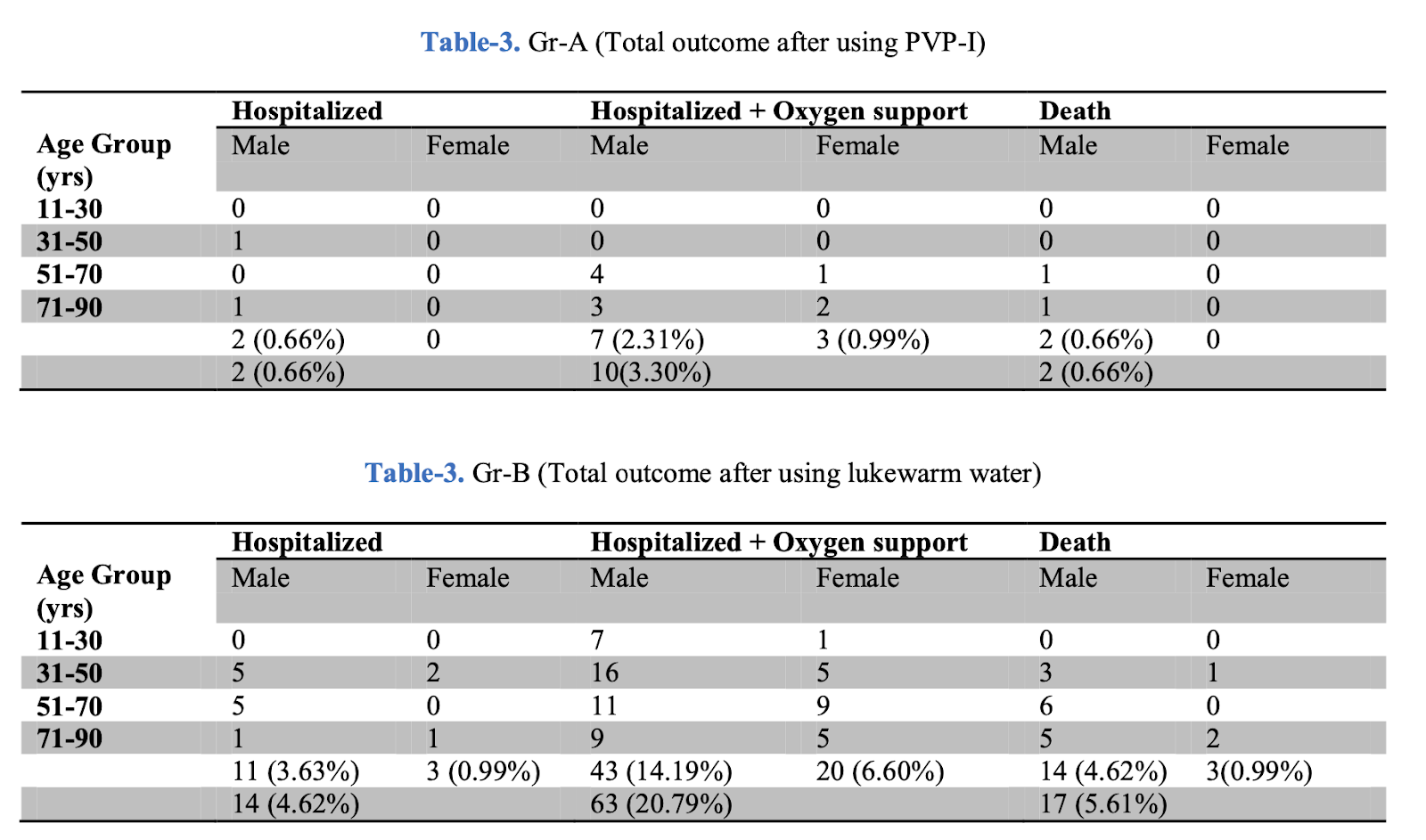
I was skeptical of these numbers at first, especially because they only tell you the total number of an age/sex group in the study, and the number of people in a demographic group with a bad outcome. Their percentages also don’t work out properly, making it hard to see the real impact. 

Luckily almost everyone in the control group was still PCR positive on day 3, which is almost like having a participant count. The number of control participants still sick on day 3 is indeed about half of every demographic. This doesn’t rule out trickier stuff like putting people at the higher end of their age band in the control group, but it’s a good deal better than that one paper where the youngest person in the control group was a year younger than the oldest person in the treatment group. 

The short-term effect of different chlorhexidine forms versus povidone iodine mouth rinse in minimizing the oral SARS-CoV-2 viral load: An open label randomized controlled clinical trial study

I originally ignored this paper, because it only reported Ct values and not outcomes or viral load.* However the previous two papers are from the same author and have shockingly concordant results, and I wanted a second opinion. 

[*Ct value = how often you have to run the PCR machine on a sample to get over a particular threshold. This corresponds to viral load but the relationship is complicated and variable. A higher Ct value means lower viral load]

The most important finding is that Ct went up by 3.3 (S genes) and 4.4 (E genes). 

N=12 so I’m not thrilled with this study, but pickings are slim. 

Side Effects, Or: Should I just gargle iodine all the time then?

Barring very specific circumstances, I wouldn’t. There are several issues that give me pause about long term continuous use.

Hyperthyroidism

Povidone iodine skin washes can cause hyperthyroidism in infants. Among adults, many studies found increases in Thyroid Stimulating Hormone (an indicator of issues but not itself terrible), but not T3 or T4 (directly casual to outcomes). These studies tend to be small and in some cases used the wrong statistical test that missed a long tail clearly visible in their plots, so I assume there exist people for whom this creates a clinically significant effect, especially after prolonged use.

I didn’t include this paper when calculating health benefits, because its control group was too different from its treatment group. But it’s still potentially useful for tracking side effects (although at n=12, it’s still pretty limited). It found a 50% increase in TSH after a week of treatment, but no change in T3 or T4. TSH returned to normal within 12 days of ceasing treatment. That’s not worrisome for healthy people on its own, but could easily reach worrisome with longer use or a vulnerable patient. 

Tissue damage could leave you worse off?

There is a long history of aggressive use of topical antimicrobial treatments leaving users worse off due to long term tissue irritation. This is why proper wound treatment changes every decade. That same study looked at this and found no increase in cellular irritation in the throat after six months of use. It’s possible they didn’t look hard enough, or they didn’t have sufficient sample size to catch the effect. It’s also possible the species that invented ghost peppers for fun has a throat surface built to handle irritation and iodine is too weak to hurt us

Oral microbiome damage could leave you worse off?

No one studied this at all, but it looks to me like an obvious failure point. I already use oral probiotics, but if I didn’t I would add them in while using iodine.

How to use

0.5% povidone iodine is sold under the brand name Betadine. You can also buy more concentrated povidone iodine and dilute it yourself. You might be tempted to use a higher concentration, but: 1. Remember the long tail of side-effects. 2. There’s some weird evidence that higher concentrations are less effective. I didn’t dig into this very weird claim but you probably should if you plan to try it. 

The Betadine bottle recommends gargling 10ml for 30s, 4x/day. The short term studies used 4-6x/day. Spacing that out is nontrivial attention tax, so when I was sick I just put the bottle on my bathroom sink and used it every time I used the bathroom. This probably comes out to more than 6x/day (especially when I’m sick and chugging fluids), but I also didn’t use a full 10ml and rarely made it to a full 30s, so hopefully it balanced out. 

More Data Needed

The state of existing knowledge around iodine gargles is poor. This is especially frustrating because I don’t think it should be that challenging to gather more. I’m toying with a plan to fix this, but will publish separately since it’s not specific to iodine. 

For financial support I would like to thank my Patreon supports and Lightspeed grants.

Nitric oxide for covid and other viral infections

Epistemic status: I spent about 5 hours looking into this, and the next day developed covid myself.  I did a bit more research plus all of the writing while sick. So in addition to my normal warning that I have no medical credentials, you should keep in mind that this knowledge may be cursed. 

ETA 4-30-24: In this post I used “nitric oxide spray” and “enovid” as synonyms. I’ve since learned this is incorrect, NO is one of several mechanisms Enovid uses. The other mechanisms weren’t mentioned in the papers I cite so it’s possible these are accurate for NO alone.

Introduction

Nitric Oxide Nasal Spray, sold under the brand name Enovid, is a reactive compound that kills viruses (and I suspect taxes your nasal tissue). It has recently been tested and marketed for treatment of covid. The protocol I found in papers was 2 sprays per nostril every 2-3 hours, after you develop symptoms. Enovid’s instructional pamphlets say twice per day, also after you get sick. This seems a little late to me.

I suspect the real power of NONS lies in use before you develop symptoms, ideally as close to exposure as possible. This is difficult because you don’t know when you would have gotten sick, and I suspect there are costs to indefinite use. I initially thought (and told people, as a tentative guess) that one round of 4 total sprays after a high risk event was a good trade off. After doing the math for this post, that intervention seems much less helpful to me, and picking the right length of post-exposure prophylaxis depends on equations for which we lack good numbers. I pulled some numbers out of my ass for this post, but you should not trust them. 

My guess is NONS is minimally useful once covid has reached the throat, unless you combine it with a separate disinfectant of the throat. I hope to write up a report on one such disinfectant soon, although TBH it’s not looking good. 

NONS can lead to false negatives on any test based on a nasal swab, because it breaks the relationship between nasal viral load and overall load.

How does it work?

First, nitric oxide is highly reactive, which makes it destructive to anything organic. Virions are fragile to this kind of direct attack, and certain immune cells will produce nitric oxide to kill bacteria, viruses, and your own diseased cells.

First-and-a-half, nitric oxide may alter the pH of your nose, and this effect may last well past the death of the original NO molecules. This was an aside in one paper, and I haven’t followed up on it. 

Second, nitric oxide is a signaling molecule within your body, probably including but definitely not limited to the immune system. I assume the immune system uses it as a signal because it serving a functional purposes. For the rest of body the selling point appears be that it crosses membranes easily but dies quickly, making it useful when the body wants the signal to fade quickly. Viagra works by indirectly increasing your body’s synthesis of nitric oxide. 

How well does it work?

Good question, and it depends a lot on how you use it.

My best guess is that a single application (2 sprays in each nostril) of Envoid ~halves the viral load in your nose. Covid doubles in 36 hours, so that’s how much extra time you’ve bought your immune system to ramp up defenses. If you follow the more aggressive protocols in the literature and apply that treatment 6 times per day, you wipe out 95% of covid in the nose. I will attempt to translate this an efficacy estimate in that mythical future, but in the meantime siderea has a write-up on why reducing viral load is valuable even if you can’t destroy it entirely

Sometimes you will see very impressive graphs for Enovid’s impact; these are inevitably looking at the results of nasal swabs. Since even in the best case scenario NONS doesn’t affect spread once an infection has reached the throat, this doesn’t feel very relevant to me. 

Sometimes you will see very unimpressive graphs, from the rare studies that looked at transmission or symptoms. These effects are so weak, in such small studies, that I consider them essentially a null result.

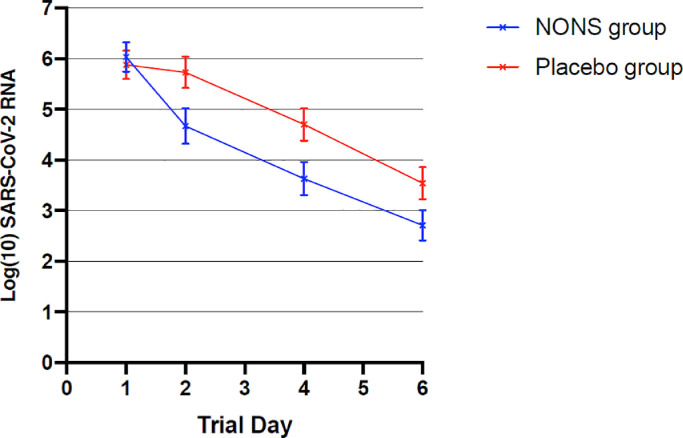
…Except that these studies all started treatment days after symptoms emerged. In one case it was a minimum of 4 days. Another said “0-3 days” after symptoms, but since it takes time to see a doctor and be recruited into a study I expect the average to be on the high end of that. Additionally, both studies showed a downward slope in infection in both treatment and control groups. This is a big deal because I expect the largest effect to come if NONS is used before exponential growth really takes off. If they’re seeing a decline in viral load in their control arm, they either administered treatment too late or their placebo isn’t. 

[I think this reasoning holds even if immune overreaction is part of the problems with long covid. Long covid is correlated with severity of initial infection.]

To figure the impact of prophylactic use, I’m going to have to get, uh, speculative. Before I do that, let me dig into exactly what the data says. 

Effect size on nasal viral load

This has very solid data: even under the unfavorable circumstances of a strong infection, a day of usage drops viral load by 90-95%

Paper 1 says 95% reduction in one day, 99% in two. They took samples from the nose and throat but don’t clarify which location that applies to. If I had the energy I’d be very angry about that right now. 

(Their placebo was a saline spray, which other people claim is an antimicrobial in its own right, so this may understate the effect)

Paper 2 finds an adjusted 93-98% decline after 1 day’s use of NONS. 

Effect on symptoms/transmission, as measured by poorly designed studies

Paper 1 did track time to cure, but with a 40% response rate on a sample size of 40 in the treatment arm I can’t bring myself to care.

Paper 2 reported a couple of metrics. One is “Time to cure (as defined by PCR results)” which is still worthless because it’s still using a nasal swab. Another is clinician-assessed improvement; this effect seemed real but not huge. 

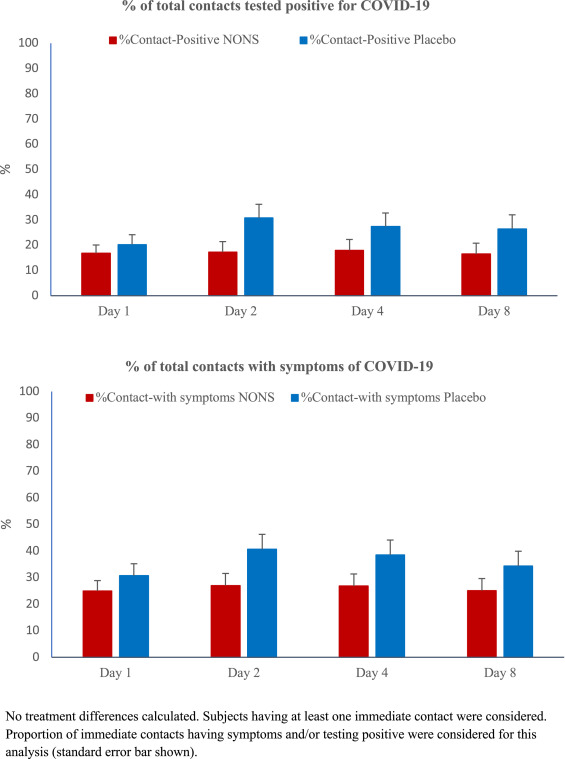
They also checked for spread to close contacts, but not very well. Contacts had to take the initiative to get tested themselves, and AFAICT they didn’t establish if they were infected before or after treatment started.  You can try to factor that out by only looking at the last day of recorded data, but the difference appears to start on day 1 of treatment, when there absolutely shouldn’t be an effect. 

Other Diseases

NONS has been studied against other infections and I fully meant to look at that data. Now that I have actual covid I consider it kind of a race to get this post out before I’m too tired, so this will come later if at all.

My wild ass guess of impact

What does a single dose do? I did a very stupid model assuming six doses over 24 hours each having the same proportionate effect, and found that halving viral load with each application was a perfect match with the data. I expect the first dose of the day has a larger effect and each one is a little less effective until you sleep and the virus has some time to marshal forces, but barring better data I’m going to treat Enovid as rolling back one doubling. 

[I want to emphasize I didn’t massage this to make the math easier. I tried .9 in my naive spreadsheet knowing it wouldn’t work, and then tried 0.5 to find it perfectly matched the data]

If my covid infection starts in the nose and I take a full course of treatment immediately after exposure, <10% chance I get sick. But that’s unachievable without constant use, which I think is a bad idea (see below).

What if you’re infected, but only in your nose? It’s a 95% reduction per day. It’s anyone’s guess how much that reduces the chance of spread to your throat; I’d say 95% is the upper bound, and am very arbitrarily setting 50% as the lower bound for the first day (this time I am trying to make the math easier). But you’re also reducing the cumulative load; on day three (after two days of treatment), your viral load is 99% lower than it would otherwise be, before you take any new doses.

I suspect the real killer app here is combining Enovid with a throat disinfectant, and am prioritizing a review of at least one throat disinfectant in a future post. 

Can I get this effect for free, without the painful stinging or logistical hassle of a nasal spray?

Maybe. Your nose already naturally produces nitric oxide, and you can increase this by 15x by humming. I haven’t been able to find the dosage of a single spray of Enovid to compare, but humming doesn’t sting so I assume it’s a lot less. On the other hand, you can hum more often than six times per day. On the third hand, I can’t tell if humming causes you to produce more NO or just release it faster, in which case chronic humming might deplete your stores. 

A quick search found multiple published articles suggesting this, but none actually studying it. The cynic in me says this is because there’s no money in it, but this study would take pennies to run and be so high impact if it worked that I suspect this is less promising than it seems. 

Update 2024-10-01: No.

Thank you to Michael Tontchev on twitter for pointing me towards humming.

Should I just use this all the time?

I don’t regularly use Envoid, despite having a shit immune system. The history of treatments like this is that long term use causes more problems than it solves. They dry out mucous membranes, or kill your own immune cells. I think the rest of you should seriously consider developing a humming habit; alas I have nerve damage in my jaw that makes vibration painful so not an option for me. 

I do think there’s a case for prophylactic use during high risk situations like conferences or taking care of a sick loved one. 

Where can I buy Enovid?

Amazon has it, but at $100/bottle it’s quite expensive. You can get it from other websites for half the price but longer shipping times; my friend used israelpharm.com and confirms he got his shipment. 

Long Covid Risks: 2023 Update

Back in 2021 I wrote a post estimating the risk of long covid. Recently a client hired me to do an update, focusing on changes induced by Paxlovid and vaccination. This was a <5h project and the literature wasn’t very rich so nothing I say here is conclusive, but nothing I said last time was conclusive either so let’s enjoy this together. 

Some caveats: 

  • I spent 5 hours on this, and that includes client-specific work I’m not including here.
  • Research that met my standard was really scarce; ultimately each conclusion is based on a single study. My goal was data that includes a large population not selected for having long covid, where reporting was automated so you don’t need to worry about response bias. In practice, this means I used data from large medical systems with integrated reporting, like the American Department of Veteran Affairs, national medical systems, and HMOs. Surveys from long covid support groups were ignored with prejudice. 

Summary

Vaccination helps, a bit: Given a medically diagnosed infection (which means it was serious enough to actually get you to the doctor), up-to-date vaccination lowers the risk of long covid by about 20% (this does not include the reduction in risk of having diagnosable covid in the first place, which is substantial). 

Paxlovid helps, more: Nirmatrelvir, which is one of two drugs that make up Paxlovid, reduces long covid risk by about 30% for medically diagnosed infections (which means it was serious enough to actually get you to the doctor). An optimist might hope the other drug (which is in the same class, although most commonly used as an adjuvant) is also useful and round this to 50%.

Most symptoms are temporary: Long covid does tend to get better over time, but how quickly depends on the symptom.  At one year post-infection, the rate of heart issues is nearly indistinguishable from controls, but cognitive issues have a 50% chance of persisting. 

Calculate your absolute risk: Your absolute risk depends on your age and comorbidities. The measured risk for 70-year-old men (not controlling for comorbidities) of developing at least one serious sequelae of medically diagnosed covid n (which means it was serious enough to actually get the patient the doctor) is ~12%. If you want to norm this for your own demographic, you can get a very crude estimate by entering your demographic information in this calculator, dividing your risk of hospitalization by 3 and multiplying the total by 0.4 (which includes the 20% reduction from vaccination and the 50% reduction from Paxlovid). If you are a cis woman, multiply by 2 to account for increased risk (trans people: I have no idea, if you find good data please let me know). 

I cannot emphasize enough how crude this is. I got that 3 by making up a 70 year old man with some common comorbidities, which has a risk of hospitalization of ~36%, and noticed 36/12=3. I don’t think The Economist has been keeping up to date with the latest strains of covid or even the impact of vaccination; these proposed calculations are strictly for order-of-magnitude estimates. 

Sample calculation: a 35 year old woman with no comorbidities shows a 3.8% risk of hospitalization (with their data, which I believe is very old). 3.8%/3= 1.3%. 1.3%*0.4= 0.5%. Times 2 for being female = 1.0%. So a covid infection bad enough to require medical attention has a 1 chance in 100 of a serious persistent issue post-covid. 

Studies

Nirmatrelvir and the Risk of Post-Acute Sequelae of COVID-19 (pre-print)

This study compared people who got covid and received Nirmatrelvir (half of Paxlovid). It used data from the American Department of Veteran Affairs, which means the participants are older (average age 65), overwhelmingly male (~90%), and very white (75%). Last time I checked maleness increases the risks of short-term covid consequences but decreases the risks of long term consequences, so good luck balancing that calculation.

The distribution of medication was not random. They don’t specify beyond this, but I assume VA doctors are more likely to aggressively treat patients who are sicker or have more co-morbidities, which should lead the study to understate the impact of treatment. Additionally they were only giving nirmatrelvir, which is one of the two drugs packaged together to make Paxlovid. I’m going to be an optimistic and assume the second drug was included for good reasons, which make this study underrepresent the usefulness of Paxlovid. But they don’t give the dosage at all, so there is a wildcard.

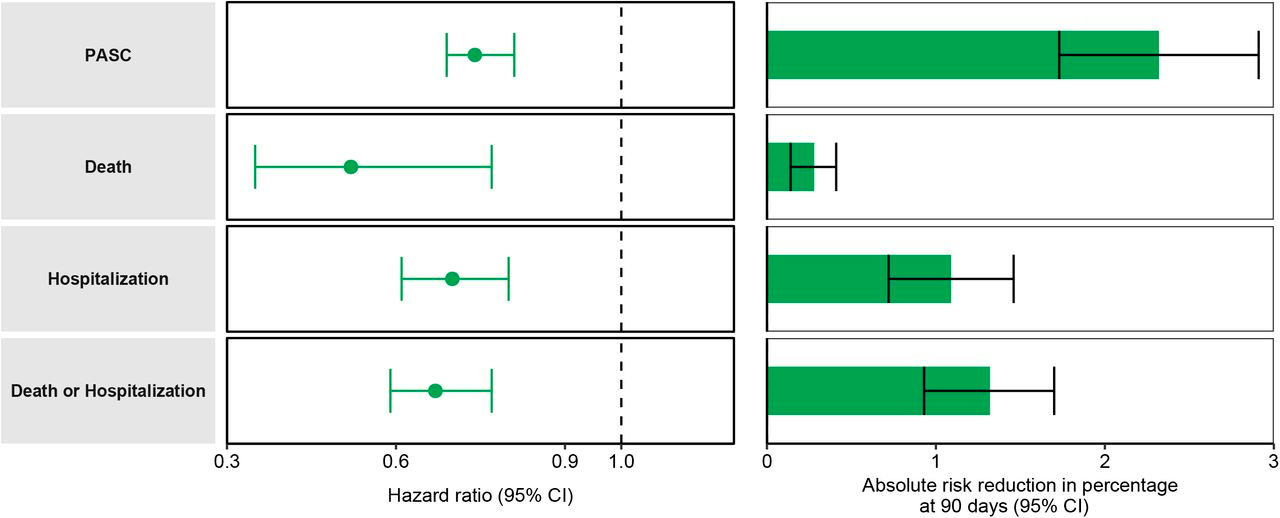
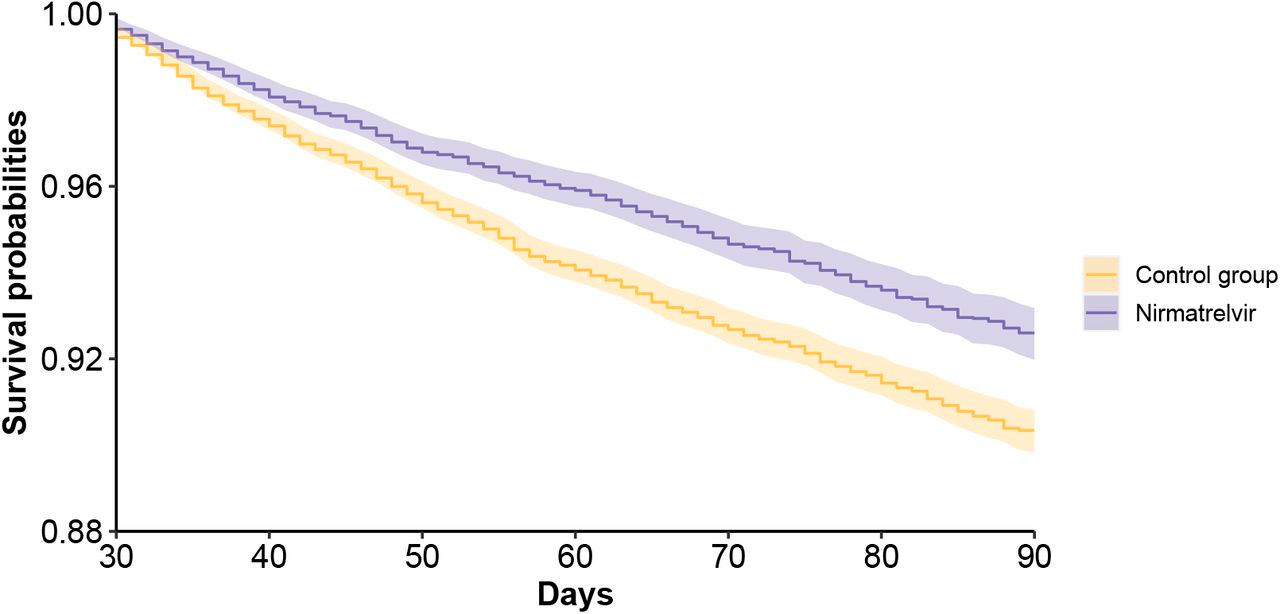
All that said: Nirmatrelvir was quite helpful, cutting the risk of long covid (PASC) at 90 days by ~25%, which in this group translated to 2.5 percentage points. 

Survival here means “survived w/o long covid symptoms”. You might ask why that goes down over time, given some people recover between days 30 and 90. I believe the answer is that they didn’t check for symptoms’ persistence: any diagnosis of long covid issues put participants in the PASC bucket forever.

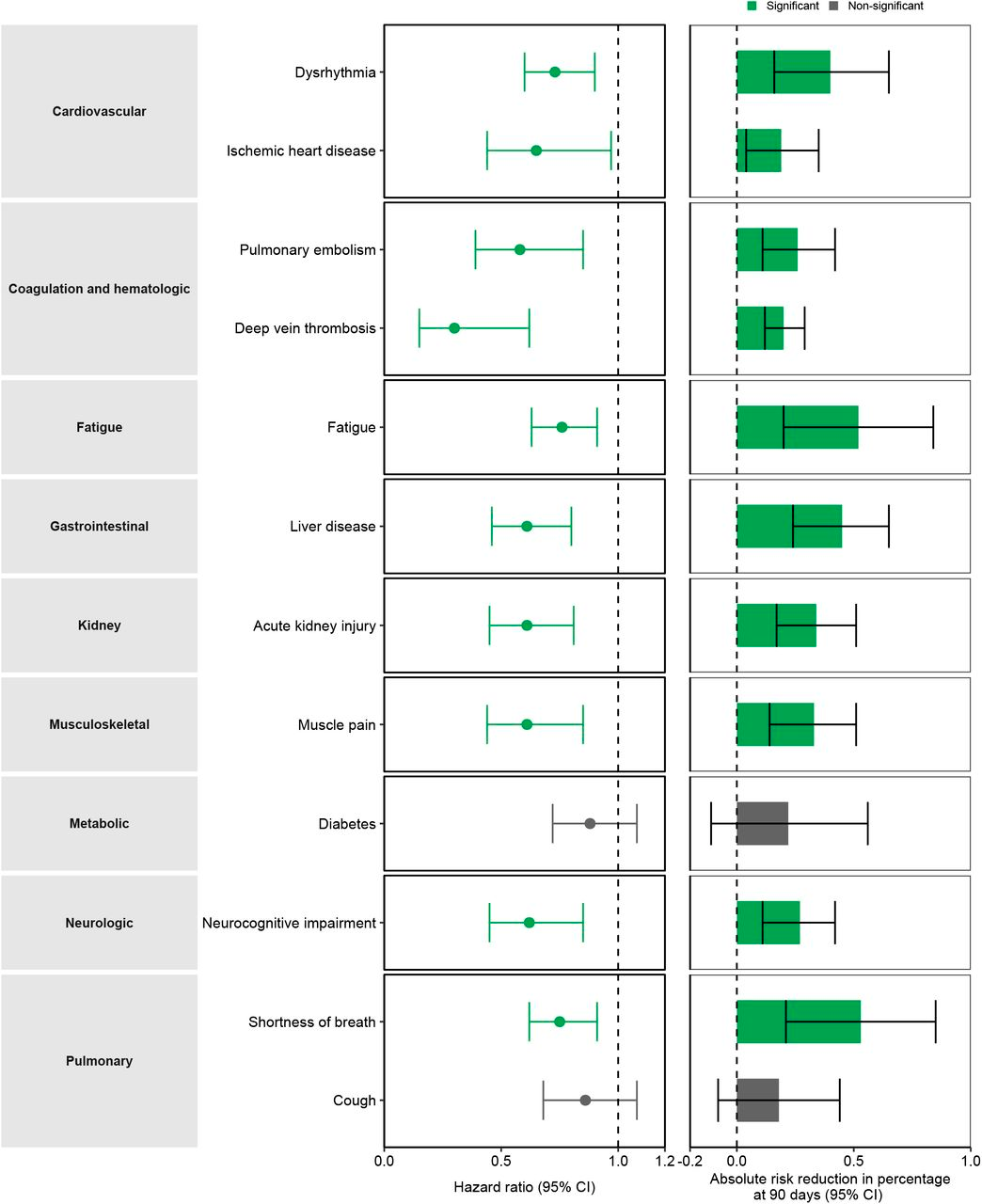
Effect by symptom:

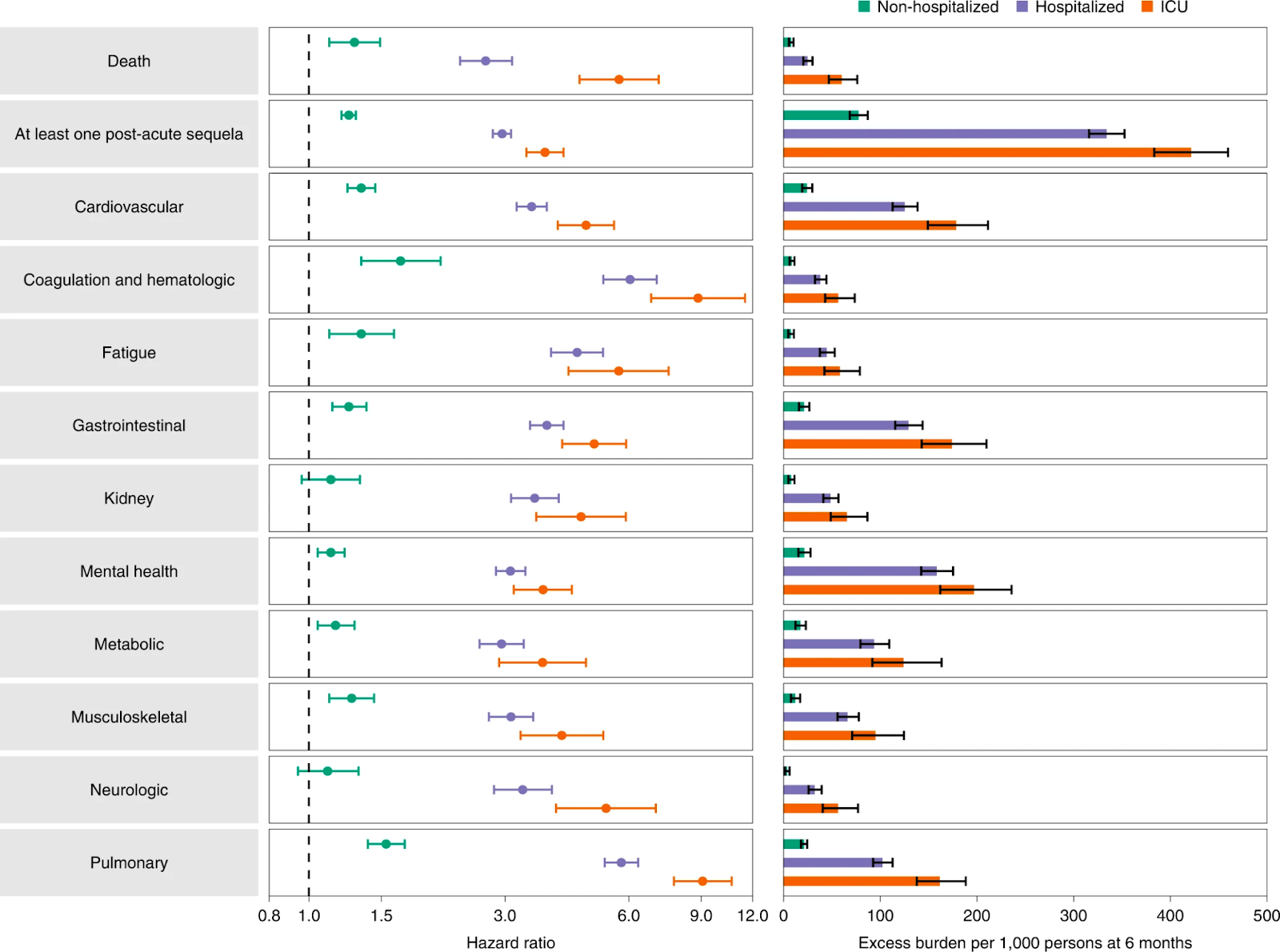
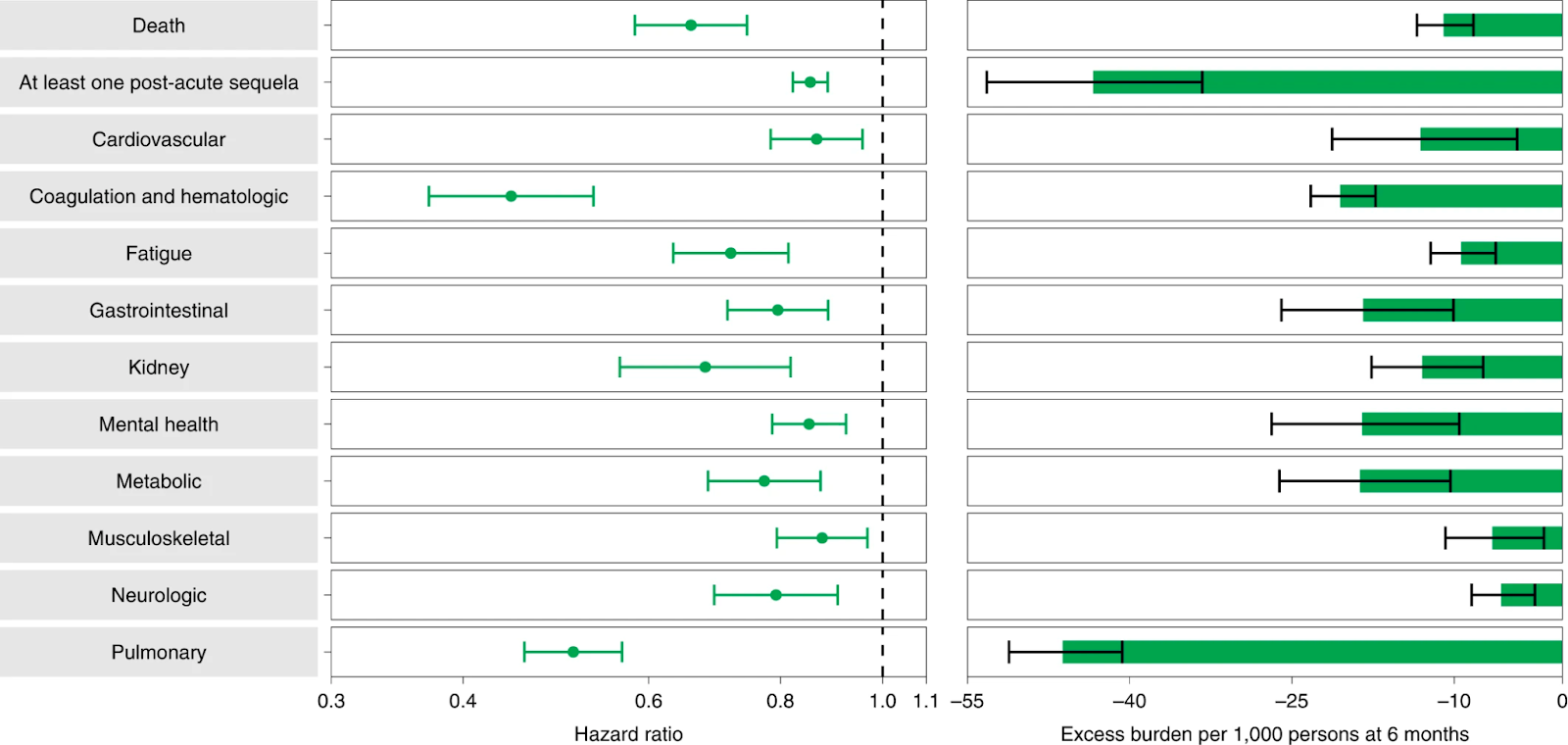
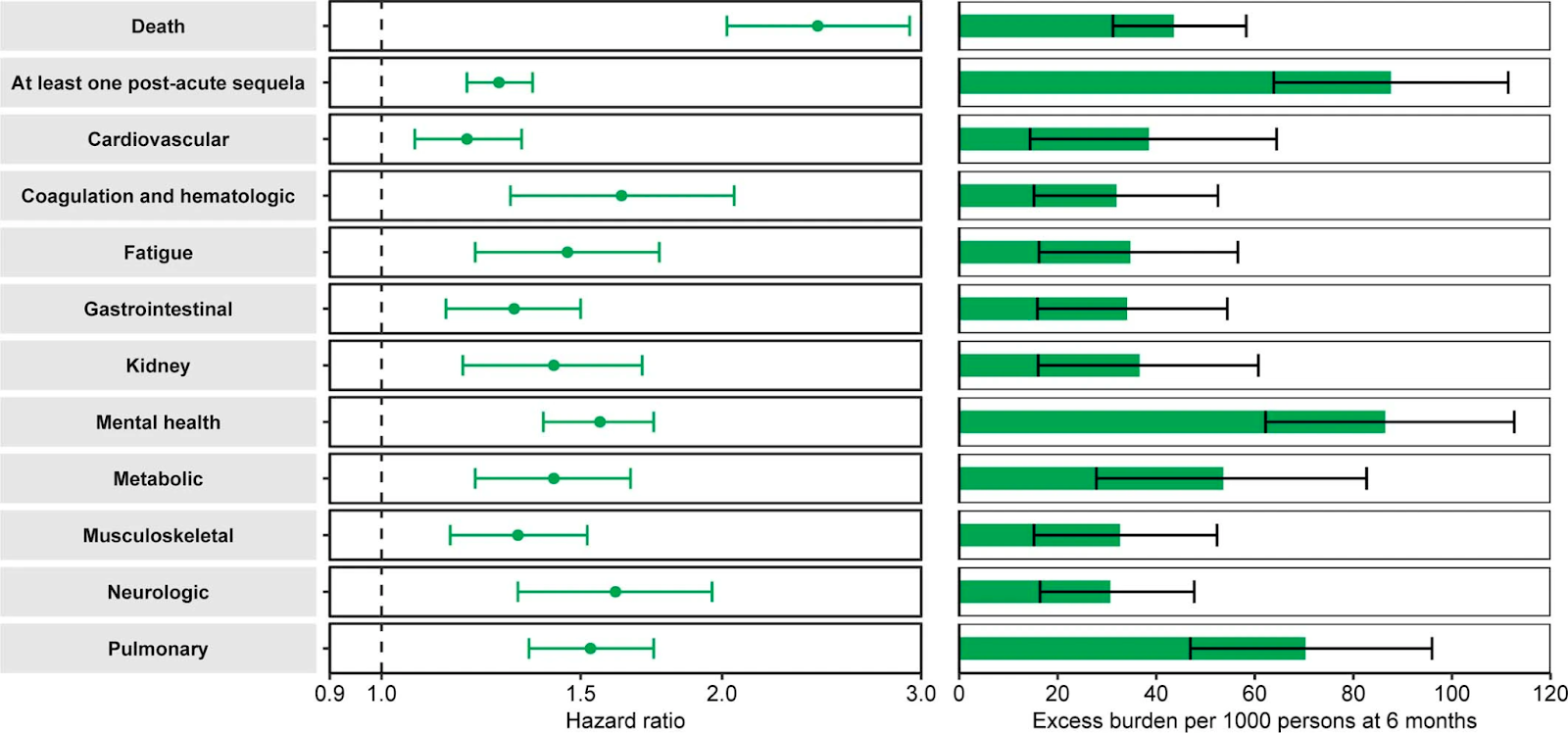
Long COVID after breakthrough SARS-CoV-2 infection

This is another study with VA data. They compared outcomes of infection after vaccination, compared with vaccinated controls. 

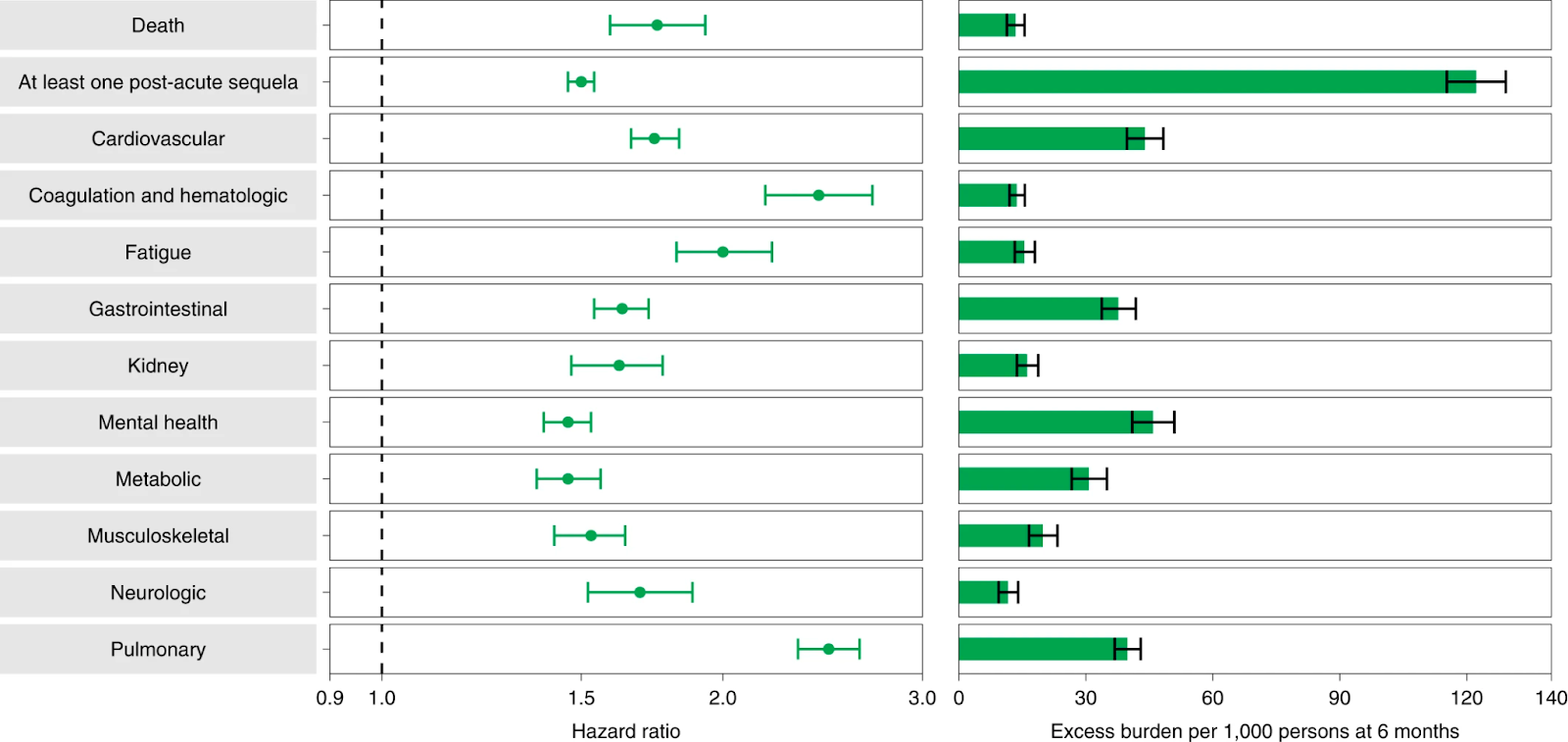
Participants with infections after vaccination (aka breakthrough infections) had a 12 percentage point increase in risk of symptoms in 12 areas, compared to vaccinated people who didn’t get infected. Again, the study population is probably at higher risk than average due to age and associated comorbidities.

However, this risk is heavily concentrated among hospitalized patients:

They also compared the risks to those of infections in unvaccinated people. Vaccination clearly helped, but not by as much as one would hope.

Just for fun, here’s the long-term risks of covid relative to the flu:

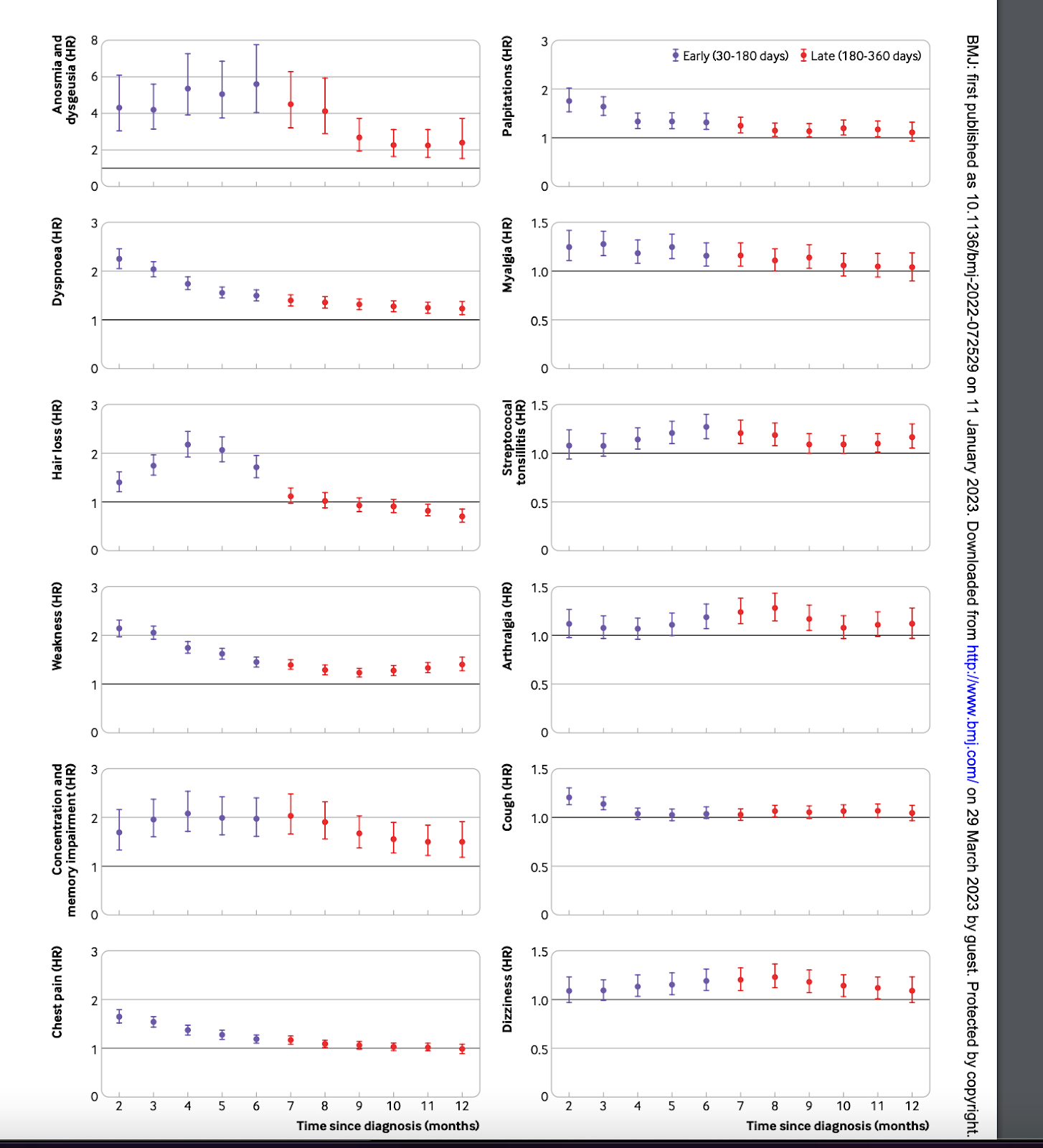
Long covid outcomes at one year after mild SARS-CoV-2 infection: nationwide cohort study

This paper looked at long-term health outcomes from an Israeli HMO. It mixed vaccinated and unvaccinated participants but held infection severity constant, which is unforgivable from an absolute risk estimation standpoint but probably fine for looking at the trajectory of recovery from long covid over time. “Mild” appears to mean “did not end up in the hospital”; however the case did need to be serious enough that it made it into medical records in the first place. 

The general trend is “things get better”, with the rate of improvement varying by symptom type. Unfortunately cognitive effects are the slowest to resolve, with at best a 50% recovery rate one year out.

Thanks to anonymous patron for supporting the original research and Patreon patrons for supporting this write-up.

Home Antigen Tests Aren’t Useful For Covid Screening

Epistemic status: I strongly believe this is the right conclusion given the available data. The best available data is not that good, and if better data comes out I reserve the right to change my opinion.

EDIT (4/27): In a development I consider deeply frustrating but probably ultimately good, the same office is now getting much more useful information from antigen tests. They aren’t tracking with same rigor so I can’t comapre results, but they are now beating the bar of “literally ever noticing covid”.

In an attempt to avoid covid without being miserable, many of my friends are hosting group events but requiring attendees to take a home covid test beforehand. Based on data from a medium-sized office, I believe testing for covid with the tests people are using, to be security theater and provide no decrease in riskAntigen tests don’t work for covid screening. There is a more expensive home test available that provides some value, and rapid PCR may still be viable.

It’s important to distinguish between test types here: antigen tests look for viral proteins, and genetic amplification tests amplify viral RNA until it reaches detectable levels. The latter are much more sensitive. Most home tests are antigen tests, with the exception of Cue, which uses NAAT (a type of genetic amplification). An office in the bay area used aggressive testing with both Cue and antigen tests to control covid in the office and kept meticulous notes, which they were kind enough to share with me. Here are the aggregated numbers: 

  • The office requested daily Cue tests from workers. I don’t know how many people this ultimately included, probably low hundreds? I expect compliance was >95% but not perfect.
    • The results are from January when the dominant strain was Omicron classic, but no one got strain tested.
  • 39 people had at least one positive Cue test, all of which were either asymptomatic or ambiguously symptomatic (e.g. symptoms could be explained by allergies) at the time, and 27 of which had recent negative cue tests (often but not always the day before, sometimes the same day)
  • Of these, 10 definitely went on to develop symptoms, 7 definitely did not, and 18 were ambiguous (and a few were missing data).
  • 33 people with positives were retested with cue tests, of which 9 were positive. 
  • Of those 24 who tested positive and then negative, 4 tested positive on tests 3 or 4.
  • Of the 20 people with a single positive test followed by multiple negative retests, 6 went on to develop symptoms.
  • 0 people tested positive on antigen tests. There was not a single positive antigen test across this group. They not only didn’t catch covid as early as Cue did, they did not catch any cases at all, including at least 2 people who took the tests while experiencing definitive systems.
    • Antigen tests were a mix of Binax and QuickVue.
    • Early cases took multiple antigen tests over several days, later cases stopped bothering entirely.
    • The “negative test while symptomatic” count is artificially low because I excluded people with ambiguous symptoms, and because later infectees didn’t bother with antigen tests. 
    • I suppose I can’t rule out the possibility that they had an unrelated disease with similar symptoms and a false positive on the Cue test. But it seems unlikely that that happened 10-28 times out a few hundred people without leaving other evidence.

A common defense of antigen tests is that they detect whether you’re contagious at that moment, not whether you will eventually become contagious. Given the existence of people who tested antigen-negative while Cue-positive and symptomatic, I can’t take that seriously.

Unfortunately Cue tests are very expensive. You need a dedicated reader, which is $250, and tests are $65 each (some discount if you sign up for a subscription). A reader can only run 1 test at a time and each test takes 30 minutes, so you need a lot for large gatherings even if people stagger their entrances. 

My contact’s best guess is that the aggressive testing reduced but did not eliminate in-office spread, but it’s hard to quantify because any given case could have been caught outside the office, and because they were trying so many interventions at once. Multiple people tested positive, took a second test right away, and got a negative result, some of whom went on to develop symptoms; we should probably assume the same chance of someone testing negative when a second test would have come back positive, and some of those would have been true positives. So even extremely aggressive testing has gaps.

Meanwhile, have I mentioned lately how good open windows and air purifiers are for covid? And other illnesses, and pollution? And that taping a HEPA filter to a box fan is a reasonable substitute for an air purifier achievable for a very small number of dollars? Have you changed your filter recently? 

PS. Before you throw your antigen tests out, note that they are more useful than Cue tests for determining if you’re over covid. Like PCR, NAAT can continue to pick up dead RNA for days, maybe weeks, after you have cleared the infection. A negative antigen test after symptoms have abated and there has been at least one positive test is still useful evidence to me. 

PPS. I went through some notes and back in September I estimated that antigen testing would catch 25-70% of presymptomatic covid cases. Omicron moves faster, maybe faster enough that 25% was reasonable for delta, but 70% looks obviously too high now. 

PPPS. Talked to another person at the office, their take is the Cue tests are oversensitive. I think this fits the data worse but feel obliged to pass it on since they were there and I wasn’t.

PPPPS (5/02): multiple people responded across platforms that they had gotten positive antigen tests. One or two of these was even presymptomatic. I acknowledge the existence proof but will not be updating until the data has a denominator. If you’re doing a large event like a conference I encourage you to give everyone both cue, antigen, and rapid PCR tests and record their results, and who eventually gets sick. If you’d like help designing this experiment in more detail please reach out (elizabeth-at-acesounderglass.com)

I Caught Covid And All I Got Was This Lousy Ambiguous Data

Tl;dr I tried to run an n of 1 study on niacin and covid, and it failed to confirm or disprove anything at all.

You may remember that back in October I published a very long post investigating a niacin-based treatment protocol for long covid. My overall conclusion was “seems promising but not a slam dunk; I expect more rigorous investigation to show nothing but we should definitely check”. 

Well recently I got covid and had run out of more productive things I was capable of doing, so decided to test the niacin theory. I learned nothing but it was a lot of effort and I deserve a blog post out of it null results are still results so I’m sharing anyway.

Background On Niacin

Niacin is a B-vitamin used in a ton of metabolic processes. If you’re really curious, I describe it in excruciating detail in the original post.

All B vitamins are water-soluble, and it is generaly believed that unless you take unbelievably stupid doses you will pee out any excess intake without noticing. It’s much harder to build up stores of water-soluble vitamins than fat vitamins, so you need a more regular supply.  Niacin is a little weird among the water-solubles in that it gives very obvious signs of overdose: called flush, the symptoms consist of itchy skin and feeling overheated. Large doses can lead to uncontrolled shaking, but why would you ever take that much, when it’s so easy to avoid?

People regularly report response patterns that sure look like their body has a store of niacin that can be depleted and refilled over time. A dose someone has been taking for weeks or months will suddenly start giving them flush, and if they don’t lower it the flush symptoms will get worse and worse. 

Some forms of niacin don’t produce flush. Open question if those offer the same benefits with no side effects, offer fewer benefits, or are completely useless.

Niacin And Long Covid

There’s an elaborate hypothesis about how covid depletes niacin (and downstream products), and this is a contributor to long covid. My full analysis is here. As of last year I hadn’t had covid (this is antibody test confirmed, I definitely didn’t have an asymptomatic case) but I did have lingering symptoms from my vaccine and not a lot else to try, so I gave the protocol a shot.

My experience was pretty consistent with the niacin-storage theory. I spent a long time at quite a high dose of the form of niacin the protocol recommends, nictonic acid. My peak dose without flush was at  least 250mg (1563% RDA) and maybe even 375mg (2345% RDA). When I hit my limit I lowered my dose until I started getting flush at the new dose, and eventually went off nicotnic acid entirely (although I restarted a B-vitamin that included 313% RDA of a different form). That ended in September or early October 2021. It made no difference in my lingering vaccine symptoms.

In early 2022 I tried nicotinic acid again. Even ¼ tablet (62.5mg, 390% RDA) gave me flush.

I Get Covid

Once I developed symptoms and had done all the more obviously useful things like getting Paxlovid, I decided it would be fun to test myself with niacin (and the rest of the supplement stack discussed in my post) and see if covid had any effect. So during my two weeks of illness and week of recovery I occasionally took nicotinic acid and recorded my results. Here’s the overall timeline:

  1. Day -2: am exposed to covid.
  2. Day 0: test positive on a cue test (a home test that uses genetic amplification).
    1. Lung capacity test: 470 (over 400 is considered health).
    2. Start Fluvamoxine and the vitamin cocktail, although I’m inconsistent with both the new and existing vitamins during the worst of the illness. Vitamin cocktail includes 313% RDA of no-flush niacin, but not nicotinic acid. 
  3. Day 1: symptomatic AF. 102.3 degree fever, awake only long enough to pee, refill my water, and make sure my O2 saturation isn’t going to kill me. I eat nothing the entire day.
    1. I monitored my O2 throughout this adventure but it never went into a dangerous zone so I’m leaving it out of the rest of the story.
  4. Day 2: start with 99 degree fever, end day with no fever. Start Paxlovid.
    1. Every day after this I am awake a little bit longer, eat a little bit more, and have a little more cognitive energy, although it takes a while to get back to normal. 
    2. Try ¼ tab nicotinic acid (62.5 mg/ 375% RDA), no flush.
    3. Lung capacity troughs at 350 (considered orange zone).
  5. Day 4: ½ tablet nictonic acid, mild flush.
  6. Day 7: lung capacity up to 450, it will continue to vary from 430-450 for the next two weeks before occasionally going higher.
  7. Day 9: ½ tablet nictonic acid, mild flush
  8. Day 10-17: ⅓ tablet nictonic acid, no flush
    1. Where by “⅓” tablet I mean “I bit off an amount of pill that was definitely >¼ and <½ and probably averaged to ~⅓ over time”
  9. Day 12: I test positive on a home antigen test
  10. Day 15: I test negative on a home antigen test (no tests in between) 
  11. Day 17: ⅓ tablet produces flush (and a second negative antigen test)
    1. This was also the first day I left my house. I had thought of myself as still prone to fatigue but ended up having a lot of energy once I got out of my house and have been pretty okay since.

Conclusions

My case of covid was about as bad as you get while still technically counting as mild. Assuming I went into it with niacin stores such that 62.5mg nicotinic acid would generate flush, it looks like covid immediately took a small bite out of them. Or it reduced my absorption of vitamins, such that the same oral dosage resulted in less niacin being taken in. There’s no way to know covid had a larger effect on niacin than other illnesses, because I don’t have any to compare it to. Or maybe the whole thing was an artifact of “not eating for two days, and then only barely, and being inconsistent with my vitamins for a week”.

Bazant: An alternate covid calculator

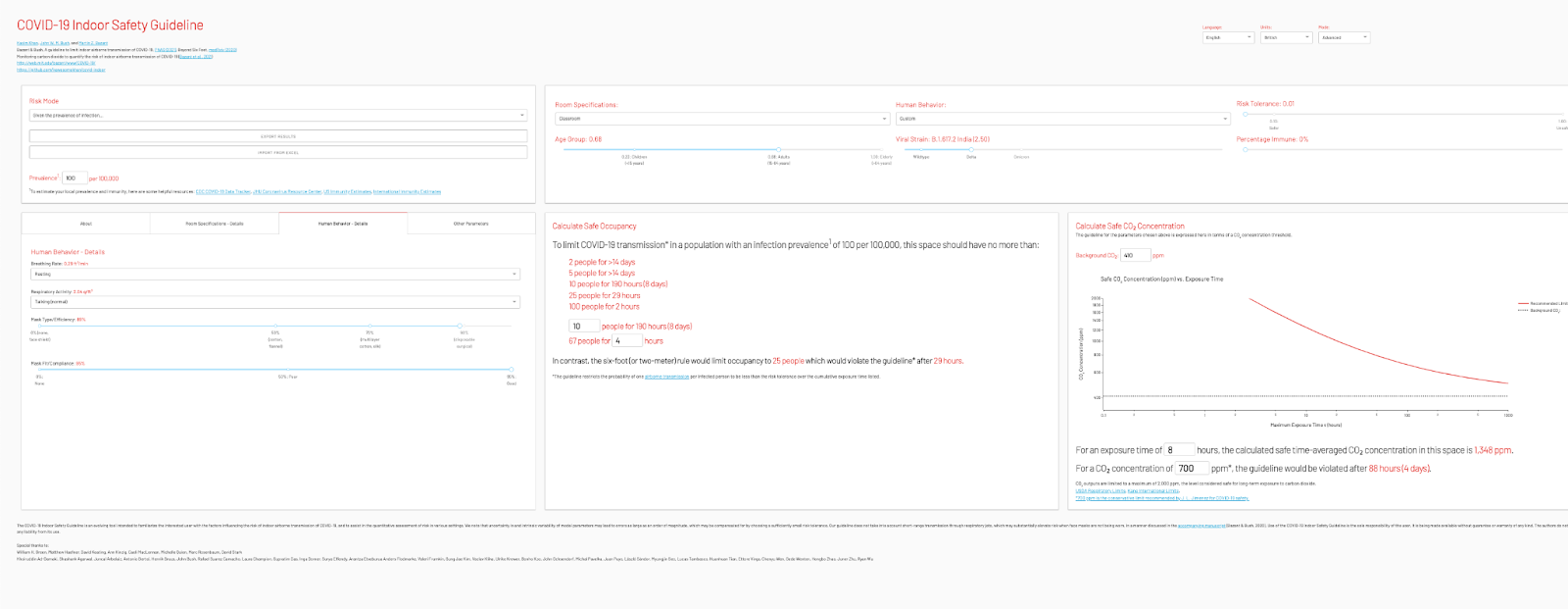
Most of what I see people use Microcovid.org for now is estimating risk for large gatherings, which it was not designed for and thus doesn’t handle very well. I spent a few hours going through every covid calculator I could find and this calculator from the Bazant lab at MIT, while less user-friendly than Microcovid and having some flaws of its own, is tailored made for calculating risks for groups indoors, and I think it is worth a shot. 

[Note: I’ll be discussing the advanced version of the calculator here; I found the basic version too limited]

The Bazant calculator comes out of physics lab with a very detailed model of how covid particles hang and decay in the air, and how this is affected by ventilation and filtration. I haven’t checked their model, but I never checked Microcovid’s model either. The Bazant calculator lets you very finely adjust the parameters of a room: dimensions, mechanical ventilation, air filtration, etc. It combines those with more familiar parameters like vaccination and mask usage and feeds them into the model in this paper to produce an estimate of how long N people can be in a room before they accumulate a per-person level of risk between 0 and 1 (1 = person is definitely getting covid = 1,000,000 microcovids per person; .1 = 10% chance someone gets sick = 100,000 microcovids per person). It also produces an estimate of how much CO2 should accumulate over that time, letting you use a CO2 monitor to check its work and notice if risk is accumulating more rapidly than expected.

Reasons/scenarios to use the Bazant calculator over Microcovid:

  • You have a large group and want to set % immunized or effective mask usage for the group as a whole, instead of configuring everyone’s vaccinations and masks individually.
  • You want to incorporate the mechanics of the room and ventilation in really excruciating detail. 
  • You want to set your own estimate for prevalence based on beliefs about your subpopulation.
  • You want a live check on your work, in the form of the CO2 estimates.

Reasons to use Microcovid instead:

  • Your scenario is outside – Bazant calculator doesn’t handle this at all.
  • You don’t want to have an opinion on infection prevalence, immunization, or mask usage.
  • Your masks are better than surgical masks (Bazant doesn’t handle N95 or similar. Also, it rates surgical masks as 90% effective, which seems very high to me).
  • Your per-person risk tolerance is < 10,000 microcovids (Bazant calculator can’t bet set at a lower risk tolerance, although you can do math on their results to approximate this).
  • You’re still using a bubble model, or tracking accumulated risk rather than planning for an event.

Scenarios neither handle well

  • Correlated risk. You might be fine with 10% of your attendees getting sick, but not a 10% chance of all of the attendees getting sick at once.
  • Differences in risk from low-dose vs. high-dose exposures.

I’m not currently planning any big events, but if someone else is, please give this a try and let us know if it is useful. 

Quick Poll: Booster Reactions

Lots of people are getting covid boosters now. To help myself and others plan I did an extremely informal poll on Twitter and Facebook about how people’s booster side effects compared to their second dose. Take home message: boosters are typically easier than second shots, but they’re bad often enough you should have a plan for that.

The poll was a mess for a number of reasons, including:

  • I didn’t describe the options very well, so it’s 2/3 freeform responses I collapsed into a few categories.
  • There was a tremendous variation in what combination of shots people got.
  • It’s self-reported. I have unusually data-minded friends which minimizes the typical problem of extreme responses getting disproportionate attention, but it doesn’t eliminate it, and self-report data has other issues.
  • I only sampled people who follow me on social media, who are predominantly <45 years old, reasonably healthy, reasonably high income, and mostly working desk jobs. 
  • I specified mRNA but not the manufacturer; Moderna but not Pfizer boosters are smaller than the original dose.

Nonetheless, the trend was pretty clear.

Of people who received three mRNA shots from the same manufacturer, comparing their second shot to their third:

  • 12 had no major symptoms either time (where major is defined as “affected what you could do in your day.” It specifically does not include arm soreness, including soreness that limited range of motion)
  • 2 had no major symptoms for their second shot but had major for their third
    • Not included in data: one person who got pregnant between their second and third shot
  • 23 had major symptoms for their second shot, and the third was easier
    • This includes at least one case where the third was still extremely bad and 2-3 “still pretty bad, just not as bad as the second”
    • Three cases fell short of  “major symptoms” for the second, but had an even easier third shot
  • 11 people had similar major symptoms both times
  • 2 had major symptoms for second shot, and third was worse

Of people who mix and matched doses

  • 2 had no major symptoms either time
  • 4 had no major symptoms for their second shot but had major symptoms for their third
    • Not included: 1 reported no symptoms for the first two and mild symptoms for the third
  • 4 had major symptoms for their second shot, and their third was easier
  • 2 people had major symptoms both times
  • 1 had major symptoms for their second shot, and their third was worse