Heart Rate Variability is one of those things that has such an obvious meaning I feel dumb asking follow up questions, but is consistently used in ways that confuse me. It sounds a lot like arrhythmia, which is bad, but The Willpower Instinct consistently refers to it as good. Plus it refers to it changing in ways that must be measured instantaneously, but changes in variability have to be measured over time, right?
Here is what I have figured out: we (I) think of the heart as beating to A Rhythm, which is your BPM. The rhythm can speed up or slow down, but it’s still a rhythm. A deviation from that is an arrhythmia, which is Bad. We (I) think this because the wikipedia article on sinus rhythm basically says it, and because the article on HRV implies it’s measured in five minute increments over 24 hours, which means it’s basically a measure of range. But at least some of the time HRV refers to beat-to-beat variation, and it’s being measured in response to an immediate stimulus (although, maddeningly, no one specifies the time period).
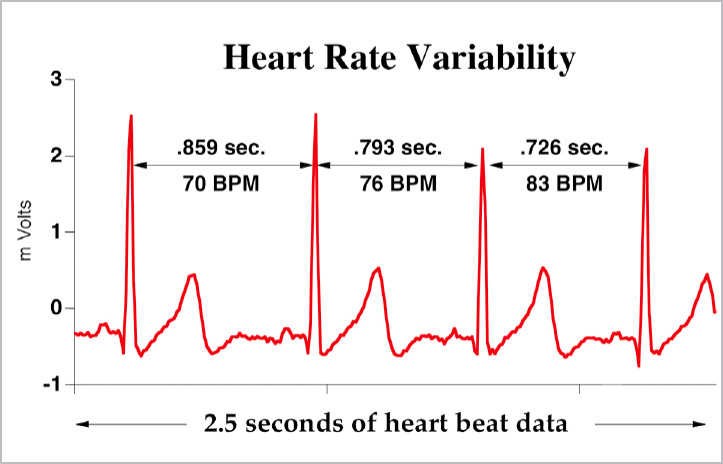
four heart beats, separated by .859, .793, and .726 seconds.
Your parasympathetic (relaxed/restorative) nervous system sends signals to your heart to decrease your heart rate. Your sympathetic (fight/flight/freeze) system sends signals to increase it. High parasympathetic activity also seems to be associated with high variability, at least to a point. My personal guess is that high variability indicates both systems are operating and interacting, while low variability indicates one has taken over, and that your body is somewhat biased towards a higher rate, so it takes a bigger push from the parasympathetic to get the rate down. Having one system dominate is not always bad: when you are running from a tiger, your heart should beat as fast as possible and redirect blood from digestion and immune system to muscles. And when you are truly safe, the parasympathetic tells your body it can safely pay off it’s technical debt. But often having both, and being able to switch between the two, is useful.
There’s a lot of data showing high heart rate variability is increased by known Good Things (meditation, exercise), and low HRV is associated with bad things (alcoholism, PTSD), but I don’t see hard enough data on causality that I’m confident of the direction.
One of the contentions of The Willpower Instinct is that a lot of things (hyperpalatable foods, lottery tickets, facebook…) are hijacking the system that incentivizes you to be productive*, making you think feel that if you do this one more thing, you will achieve an important goal (nutrition, money, social connection). You can try to stare it down, but what you are really fighting is not the specific action, but the goal, and everything in you believes that goal is good, so it’s an expensive battle you will ultimately lose.
Recently I’ve been experimenting with hijacking back. Let’s use food as an example. I noticed that I would feel a very strong drive to eat candy, but eating it alleviated the urge for less than a second. There was no amount of candy that would move me to a not-wanting-candy state. Once I had that perspective, I could use higher brain powers to figure out what would actually scratch that itch. Moreover, I could use the urgency generated by the proximity of candy to power making real food with actual nutritional value. And the dopamine system couldn’t really do anything about it, because it had sold candy to my body as a means to an end.
It works for video games too. Sometimes I play video games because they are fun. Sometimes I play them because I need the feeling of Doing a Thing, and doing actual things will involve an unpleasant intermediate steps. Of course video games can’t actually make me feel productive, but the reward system tells me that means I need to play harder.
This is a difficult urge to fight. But if I pull back and notice doing the thing is not making the urge to do the thing lessen, it becomes obvious I need to do the unpleasant intermediate steps in order to get what I want.
*This is identified only as “dopamine”, but dopamine is a neurotransmitter, so she must mean dopamine in a particular part of the brain. For simplicity I’ll keep referring to it as the dopamine system.
This is Huey. He has not met you yet, but he loves you, and he wants you to love him too. Almost all dogs are human-oriented, but Huey takes it to the next level. He has been known to hyperventilate with happiness when a friend arrives- and that’s after he’s been at home all day with his work-from-home owner, so it’s not loneliness or separation anxiety, he is just that happy to see you.
Pictured: a dog that would really like to be told he is good.
Sometimes Huey’s desire for affection puts him at odds with himself. For example if you tell him to stay and walk away, he wants to do what you said, but he also wants to be near you. He will literally vibrate with the effort it takes to stay in place. But once you tell him good puppy, all the strain goes out of him. He rushes over for his well deserved affection, and then he’s done. He might even go play with a chew for a bit.
If you’d like a more human example, consider the orgasm. Most humans on the edge of orgasm will do anything to finish it. Immediately post orgasm, they will do absolutely nothing. Even people who have multiple orgasms will usually have a final one after which they really don’t care.
According to The Willpower Instinct, dopamine release corresponds to the vibrating-with-effort phase, not the good puppy phase. Dopamine doesn’t mark pleasure, because pleasure doesn’t need to be marked. Dopamine tells you pleasure is just around the corner, so keep trying. Note that this is slightly different than Peter Redgrave’s timestamp hypothesis I talked about before, but either would account for a lot of available data. For example, people with ADHD (who are energetic and yet somehow unable to get themselves to do the thing to get the results they want) are on average low in dopamine, and almost all ADHD treatments increase dopamine availability*. Dopamine levels rise copiously during sex until orgasm, at which point they plummet. Dopamine is also heavily involved in addiction.
When asked about his dopamine levels, Huey asked which answer would make me love him the most.
This makes slightly more sense to me than the timestamp hypothesis, but is less interesting. Normally interesting is a bad sign for a hypothesis (almost anything is more interesting than chance, and chance explains a lot), but I’m not sure that applies in this case. The timestamp hypothesis is a lot more specific and thus testable, the priming hypothesis seems sort of vague in comparison. And of course both could be true- dopamine simultaneously says “reward coming soon” and “reward is because of this”. Those actually make sense to go together, as opposed to some things our body has combined.
I’m never going to be able to conclusively prove one or the other sitting at my computer, but let’s talk about how they differ. Timestamp hypothesis suggests people with low dopamine will be attracted to things that make it is easy to distinguish what caused a reward, like video games and obsessive facebooking. Based on my friends and reddit, those are heavily associated with both depression and ADHD. My literature search turns up some support for this**, but nothing with a design I consider rigorous.
Timestamp covers the H in ADHD better (a low baseline makes a small increase more distracting than it should be), but priming seems more apt for ADHD- inattentive type (ADHD minus H) and depression, where nothing is attractive enough to pull the person out of their focal activity.
So the answer is “some of both plus probably some other stuff”. But variations in which of these dominate might explain why a given person reacts to low dopamine the way they do.
*In addition to changing other neurotransmitters and hormones. The brain is complicated and no one understands it.
The Last Day of Her Life: a psychology researcher’s decision to and process of ending her life as her Alzheimer’s progresses. Fun fact: state-sanctioned euthanasia requires you be mentally competent and have less than six months to live. Alzheimer’s patients are mentally incompetent years before they die of the disease.
The (crime-related) Broken Window Theory states that low level visible crime (graffiti, litter) leads to more crime, of all varieties. It is most famous for being Rudy Guilani’s method for reducing crime in New York City. My understanding was that that had been debunked, and NYC’s drop is crime was caused mostly by demographic trends. But some researchers did some fairly rigorous tests of it and it held up. Caveat: they tested visible crime’s evidence on other crimes of similar magnitude, not escalations like theft.
This week’s “beautiful theory killed by an ugly gang of facts” award goes to the meditation chapter of The Willpower Instinct, which promises fantastic benefits from the very beginning. In fact it says that meditating badly is in some ways better for you than meditating well, because it is the practice of refocusing yourself after you become distracted that is so beneficial. Unfortunately none of the studies cited show that exact things, and what they do show is a small effect on a noisy variable, in a small sample.
[I don’t want to be too hard on The Willpower Instinct. It encourages you to do your own experiments and stick with what works, I found some of it helpful, and it’s good for getting yourself into a willpower mindset. It’s just scientifically weaker than it would have you believe.]
When it comes to anti-depressants, there’s SSRIs, tricyclics, MAOIs, and… bupropion*. I always wondered why it was that every other anti-depressant** came in a variety of forms, but there was only one bupropion.
Bupropion is metabolized into several different compounds in your body, the most important being hydroxybupropion, which is a norepinephrine-selective reuptake inhibitor***, meaning it causes the neurotransmitter norepiniephrine to hang around longer so your nerves experience more of it. “Selective” means it doesn’t affect all receptors equally, but is otherwise spectacularly uninformative. Bupropion itself and several lesser metabolites also increase dopamine availability, but it’s not clear if that happens to any measurable degree in humans in the doses we take. So we assume the effects on norepinephrine is the major reason bupropion works, but no one really has idea what it is going on in the brain so we can’t be sure.
Turns out there is another NSRI available, and it is actually quite well marketed. Just not for depression. Atomoxetine is better known as Strattera, one of very few non-stimulant treatments for ADHD. Its effects are not identical to bupropion, but they’re pretty similar, and there are studies showing atomoxetine is useful for treating depression. Why then does no one market atomoexetine as an antidepressant, or bupropion as an anti-ADHD treatment (even though it’s shown promise)? I don’t want to jump to the worst possible explanation, but the FDA requires new trials for every usage of a drug, and crazymeds.us is not wrong when it notes there is more money in treating ADHD and competing with very heavily controlled drugs that work very differently than there is in treating depression and competing with many off-patent drugs, one of which works in a very similar way. And now that’s its been approved for something, any doctor who wants can still prescribe it for depression. Meanwhile bupropion went off patent before ADHD was really a thing, so no one has any incentive to pay for additional testing now.
There are a number of other NRIs and NSRIs, few of which made it to the US. But I hope bupropion takes comfort in knowing it does have a family, even if they spell their name differently.
*Brand name Wellbutrin when marketed as an anti-depressant, Zyban when marketed as an anti-smoking aid.
**Until you get to the really weird stuff they use for treatment-resistant depression. Every atypical antipsychotic is its own little snowflake.
***The more common name for these is selective norepinephrine reuptake inhibitor, but that has the same acronym as serotonin norepinephrine reuptake inhibitor, a different kind of drug, so I use NSRI to avoid confusion.
I went into this pretty skeptical, based on Scott Alexander’s analysis of the science. But the reality was worse than I imagined. First, she never even defines terms like talent or ability. I would use ability to mean “current level of performance” and talent to mean something like “innate propensity to excel at task, as manifested in initial ability, ease of learning, or ceiling on ability.” She… maybe uses ability to mean both those things? She’ll talk about initial ability or talent and then increased ability or talent after practice, but that doesn’t mean the same amount of effort will get everyone to the same place, or all places are reachable by all people. For that matter, she never defines mindset. She talks about it like a fairly fixed trait (meaning it stays constant from one situation to another), but her own studies show it being changed by a four second speech.
Second, you can’t just make a list of good things and a list of bad things and wrap all the good things under your label and bad things under it’s opposite. Here is a list of statements I believe will be uncontroversial:
A person who treats failure as a learning opportunity will learn more and be happier than a person who treats it as a mandate to curl into a ball and cry.
Ditto for viewing feedback as a source of information, rather than a referendum on you as a person.
Sometimes people start out bad at a task, practice, and then get really good at it.
This is more likely to happen if the person believes practice can improve their skill.
Children (and probably all people) tend to do better when their successes are ascribed to something they can control than to forces outside their control.
These things don’t necessarily go together. For example, it is entirely possible to believe almost anything is learnable, and then beat yourself up for failure because you should have learned it already. I’ve seen me do it. “I’ll do better next time” can just as easily become a mantra to avoid mindfulness as to encourage it.
Third, I can’t even with the chapter on corporations. Jack Welch brought stack ranking aka “rank and yank” to the masses, and she uses him as an example of not only having growth mindset, but fostering it throughout his company.
[An artist’s rendering of working at GE]
After this I refused to trust her anecdotes, and Scott already took down the studies. You might think that left the book with nothing, but surprisingly it didn’t. Her descriptions of the individual facets of growth or fixed mindset and how they affect people were useful and informative, even if I don’t think they have anything to do with each other. And I think growth vs. fixed mindset might actually be a useful schema for institutions. It certainly captures a lot of what’s wrong with American schools.
And as inspirational reading, it’s pretty good. I would love to live in a world where one determined teacher takes 40 students from illiterate to Shakespeare, and stereotype threat is countered with a short speech. In a world that overvalues innate talent, a push too far in the other direction may still leave us better off. But that doesn’t make it correct.
Effective art management. I think the author is a little harsh here. Refusing to pay continuous expenses from capital is usually a good plan, and if sales are going to be an influx of cash into the art world as a whole, the art will need to be sold to a private investor, otherwise it’s just a different museum struggling to raise operating costs. The problem is that every individual following these sensible policies means that in aggregate we’ve got a lot of art locked away that no one can see.
EDIT: Ben points out that the author was suggesting using the sales of art to fund an endowment, not fund programs directly. This is a substantially better idea.
An ode to pixel art. I rankled a bit when he said “people prefer X when Y is clearly superior” for differences that were strictly matters of taste. But seeing how an artist compares works vs. a layperson is interesting.
The winner of this week’s “Beautiful theory killed by ugly gang of facts” award is Science, who reported that rats will save a distressed friend before getting themselves treats, without mentioning that the sample was 10 rats, total, split into two different treatment groups, and only seven or eight of those rats went for their friend first. The natural control here would be how often the rats go for the chocolate door when there is no friend or an undistressed friend on the other side of the door, and the fact that they didn’t do that makes me suspicious. If that experiment is published in a subsequent study, I withdraw my suspicion.
I am really, really trying to stay away from takedown pieces, but multiple books on the importance of practice and irrelevance of talent cite Ericsson, Krampe, and Tesch-Romer’s “The Role of Deliberate Practice in the Acquisition of Expert Performance” (PDF) as proof of the importance of deliberate practice (and the irrelevance of innate talent, but that’s a different issue). This study compared the best, excellent, and good violinists, and their methods of study. They claim the most accomplished students had more accumulated hours of practice than the least, and while they all currently practiced the same amount, the most accomplished students spent more of it in deliberate practice, thus proving its importance.
Let me make this quick: the study had an n of 30, spread out over three treatment groups, all of which were recruited from a music school, and the measure of success was not “successful career” but “professor prediction of successful career”. So if the sample size was big enough to prove anything (which it wasn’t) and the sample was representative of the population (which it wasn’t), they still only proved that professors like people who study a lot. We’re not even getting into how they estimated cumulative lifetime hours of practice for people who started picked up an instrument at four years old. Having this be a foundational study for multiple books is embarrassing.
My most recent encounter with this study was from The Talent Code, which cites many studies showing the best people in a field engage in deliberate practice and zero experiments showing people improved after being taught deliberate practice. I looked on google scholar and found mostly papers on how to deliberately practice teaching, not teach deliberate practice, and a few that taught using it (without a control group). Deliberate practice looks extremely plausible and I plan on applying more of it myself, but seriously, how has this idea been around for 20 years and no one has done the most basic experiments on it?
This week’s surprisingly well sourced weird-ass science fact from cracked.com is “Among depressed people, sweating is heavily predictive of suicide.” According to them, 97% subjects getting treatment for depression who sweated less in response to loud noises went on to commit suicide, compared with 2% of people with normal sweat response. Those numbers are astonishing- and a sample size of 800, big for a psych study. Not to doubt the website that brought us “6 Fictional Alcoholic Beverages That Actually Get You Drunk“, but I wanted to check the tape on this one.
This was actually a metastudy, combining the results of several other studies. Five different studies with a total of n participants are not nearly as good as a single study with n participants, first because there’s more opportunities to throw out data, second because the experiments rarely have exactly the same set up. A person who scored high-sweating in one set up might score low-sweating in another.
The total of 783 people includes people with bipolar disorder (126), depression (540), and other, which meant either dysthemia (mild depression), or depression AND a personality or adjustment disorder (118). Those are different things. Bipolar patients are at significantly higher risk of suicide than unipolar patients, because they’re more likely to simultaneously have the desire to end their life and the will to act on it. And Other will include people with borderline personality disorder, which is really its own issue.
Only 36 people total completed suicide. The researchers claim for specificity is for completed suicide (violent or not) AND violent attempts, which may occur before or after the study took place. They excluded non-violent suicide attempts out of the belief that non-violent attempts were more likely to have been cries for help. 9% of completed suicides were non-violent where 55% of attempts were, so that part seems fair. On the other hand, predicting the past is not nearly as impressive or useful as predicting the future.
In the discussion section, the authors acknowledge that many of the subjects were selected from mental hospitals where they had been admitted due to a past or feared suicide attempt. This is what’s known as a biased sample. The data is still suggestive of underlying physiological processes, but the specificity/sensitivity numbers can’t be translated to the general population without further work, and in particular I wouldn’t recommend using this as a diagnostic criteria for whether hospital admittance is a good idea.
So it looks like cracked was severely exaggerating the claims of this research, which is too bad. But there does appear to be some effect, which could help us figure out the physiology of depression, which would be extremely useful.
There’s a lot of games that attempt to be educational out there. I break them down into the following categories.
Gamification:
You do the exact same work, but receive stickers or points or badges for doing so.
Example: Kahn Academy badges, arguably all grades. Extra Credits describes an intricate system here.
I was a grade grubber for years, and I’ll admit I still kind of miss the structure of school. But gamification wears off really quickly, and Alfie Kohn has made a career out of arguing that extrinsic rewards are inherently harmful. The one benefit I see in Extra Credit’s system is that it would reinforce students for other students’ performance, cutting down on bullying the smart kids. It may also encourage the strongest students to help the weakest ones. Or it might make everyone hate the weak students or help them cheat so they can get a pizza party. Kids will do a lot for a pizza party. And they may start to resent the smart kids for not helping enough. So I guess I’m against this, but that may stem from years in the worst possible educational environment.
In that same video EC suggests the much less likely to backfire benefits of tailored difficulty curves and immediate feedback. These strike me as much more valuable, but they will mostly fall in another category.
Familiarity Builders:
These are games that don’t really teach you anything you could use on a test, and often have fictionalized elements, but do build conceptual fluency, which can make it easier to learn real things later. Pretty much any game set in the real world qualifies for this, but my personal favorite is Oregon Trail for introducing millions of school children to the concept of dysentery.
Counterpoint: I misspelled dysentery when uploading this photo. Twice.
A lot of the games on Extra Credits’s steam shelf fall into this category. I was initially pretty dismissive of this, but I’ve changed my mind.
There are a lot of reasons that middle class + white children do better at school than poor + minority children, but one of them is the amount and type of knowledge they’re exposed to at home. Poor parents flat out talk to their children less, which gives them less time to transmit knowledge. They’re also less likely to have the kind of knowledge their children will be tested on at school. As Sharon Astyk so heartbreakingly puts it, her foster children needed to be taught how to be read to but had a highly developed internal map of food-containing garbage cans.
There’s no video game for learning to not chew on books. But there are lots of video games with maps. A big part of my 6th grade social studies class was blank map tests, where we would be given a blank map and have to label all the countries. We had a decent teacher, so I suspect this was fluency building and not drilling for drilling’s sake: when we read about Egypt and Greece and Rome, she wanted us to be able to put events in geographical context. I didn’t know where every country was, but I did know, or at least recognize, the names of most countries. This put me strictly ahead of the girl who called Syria “cereal”. When we took tests I only had to put effort into remembering locations, she had to put effort into locations, and names, and possibly what a country was. And it’s really hard to put in that effort when you don’t see a point and this other girl is doing so much better than you without even trying. Carmen San Diego, or any video game with a strong sense of real-world place, could have given her a way to catch up. Even if it wasn’t fun, it wouldn’t have had the same ugh field around it that studying did.
This is related but not identical to what Extra Credits describes as “familiarity builders“, where the goal is basically to make something interesting enough people look up the actual facts on wikipedia later.
Drill and Killers:
These games overlay what they’re trying to teach on top of typical game mechanics. These are more than fluency builders because they use the same skills you’d use on a test or in real life, but they don’t teach you anything new, they just give you practice with what you already know. Examples: Math Blasters, Mario Teaches Typing.
How good these are depends on who you ask. I suspect you need a certain minimal fluency to make them at all fun, which makes the difficulty curve important. And they’re less fun or game-like than the other types on this list. But some things just have to be drilled, and video games are a more fun way to do that than flash cards.
Abstract Skill Builders:
Games that teach useful skills. They would need translation to be anything useful on a test or in real life, but it does build up some part of the brain.
Example: Logical Journey of The Zoombinis, which teaches pattern matching, logical thinking, and arguably set theory.
On one hand, abstract skills like these are very hard to teach. On the other hand, people are very bad at transferring skills from one domain to another (which is why some people can make change just fine but have trouble with contextless arithmetic, or can do arithmetic but not word problems). On the third hand, people are very bad at transferring skills from one domain to another, so if there’s a tool that helps than learn that, it would be very valuable.
Incentivizers
You don’t technically have to learn anything to play these games, but you will be rewarded if you do.
Example: Sine Rider. Technically you can get by with guess and check, but you will win faster if you actually understand trigonometric equations.
Seamless Integration:
A step further than skill builders or drillers, these games have both flavor and mechanics based in the subject you are trying to teach. These games are not necessarily complete substitutes for textbooks because it’s hard for them to be comprehensive, but they do completely teach whatever it is they’re trying to teach.




 Aceso Under Glass