Chaos Theory in Ecology

One of the reasons I got into chaos theory as a model paradigm shift was the famous Gleick book on chaos. One of the reasons I believed the Gleick book was trustworthy was that its description of chaos in ecology and population biology matched what I learned in college, 25 years later. Recently I learned that the professor who taught me was one of maybe 3 theoretical ecologists in the country who taught or believed in chaos having applications to ecology at the time. Perhaps I should have been more suspicious that he was writing his own textbook.

However chaos is back in vogue in ecology, and attempts are in progress to make it pay rent. In this latest podcast episode I talk with Drs Stephen Munch and Tanya Rogers (both of work at NOAA, but were speaking as private citizens) about their application of chaos theory to ecology and fisheries management.

Most interesting takeaways:

  • You can translate some physics techniques into ecology, despite the smallest dataset in physics being 100x larger than the largest ecological dataset. 
  • The work discussed in this episode, and perhaps all of chaos in ecology, is downstream of one physicist turned mathematician and biologist (Robert May).
    • Doyne Farmer (a founding chaotician) talks about physics colonizing finance and economics due to a bad job market, which has me thinking scientific progress comes from hyping a field so the smartest people get deep into it, and then denying them jobs so they’re forced to colonize other fields.
  • Empirical Dynamical Modeling allows you to substitute past observations of known variables for current observations of unknown variables. This gets you a longer prediction horizon than you could otherwise get with only the known variables.
  • There is a salmon forecasting prize and it pays $2000-$5000 cash

I’ve had some requests to include transcripts in the body of the text rather than a separate document. I’ll try that this time and if you don’t like, please complain.

Thank you to my Patreon Patrons for their support.

Chaos in Theoretical Ecology

[00:00:00] Elizabeth: Hey, this is Elizabeth Van Nostrand. Today I’m going to talk to two guests about the influence and applications of chaos theory on population biology and ecology. 

[00:00:10] Stephen Munch: I’m Steve Munch. I am , an evolutionary ecologist, a mathematical ecologist. I work at , NOAA Fisheries, and I’m an adjunct in Applied Math at UC Santa Cruz. I have an abiding interest in applying math to ecological and evolutionary problems. And for the past decade or so, I’ve been thinking a lot about chaos and nonlinear forecasting and its potential role as a tool in ecosystem management.

[00:00:38] Tanya Rogers: I’m Tanya Rogers. I’m a research fish biologist here at NOAA Fisheries. My background is in ecology, and I got more interested in population dynamics and modeling in graduate school and in how that can be applied to solving ecological problems. Steve was my postdoctoral advisor and we continue to collaborate on projects. 

[00:01:02] Elizabeth: You guys co wrote several papers on chaos and empirical dynamical modeling in biology and especially in conservation and wildlife management.

[00:01:12] Stephen Munch: Primarily fisheries, but, the math is the same, whether it’s a bird or a fish. 

[00:01:16] Elizabeth: My recollection from college was fisheries was the place one made money with population biology.

[00:01:24] Tanya Rogers: Well, I think fisheries certainly makes itself a lot of money and there’s a lot of interest in ensuring that fisheries are sustainable and profitable. And so there’s a lot of interest in making sure that our management is as good as it can be and that we’re, using the best models possible for fisheries. 

[00:01:45] Stephen Munch: My ph. D. advisor once said that, uh, you know, a lot of people in the oceanography program look down on fisheries, but fisheries employs more marine ecologists than any other subdiscipline. So it’s not a bad bet if you would like to have a job after grad school. 

[00:02:01] Elizabeth: And you’re applying chaos theory right now to fisheries management, right?

[00:02:05] Stephen Munch: Well, I’m applying it right now to fisheries data in the hopes of getting this stuff used in management. There’s the fishery for shrimp in the Gulf of Mexico, which is a federally managed fishery where they’re exploring using EDM to set harvest policy and next year’s, landings targets.

[00:02:28] Elizabeth: Uh, could you explain EDM before we go further?

[00:02:32] Tanya Rogers: empirical dynamic modeling, or EDM, is a way of.

[00:02:35] Tanya Rogers: Modeling a dynamical system when we have incomplete knowledge and incomplete data about that system, as is often the case in ecosystems, and it does so in a way that preserves the dynamical properties of that system, including chaos and allows us to make better short term predictions in chaotic systems without making a lot of assumptions.

[00:02:55] Tanya Rogers: So EDM has two main features. The first is that it’s a non parametric approach that makes few assumptions about the functional forms of relationships. And the second is that it uses time lags to account for unobserved variables. To explain this further, the relationship between some values, say fish abundance and its past values is going to follow the relationship in the data rather than some predefined functional form.

[00:03:22] Tanya Rogers: It can also happen that some of the apparent noise around this relationship can be explained by adding additional dimensions. For example, the abundance of a prey species. So perhaps we can predict fish abundance better using past fish abundance and past prey abundance. Now it may be the case that we don’t have data on prey abundance, in which case you can actually substitute an additional lag of fish abundance.

[00:03:45] Tanya Rogers: So not just fish last year, but also fish two years ago. And you’ll get a different looking relationship, but it will still do a pretty good job at predicting abundance. So why this works has to do with Taken’s delay embedding theorem, but the point is that missing variables create memory in the system.

[00:04:04] Tanya Rogers: And so you can use lags of observed variables as substitutes for unobserved variables. What this means practically in population biology is that we can model population size as some function of past of lags of past population sizes. And this function is fit using nonparametric methods. What this means practically in population biology is that we’re modeling population size as some function of lags of past population sizes, and this function is fit using nonparametric methods.

[00:04:38] Tanya Rogers: So chaos and using methods that can accommodate chaos, like EDM, matters for ecological forecasting because it affects how far realistically you can predict into the future. So chaotic dynamics, unlike random dynamics, are deterministic and predictable in the short term, um, And so if chaos is can mischaracterize as noise around an equilibrium, you’re going to miss out on that short term predictability and make worse forecasts than you could otherwise.

[00:05:07] Tanya Rogers: Long term forecasts will also be inaccurate and overconfident if you assume the system is just going to converge to an equilibrium. In terms of ecological inference, the sensitivity to initial conditions that results from chaos might also vary. Help explain why some experimental replicates with seemingly identical starting conditions sometimes end up in totally, totally different places

[00:05:28] Elizabeth: How do you determine sensitivity to initial conditions or whether it’s just random?

[00:05:37] Tanya Rogers: well, part of it is determining whether or not it’s chaotic or not. 

[00:05:40] Tanya Rogers: There are a variety of methods for detecting chaos, which we explore in our paper. Many of them use EDM or a similar form of time delay embedding to reconstruct the dynamics in a flexible way. And from that, estimate some quantities such as the Lyapunov exponent, which quantifies the deterministic divergence rate of nearby trajectories.

[00:06:02] Speaker 4: The idea is actually really simple, that if you take two points, two states of the system that are initially close together. In day to day experience, the things that we think of as, uh, predictable, as deterministic, you know, you do the same thing twice in a row, you expect to get the same answer. You do slightly different things twice in a row, you expect to get slightly different answers, right? And that’s, that’s where chaos is really different.

[00:06:30] Speaker 4: You do slightly different things and you get really different answers, you know, if you wait long enough. That’s the important part. That’s the difference between something that’s random and something that’s chaotic. Something’s random, you do two, two slightly different things. You get two different answers immediately.

[00:06:47] Speaker 4: Whereas in chaos, things become effectively random if you wait long enough. But there’s the period between then and now where you can see the dynamics unfolding and that makes things predictable, at least over the short term.

[00:07:03] Tanya Rogers: So that paper we explored several different methods that um, are used to detect chaos. Many of them were developed in physics but had not been tested on ecologically, or time series of ecologically relevant lengths, which is to say short ones, and with uh, Ecologically relevant levels of observation error.

[00:07:26] Stephen Munch: To give you some context for that, a lot of those papers test things on short time series, which have 5000 observations. Ecological time series that are long are 50 years, which is one time

[00:07:42] Elizabeth: That would be an astonishing data set

[00:07:45] Stephen Munch: Right. Yeah, so what, you know, two people’s careers is 50 years, right, of ecological data collection.

[00:07:55] Stephen Munch: So, very different standards in terms of, you know, time series length. So, it was an open question whether any of these things would work on ecologically relevant timescales. And, and there are definitely things that would miss, um, having only 50 time points that you, you would love to see if you had 5, 000, but.

[00:08:15] Tanya Rogers: we found three of the six methods we tried did not work very well at all, but three performed reasonably well, and in the presence of observation error, they were more likely to not detect chaos when it’s present than to detect chaos when it’s absent. 

[00:08:31] Elizabeth: This is one of the things that attracted me to chaos initially was that techniques developed in one field could be applied to a seemingly completely unrelated field. So I would love if you could get into details on like how you chose what to port over from physics and what you had to change.

[00:08:51] Tanya Rogers: So I think whether we’re talking about complex physical systems or complex ecological systems, the concepts are very much the same, and so the main difference, I think, are in terms of data availability, observation error, the time scales on which did the dynamics occur and also how well we understand the underlying dynamics

[00:09:10] Stephen Munch: , the biggest hurdle to having chaos come over to biology is all of the mathematical jargon 

[00:09:16] Elizabeth: So what you guys discovered is maybe there’s many more chaotic, not random ecosystems or species than we thought. And this has implications for managing the population in the short run.

[00:09:29] Tanya Rogers: In our study, we found that chaos wasn’t rare in a database of , ecological population time series. It wasn’t the majority of time series, but chaos wasn’t rare enough to be ignorable, particularly for short lived species.

[00:09:42] Stephen Munch: So since, , chaos theory reached its heyday in the late 90s, early 2000s, people have Arrived at the conclusion that chaos is rare in ecology and rare is hardly ever defined quantitatively, right? People frequently say, well, chaos is rare. Therefore, we can are safe and assuming equilibrium. Chaos is rare. Therefore, uh, we are safe in using linear models to approximate dynamics. 

[00:10:14] Elizabeth: Am I correct that that doesn’t make sense regardless of chaos? . You can have non chaotic, non linear dynamics.

[00:10:22] Stephen Munch: Right. There is that. But most of the time, the context is we like to imagine that ecological systems are stable and given that they are stable, they will recover from some small perturbation

[00:10:37] Elizabeth: That there’s some equilibrium point that, that is definitely self reinforcing and may be an attractor.

[00:10:43] Stephen Munch: Yeah. Um, and, and so a lot of the time the math comes after you assume stability. Stability is the foundation from which we’re going, then you can approximate things with a linear dynamics reasonably well.

[00:10:58] Stephen Munch: You can have some hope of assuming an equilibrium and not being terribly wrong, but if things are chaotic and not stable then that’s, that’s not true. 

[00:11:10] Elizabeth: So if you have a fish population that you are trying to manage to get maximum yield from, if you think there’s some equilibrium, what you try to do is not disturb things away from the equilibrium too much. But , what happens if it’s chaotic ?

[00:11:24] Stephen Munch: So I think probably in terms of management, the, uh, the biggest change in perspective is that a state dependent policy can do a lot better than one that is just sort of do the same thing all the time. If you imagine that things are equilibrium and stable, then you can set a harvest policy and let it go.

[00:11:50] Stephen Munch: And, sometimes you’ll be over, sometimes you’ll be under, but all in all it’ll come out in the wash and you’ll end up with more or less the average return will be that what you predict. for the steady state. If things are chaotic, when you’re over or under, you’ll just keep going off in some direction that you hadn’t really been expecting.

[00:12:09] Stephen Munch: And, uh, so a better policy would be one where you say, okay, uh, when we’re in this state, you can harvest this much when, when things, when the fish abundance is low or has been low for several years, you need to change to a different harvest strategy. When things have been high for several years, you need to change to a different strategy.

[00:12:26] Stephen Munch: And you can do a lot better than, by trying to stick with exactly the same thing.

[00:12:31] Elizabeth: Is anyone doing that?

[00:12:33] Stephen Munch: That is what we’re trying to do with the shrimp fishery in the Gulf of Mexico, what we’re trying to do with the squid fishery in California. Importantly, both of these are short lived species that have huge fluctuations in abundance, that the typical mental model is that dynamics are being driven by Unpredictable environmental variation., in contrast to long lived species like things like on this coast like the rockfish , which, live typically for decades and their dynamics are much smoother, , and so a lot of the sort of standard fisheries things work out okay because the dynamics are so slow to change. But in these short lived species, the dynamics are much faster and they fluctuate much more dramatically, which is why I think that there’s a reason to try applying EDM or chaos theory to managing them. And it turns out that in those, these species that we typically say, oh, you know, most of that fluctuation is due to environmental variation, it turns out that we actually have reasonably good predictability, two or three times the predictability that we have with our standard steady state models.

[00:13:48] Elizabeth: Oh, so there was, a rapid change that was put down to change in the environment and , you can predict that it would have happened using a deterministic model.

[00:13:57] Stephen Munch: Yeah, this is where we’re using the empirical dynamic modeling stuff where the idea is you use past values of the abundance or whatever the system variable is. But in this case, it’s the past abundances of Shrimp or squid to tell us where the next abundance is likely to go now. It’s not just this year’s.

[00:14:20] Elizabeth: Tanya, are you working on that too? Mm hmm. Um,

[00:14:25] Tanya Rogers: I’ve been helping support the applications that Steve is discussing, exploring how we can use EDM to improve predictability and manage species. And also when, where, and in which species we expect to see chaos in ecology more broadly. So the idea is if we use.

[00:14:44] Tanya Rogers: If using time lags of our observed variables as additional coordinates gets us better predictions, that tells us there are state variables missing and we could, we could potentially do better if we had additional data on those variables, if we can figure out what they are.

[00:14:58] Elizabeth: So the idea is like, if you have a 50 variable system, if you could fill in every variable, then that would be enough. You could just use your model to predict the next state. But if you have five of those variables if you use just those five predictions are bad, but if you track those five variables through the past, that gives you some insight into the missing 45.

[00:15:23] Stephen Munch: Right. Yeah. 

[00:15:24] Stephen Munch: There’s a mathematical subtlety there and I don’t know if this is of interest, but if, if you start with a system that’s 50 variables, um, most of the time in things that have chaos, they are contracting. The dynamics actually don’t fill that 50 dimensional space.

[00:15:44] Stephen Munch: They’re actually constrained to often a much lower dimensional shape. called the attractor for the system. And it’s, it’s the dimension of that that tells you how many lags you need or how far into the past you need to go to reconstruct dynamics. 

[00:16:01] Elizabeth: So, if the attractor has five dimensions, you need to go five steps into the past?

[00:16:06] Stephen Munch: It’s twice the attractor dimension plus one. So, 11.

[00:16:11] Elizabeth: Interesting. Is it possible to figure out the dimensions of the state of the attractor? How do you do that in practice?

[00:16:22] Tanya Rogers: The simplest way to go about that is to forecast with one, then two, and then three dimensions, and then continue until you get to a point where the prediction accuracy saturates.

[00:16:31] Elizabeth: So you’re applying EDM to fisheries in particular. You’ve got the shrimp, you’ve got the squid, when will you know if it’s working? How will you know if it’s working?

[00:16:41] Stephen Munch: Well, there’s working and there’s working, right? I mean, so in terms of being able to make better predictions than we can with the models we’ve been using so far, that is working now. In terms of knowing whether our revised harvest policy is going to work better than our historical harvesting policy, that’s going to take some time.

[00:17:06] Stephen Munch: You can really only get there by doing it. And so it’s kind of hard. It’s a hard sell, right? To move to a whole new branch of doing things in real life when, uh, you can’t really demonstrate that you’re sure that it’s going to work

[00:17:20] Elizabeth: I’m gonna ask you both to speculate wildly. Assuming you waved a magic wand and some fishery management of your choice started using your system, what would the improvement be?

[00:17:34] Stephen Munch: well, I have no idea about that, but, uh, I will uh, when we’ve simulated things, we typically do somewhere between 10 to 50 percent better harvest, depending on how the system really works.

[00:17:49] Elizabeth: When you say better, you mean more accurate.

[00:17:52] Stephen Munch: I mean, in terms of 10 to 50 percent more in terms of sustainable, we almost always do somewhere between, 20 to 50 percent better in terms of prediction accuracy.

[00:18:06] Elizabeth: That sounds really impressive. 

[00:18:08] Tanya Rogers: So the idea is that, so the idea is that if populations are fluctuating a lot, we can predict those fluctuations and then harvest accordingly. So this way fishers aren’t over harvesting when abundances are low and won’t miss out on fish they could harvest sustainably when abundances are high. So for instance, I work a bit on salmon forecasting and there’s a lot of interest in making accurate predictions of salmon runs or salmon returns so they can determine how much they can, people can safely harvest versus allow to return to the spawning grounds to start the next generation.

[00:18:44] Tanya Rogers: For my work at least, I developed a new forecast model for the Sacramento River winter run Chinook salmon, which is an endangered run. Managers here want to know how many of these fish are going to be returning in order to set harvest rates so that the endangered run isn’t overly impacted by ocean fishing on non endangered runs, since Chinook salmon are hard to tell apart when they’re out in the ocean.

[00:19:10] Tanya Rogers: And this is one where the time series are a little too short to do EDM with time lags. There’s only about 20 years of data, but we’ve been able to use non parametric regressions and other ways to try and get better forecasts. And that model is currently in use for management and it appears to be doing a much better job than the population model they’d been using previously

.

[00:19:31] Elizabeth: So you did make substantial improvements in Harvest.

[00:19:34] Tanya Rogers: Well, we’ve made improvements, at least in prediction. Salmon in California face a lot of challenges, not just fishing, and the fishery right now in California is closed due to low abundances of all stocks, so we’ll have to wait and see. 

[00:19:48] Tanya Rogers: recently the salmon prize forecasting competition started. It’s something I participated in on the side for fun outside of work. And they’ve been looking for people to develop models and submit forecasts for different salmon runs. This year’s was for sockeye in three different systems with the hope of finding better prediction models than the ones that are currently in use

[00:20:12] Elizabeth: Going back to, , some of the earlier work we were discussing, steve, you mentioned you were bringing over a lot of stuff from physics, but it needed to be adapted. 

[00:20:23] Elizabeth: One of the reasons I got interested in chaos in particular was it seemed like it should give you the ability to like do work in one field and port it to five different fields. I’m really curious, for every step of this, starting with how did you find the thing, the tools you ended up porting over?

[00:20:43] Stephen Munch: Um. So the, the main tool is the empirical dynamic modeling stuff, which had its, uh, origins in the sort of physics literature in the, um,

[00:20:59] Elizabeth: Oh, so EDM came over from physics do you know how it made that leap?

[00:21:04] Stephen Munch: Yeah, so, uh, there are a couple of seminal papers, uh, in the, uh, late 80s, early 90s. So, Sugihara and May in 1990, uh, showed that you could do this nonlinear forecasting, uh, stuff and in an ecological setting and that, you know, that, that, um, you could make predictions of ecological dynamics without having to have a specific model formulation.

[00:21:37] Stephen Munch: A little bit prior to that, Bill Schaefer and, Mark Kot had a paper on, um, using sort of time delays to try and reconstruct the a low dimensional projection of the dynamics. So their idea was very similar in spirit, using the sort of time lags to reconstruct things, but it , didn’t quite take off as a tool for making practical forecasts.

[00:22:05] Stephen Munch: So that’s, that’s what Sugihara and May managed to do. Um, but the, uh, the idea of the time delays in lieu of A complete set of state variables comes from, , initially a paper by Packard et all, uh, and then, um, a rigorous proof of that idea. So that’s in 1980 and then a rigorous proof of the idea in 1981 by Takens.

[00:22:35] Elizabeth: There were specific scientists who found it somehow

[00:22:38] Elizabeth: I am very curious about the step before the papers getting, get written. what drove people to find something either outside their field or why was , someone already working in an interdisciplinary way and porting over these tools?

[00:22:54] Stephen Munch: So the really early, right, like in the 70s, Bob May, John Beddington, Bill Schaeffer, they were all working on, chaos in ecological dynamics as like from a theoretical point of view and they were they’re hoping they’re showing that like with really slow dimensional models you can get nearly effectively random looking dynamics and maybe that’s why ecological dynamics looks as messy as it does but there wasn’t any easy way to connect that to Ecological time series.

[00:23:28] Stephen Munch: , there were a couple of attempts to do that by fitting low dimensional models to some time series data. Those generally concluded that things were not chaotic. Bob may actually has a really super quote. In one of those papers that says fitting the what is likely to be the high dimensional dynamics of ecological system to this low dimensional model does great violence to the reality of ecology .

[00:23:53] Stephen Munch: That didn’t work. Um, it was a reasonable thing to try when you don’t have too much data, but that, that idea just doesn’t really work. And, um, And then the time delay embedding stuff got invented. And those guys were busy thinking of, they were part of the chaos community.

[00:24:08] Stephen Munch: It wasn’t like, uh, you know Bob may just sort of saw that said, Oh yeah, I can grab that and bring it over from, uh, like, Okay. Without any initial sort of prep, he was already sort of actively participating in sort of theoretical chaos stuff.

[00:24:26] Elizabeth: When was he doing that?

[00:24:28] Stephen Munch: so his early stuff on chaos and ecological dynamics happens in the early 1970s.

[00:24:35] Stephen Munch: And so when Taken’s delay embedding theorem happens, it does take a little while for people to pick it up and turn it into a practically useful tool. The ecologists and the physicists are so completely separate that it’s a miracle that it makes it over 

[00:24:50] Elizabeth: There were people who were already straddling the borders?

[00:24:53] Stephen Munch: Yeah,

[00:24:54] Elizabeth: Yeah. That’s hard to do in academia, isn’t it? .

[00:24:57] Stephen Munch: Well, Bob May started in physics. and came over to ecology from, physics. So, um, and there’ve been a lot of people who’ve gone that way. I, he’s arguably the most successful physicist turned ecologist by a lot, but, um, there are surprisingly few people who go the other way.

[00:25:19] Elizabeth: Yeah, I do notice physics seems to send out a lot more immigrants.

[00:25:26] S+T: I don’t know. Maybe the physics job market is just really tight.

[00:25:30] Elizabeth: I was just reading Doyne Farmer’s book on chaos and finance, and what he says is , “well, there weren’t any more physics jobs, but they would pay us so much money to do finance”. 

[00:25:40] Stephen Munch: Yeah.

[00:25:42] Stephen Munch: Those were good times. 

[00:25:44] Stephen Munch: One of the sort of really interesting things about sort of theoretical ecology and then applied theoretical ecology and then like real like, um, boots on the ground ecology is the level of math involved is like an order of magnitude between each one. So the theoreticians are real mathematicians 

[00:26:06] Stephen Munch: And then the folks who do sort of quantitative fisheries management are, you know, a jack of all trades. They know just enough math to do one thing, just enough math to do another thing, trying to put it all together with some statistics. And then there are the people who collect data and those people often know very little math. If there was a, , physics like revolution in, , theoretical ecology, I’m not sure, as one of the sort of mid level guys. I’d be aware of it, 

[00:26:34] Elizabeth: interesting. 

[00:26:37] Elizabeth: In weather, which is so incredibly complicated, the big breakthrough was ensemble forecasting. That you make a bunch of different forecasts jiggling your assumptions a little bit and that’s how you get 30 percent chance of rain because 30 percent of nearby worlds produced rain.

[00:26:55] Elizabeth: Has ensemble forecasting been tried in ecology or in wildlife management? 

[00:26:59] Stephen Munch: I’ve definitely run across papers where people have talked about ensemble forecasts for ecological dynamics or even super ensemble forecasts. But, I’m not aware that it’s made an enormous difference in terms of the predictions.

[00:27:14] Stephen Munch: I think the maybe the Biggest reason for that is that uh There aren’t too many people that I’m aware of who argue that the Navier Stokes equations, the things that govern the fluid dynamics, that governs the weather, right, are wrong, right? We all kind of accept that the equations are the equations of fluid dynamics.

[00:27:35] Stephen Munch: And so the real uncertainties are in how you handle The, the boundaries. How do you model the mountains? How do you model the clouds? Those are the parts where we’re not certain. And so if we vary those and we average over some amount of uncertainty in those boundary conditions and the initial conditions, we can sort of take care of some of that and sort of push a little farther into the future in terms of of how far we can make reasonable predictions.

[00:28:01] Stephen Munch: In ecology, on the other hand, there, there aren’t the equivalent of the Navier Stokes equations. There isn’t some like first principles model of how an ecosystem works that’s sufficient to make the kinds of predictions you might want to

[00:28:14] Elizabeth: That’s why you end up with something like EDM where you don’t need to know what you don’t know.

[00:28:19] Stephen Munch: there are two pillars to EDM. the first is what we talked that you can accommodate the fact that you have incomplete observations.

[00:28:27] Stephen Munch: That is, you haven’t seen all of the state variables of system using lags of the observables. That’s, that’s one pillar. The second pillar of EDM is that we’re not gonna try and write down equations. It’s a very simple that collection of variables turns into the future states of those variables. We’re instead going to try and infer that directly from what we’ve seen in the past.

[00:28:48] Stephen Munch: And so sort of combination of using lags to, as surrogate variables and using sort of nonparametric or super flexible data driven approaches to modeling, to turning the past states of the system into the future. That’s the second part that’s really important. 

[00:29:05] Elizabeth: What got you interested in that in grad school?

[00:29:08] Tanya Rogers: Uh, I guess. It was meeting Steve. I came to do an internship here at NOAA when I was in graduate school for a few months. I started working with Steve and, um, discovered that he invented and created new methods for analyzing data, which I did not realize was a thing as a just of existing methods, and I thought that was really cool and that he, he has a really cool way of just analyzing data.

[00:29:37] Tanya Rogers: Thinking about ecosystems and how species interact from a mathematical perspective that, um, I think brings a lot of insight and he made population dynamics interesting. I previously did a lot of community ecology work , collected a lot of data myself was mostly counting things. I did experiments in the labs, and this was just kind of a different approach that I thought was valuable.

[00:29:59] Tanya Rogers: And I, as part of. by working. That’s why I think I got this job at NOAA is that it can kind of merge the like mathematical approaches and field approaches and

[00:30:10] Elizabeth: is like the, the central tier that Steve was talking about is you have some people who are doing, my dad’s an applied mathematician so he would call them recreational mathematicians, and you have the boots on the ground people, and then you’ve got the sort of interfacers.

[00:30:27] Tanya Rogers: yeah, that’s us. So Steve is a very good interfacer. I definitely started as like a boots on the ground. I still do some of that data collection work myself. And I think that brings a valuable perspective in terms of understanding the complexity of ecosystems and where the data come from. and sources of error.

[00:30:44] Tanya Rogers: And even just like the natural history of some of these systems and what would make sense in terms of modeling them. I try and bring that perspective to my job as like fisheries ecologist and someone who helps with forecasting and management and stock assessments. And then in terms of research, I continue to collaborate with Steve on a bunch of different projects related to chaos and population dynamics and predictability and ecology.

[00:31:08] Stephen Munch: And Tanya provides an irreplaceable anchor to reality. Like I will go off and some like cool. Thing and some statistical mechanics and I’ll be like, oh, what do you think about this? She’s like why how will we use that steve? Like what is that for? And uh that sort of you know sounding board for like what is the practical value of this thing?

[00:31:30] Stephen Munch: How are we going to do it? What’s is it going to work on the data that we have available? Is uh, just just incredible plus I think tanya’s selling herself a bit short. She’s also Incredibly talented as a scientist and is great at getting things done and a great writer

[00:31:44] Elizabeth: you guys found each other, more or less at random. Like this wasn’t a purposeful pairing? 

[00:31:50] Stephen Munch: So actually, it’s a guy named Brian Wells, who Tanya was actually here to work with. He said, Oh, you know, you might get something out of talking to Steve. And he, so he introduced us. And then I found out that Tanya had data that was actually really great for applying a method that I’d cooked up.

[00:32:09] Stephen Munch: And, um, and so we, and after that, we really hit it off. 

[00:32:12] Tanya Rogers: Yes, that was my third dissertation chapter. And then Steve offered me a postdoc and I came out worked with them a bit. And then I got the job that I currently have, uh, at NOAA in the same office working for a different group, but we continue working together.

[00:32:29] Elizabeth: , that’s all I had. Thank you so much for your time. Have a great day guys.

[00:32:32] Stephen Munch: thanks. You too. 

Applications of Chaos: Saying No (with Hastings Greer)

Previously Alex Altair and I published a post on the applications of chaos theory, which found a few successes but mostly overhyped dead ends. Luckily the comments came through, providing me with an entirely different type of application: knowing you can’t, and explaining to your boss that you can’t.

Knowing you can’t

Calling a system chaotic rules out many solutions and tools, which can save you time and money in dead ends not traveled. I knew this, but also knew that you could never be 100% certain a physical system was chaotic, as opposed to misunderstood.

However, you can know the equations behind proposed solutions, and trust that reality is unlikely to be simpler[1] than the idealized math. This means that if the equations necessary for your proposed solution could be used to solve the 3-body problem, you don’t have a solution. 

[[1] I’m hedging a little because sometimes reality’s complications make the math harder but the ultimate solution easier. E.g. friction makes movement harder to predict but gives you terminal velocity.]

I had a great conversation with trebuchet and math enthusiast Hastings Greer about how this dynamic plays out with trebuchets.

Transcript

Note that this was recorded in Skype with standard headphones, so the recording leaves something to be desired. I think it’s worth it for the trebuchet software visuals starting at 07:00

My favorite parts:

  • If a trebuchet requires you to solve the double pendulum problem (a classic example of a chaotic system) in order to aim, it is not a competition-winning trebuchet.  ETA 9/22: Hastings corrects this to “If a simulating a trebuchet requires solving the double pendulum problem over many error-doublings, it is not a competition-winning trebuchet”
  • Trebuchet design was solved 15-20 years ago; it’s all implementation details now. This did not require modern levels of tech, just modern nerds with free time. 
  • The winning design was used by the Syrians during Arab Spring, which everyone involved feels ambivalent about. 
  • The national pumpkin throwing competition has been snuffed out by insurance issues, but local competitions remain. 
  • Learning about trebuchet modeling software. 

Explaining you can’t

One reason to doubt chaos theory’s usefulness is that we don’t need fancy theories to tell us something is impossible. Impossibility tends to make itself obvious.

But some people refuse to accept an impossibility, and some of those people are managers. Might those people accept “it’s impossible because of chaos theory” where they wouldn’t accept “it’s impossible because look at it”?

As a test of this hypothesis, I made a Twitter poll asking engineers-as-in-builds-things if they had tried to explain a project’s impossibility to chaos, and if it had worked. The final results were:

  • 36 respondents who were engineers of the relevant type
    • This is probably an overestimate. One respondee replied later that he selected this option incorrectly, and I suspect that was a common mistake. I haven’t attempted to correct for it as the exact percentage is not a crux for me.
  • 6 engineers who’d used chaos theory to explain to their boss why something was impossible.
  • 5 engineers who’d tried this explanation and succeeded.
  • 1 engineer who tried this explanation and failed.

5/36 is by no means common, but it’s not zero either, and it seems like it usually works. My guess is that usage is concentrated in a few subfields, making chaos even more useful than it looks. My sample size isn’t high enough to trust the specific percentages, but as an existence proof I’m quite satisfied. 

Conclusion

Chaos provides value both by telling certain engineers where not to look for solutions to their problems, and by getting their bosses off their back about it. That’s a significant value add, but short of what I was hoping for when I started looking into Chaos. 

Simon DeDeo on Explore vs Exploit in Science

Good news everyone: I’m getting into podcasting! 

As part of my investigation into how scientific paradigms are created, I hosted a talk by Simon DeDeo, Professor Of Many Topics at Carnegie Mellon and the Santa Fe Institute, recorded at the recent ILIAD conference in Berkeley. He discusses the idea of explore vs exploit in science. Spoiler: he comes down very hard on the exploit side, based primarily on a case study of Darwin. 

For the video averse among you, here’s the transcript

I have two more episodes in editing, but am on the hunt for more guests. I’m looking to talk to scientists or ex-scientists about how ideas are created and spread in their field. Bonus points if they can talk about Chaos, Complexity, or Catastrophe Theory in particular. 

Thanks to my Lightspeed Grants and my Patreon patrons for supporting this work.

Quick look: applications of chaos theory

Introduction

Recently we (Elizabeth Van Nostrand and Alex Altair) started a project investigating chaos theory as an example of field formation.[1] The number one question you get when you tell people you are studying the history of chaos theory is “does that matter in any way?”[2]. Books and articles will list applications, but the same few seem to come up a lot, and when you dig in, application often means “wrote some papers about it” rather than “achieved commercial success”. 

In this post we checked a few commonly cited applications to see if they pan out. We didn’t do deep dives to prove the mathematical dependencies, just sanity checks.

Our findings: Big Chaos has a very good PR team, but the hype isn’t unmerited either. Most of the commonly touted applications never received wide usage, but chaos was at least instrumental in several important applications that are barely mentioned on wikipedia. And it was as important for weather as you think it is. 

[1] This is a follow up to Elizabeth’s 2022 work on plate tectonics

[2] The second most popular is “oh you should read that book by Gleick”

Applications

Cryptography and random number generators- Strong No (Alex)

The wikipedia page for Chaos theory has a prominent section on cryptography. This sounds plausible; you certainly want your encryption algorithm to display sensitive dependence on initial conditions in the sense that changing a bit of your input randomizes the bits of your output. Similarly, one could imagine using the sequence of states of a chaotic system as a random number generator. However a quick google search makes me (Alex) think this is not a serious application.

I’ve seen it claimed [Footnote: in Chaos: a very short introduction, page 44, and in this youtube video] that one of the earliest pseudo-random number generators used the logistic map, but I was unable to find a primary reference to this from a quick search.

Some random number generators use physical entropy from outside the computer (rather than a pseudo-random mathematical computation). There are some proposals to do this by taking measurements from a physical chaotic system, such as an electronic circuit or lasers. This seems to be backward, and not actually used in practice. The idea is somewhat roasted in the Springer volume “Open Problems in Mathematics and Computational Science” 2014, chapter “True Random Number Generators” by Mario Stipčević and Çetin Kaya Koç.

Other sources that caused me to doubt the genuine application of chaos to crypto include this Crypto StackExchange question, and my friend who has done done cryptography research professionally.

As a final false positive example, a use of lava lamps as a source of randomness once gained some publicity. Though this was patented under an explicit reference to chaotic systems, it was only used to generate a random seed, which doesn’t really make use of the chaotic dynamics. It sounds to me like it’s just a novelty, and off-the-shelf crypto libraries would have been just fine.

Anesthesia, Fetal Monitoring, and Approximate Entropy- No (Elizabeth)

Approximate Entropy (ApEn) is a measurement designed to assess how regular and predictable a system is, a simplification of Kolmogorov-Sinai entropy. ApEn was originally invented for analyzing medical data, such as brain waves under anesthesia or fetal heart rate. It has several descendents, including Sample Entropy; for purposes of this article I’m going to refer to them all as ApEn. Researchers have since applied the hammer of ApEn and its children to many nails, but as far as I (Elizabeth) can tell it has never reached widespread usage.

ApEn’s original application was real time fetal heart monitoring; however as far as I can tell it never achieved commercial success and modern doctors use simpler algorithms to evaluate fetal monitoring data. 

ApEn has also been extensively investigated for monitoring brain waves under anesthesia. However commercially available products only offer Spectral Entropy (based purely on information theory, no chaos) and Bispectral Index

ApEn has been tried out in other fields, including posture, neurological issues, finance, and weather. I was unable to find any evidence any of these made it into practice, although if some day trader was making money with ApEn I wouldn’t expect them to tell me. 

Empirical Dynamical Modeling– Unproven (Elizabeth)

EDM is a framework for modeling chaotic systems without attempting to use parameters. It was first created by George Sugihara and Robert May (a prominent early advocate and developer of chaos theory), but Stephen Munch is the scientist most putting the tool into practice. Munch has an excellent-looking experiment in which he applies EDM to wild shrimp management (fisheries being one of two places you can make money with theoretical ecology[3]) and compares his output with other models. Alas, his results will not be available until 2041. At least they’ll be thorough.

Sugihara himself applied the framework across numerous fields (including a stint as a quant manager at Deutsche Bank), however his website for his consulting practice only mentions systems he’s modeled, not instances his work was put into practice. His work as an investment quant sounds like exactly the kind of thing that could show a decisive success, except there’s no evidence he was successful and mild evidence he wasn’t. 

Process note: one of the reasons I believed in the story of Chaos Theory as told in the classic Gleick book was that I (Elizabeth) studied theoretical ecology in college, and distinctly remembered learning chaos theory in that context. This let me confirm a lot of Gleick’s claims about ecology, which made me trust his claims about other fields more. I recently talked to the professor who taught me and learned that in the mid 00s he was one of only 2 or 3 ecologists taking chaos really seriously. If I’d gone to almost any other university at the time, I would not have walked out respecting chaos theory as a tool for ecology. 

[3] The other is epidemiology

Weather forecasting- Yes (Alex)

Weather forecasting seems to be a domain where ideas from chaos theory had substantial causal impact. That said, it is still unclear to me (Alex) how much this impact depended on the exact mathematical content of chaos theory; it’s not like current weather modeling software is importing a library called chaos.cpp. I think I can imagine a world where people realized early on that weather was pretty complicated, and that predicting it required techniques that didn’t rely on common simplifying assumptions, like locally linear approximations, or using maximum likelihood estimates.

Here is a brief historical narrative, to give you a sense of the entanglement between these two fields. Most of the below can be found in “Roots of Ensemble Forecasting” (Lewis 2004), although I have seen much of it corroborated across many other sources.

By the 1940s, weather forecasting was still being done manually, and there was not much ability to predict that far into the future. As large electronic computers were being developed, it became clear that they could provide substantially more computation for this purpose, perhaps making longer predictions feasible. John von Neumann was especially vocally optimistic on this front.

Initially people assumed that we would make useful weather predictions by doing the following; 1) formulate a dynamical model of the weather based on our knowledge of physics 2) program that model into the computer 3) take measurements of current conditions, and 4) feed those measurements into the computer to extrapolate a prediction for a reasonable timespan into the future. People knew this would be very challenging, and they expected to have to crank up the amount of compute, the number of measurements, and the accuracy of their model in order to improve their forecasts. These efforts began to acquire resources and governmental bodies to give it a serious go. Researchers developed simple models, which would have systematic errors, and then people would go on to attempt to find corrections to these errors. It sounds like these efforts were very much in the spirit of pragmatism, though not entirely consistent with known physical principles (like conservation of energy).

After a decade or so, various scientists began to suggest that there was something missing from the above scheme. Perhaps, instead of using our best-guess deterministic model run on our best-guess set of observations, we should instead run multiple forecasts, with variations in the models and input data. In case our best guess failed to predict some key phenomenon like a storm, this “ensemble” strategy may at least show the storm in one of its outputs. That would at least let us know to start paying attention to that possibility.

It sounds like there was some amount of resistance to this, though not a huge amount. Further work was done to make estimates of the limits of predictability based on the growth rate of errors (Philip Thompson, E. Novikov) and construct more physically principled models.

Around this point (the mid 1950s) enters Edward Lorenz, now known as one of the founding fathers of chaos theory. The oft-related anecdote is that he accidentally noticed sensitive dependence on initial conditions while doing computer simulations of weather. But in addition to this discovery, he was actively trying to convince people in weather forecasting that their simplifying assumptions were problematic. He impacted the field both by producing much good work and by being an active proponent of these new ideas. It is especially notable that the Lorenz system, a paradigmatic chaotic system, came from his deliberate attempt to take a real weather model (of convection cells in a temperature differential) and simplify it down to the smallest possible system that maintained both the chaotic behavior and the reflection of reality. By cutting it down to three dimensions, he allowed people to see how a deterministic system could display chaotic behavior, with spectacular visuals.

Through continued work (especially Edward Epstein’s 1969 paper “Stochastic Dynamic Prediction”) people became convinced that weather forecasting needed to be done with some kind of ensemble method (i.e. not just using one predicted outcome). However, unlike the Lorenz system, useful weather models are *very* complicated. It is not feasible to use a strategy where, for example, you input a prior probability distribution over your high-dimensional observation vector and then analytically calculate out the mean and standard deviation etc. of each of the desired future observations. Instead, you need to use a technique like Monte Carlo, where you randomly sample from the prior distribution, and run each of those individual data points through the model, producing a distribution of outputs.

But now we have another problem; instead of calculating one prediction, you are calculating many. There is an inherent trade-off in how to use your limited compute budget. So for something like two decades, people continued to use the one-best-guess method while computing got faster, cheaper and more parallelized. During this wait, researchers worked on technical issues, like just how much uncertainty they should expect from specific weather models, and how exactly to choose the ensemble members. (It turns out that people do not even use the “ideal” Monte Carlo method mentioned above, and instead use heuristical techniques involving things like “singular vectors” and “breeding vectors”)

In the early 1990s, the major national weather forecast agencies finally switched to delivering probabilistic forecasts from ensemble prediction systems. The usefulness of these improved predictions is universally recognized; they are critical not just for deciding whether to pack an extra jacket, but also for evacuation planning, deciding when to harvest crops, and staging military operations.

Fractals- Yes (Elizabeth)

Fractals have been credited for a number of advancements, including better mapping software, better antennas, and Nassim Taleb’s investing strategy. I (Elizabeth) am unclear how much the mathematics of fractals were absolutely necessary for these developments (and would bet against for that last one), but they might well be on the causal path in practice.

Mandelbrot’s work on phone line errors is more upstream than downstream of fractals, but produced legible economic value by demonstrating that phone companies couldn’t solve errors via their existing path of more and more powerful phone lines. Instead, they needed redundancy to compensate for the errors that would inevitably occur. Again I feel like it doesn’t take a specific mathematical theory to consider redundancy as a solution, but that may be because I grew up in a post-fractal world where the idea was in the water supply. And then I learned the details of TCP/IP where redundancy is baked in. 

Final thoughts

Every five hours we spent on this, we changed our mind about how important chaos theory was. Elizabeth discovered the fractals applications after she was officially done and waiting for Alex to finish his part.

We both find the whole brand of chaos confusing. The wikipedia page on fractals devotes many misleading paragraphs to applications that never made it into practice. But nowhere does it mention fractal antennas, which first created economic value 30 years ago and now power cell phones and wifi. It’s almost like unproductive fields rush to invoke chaos to improve their PR, while productive applications don’t bother. It’s not that they hide it, they just don’t go out of their way to promote themselves and chaos. 

Another major thread that came up was that there are a number of cases that benefited from the concepts of uncertainty and unpredictability, but didn’t use any actual chaos math. I have a hunch that chaos may have provided cover to many projects whose funders and bosses would otherwise have demanded an impossible amount of predictability. Formal chaos shouldn’t have been necessary for this, but working around human stupidity is an application. 

Acknowledgements

Thank you to Lightspeed Grants and Elizabeth’s Patreon patrons for supporting her part of this work. Did you know it’s pledge drive week at AcesoUnderGlass.com?

The Balto/Togo theory of scientific development

Tragically I gave up on the Plate Tectonics study before answering my most important question: “Is Alfred Wegener the Balto of plate tectonics?”

Let me back up.

Balto

Balto is a famous sled dog. He got a statue in NYC for leading a team of dogs through a blizzard to deliver antibody serum to Nome, Alaska in 1925, ending a diphtheria outbreak. Later Disney made a movie about how great he was.

Except that run was a relay, and Balto only got famous because he did the last leg, which had the most press coverage but was also the easiest. The real hero was Togo, the dog who led the team through the hardest terrain and covered by far the most miles as well. Disney later made a movie about him that makes no mention of Balto for the first 90%, and then goes out of its way to talk about what a shit dog he was, that’s why he didn’t get included in any of the important teams, but Togo had had to do so many hard things they needed a backup team for the trivial last leg so Balto would have to do.

Togo’s owner died mad about the US mainland believing Balto was a hero. But since all the breeders knew who did the hard part Togo enjoyed a post-Nome level of reproductive success that Ghengis Khan could only dream about, so I feel like he was happy with his choices.

plus he did eventually get some statues

But it’s not like Togo did this alone either. He led one team in a relay, and there were 20 humans and 150 dogs that contributed to the overall run. Plus someone had to invent the serum, manufacture it, and get it to the start of the dog relay at Nenana, Alaska. So exactly how much credit should Togo get here?

The part with Wegener

I was pretty sure Alfred Wegener, popularly credited as the discoverer/inventor of continental drift and mentioned more prominently than any other scientist in discussions of plate tectonics, is a Balto.

First of all, continental drift is not plate tectonics. Continental drift is an idea that maybe some stuff happened one time. Plate tectonics is a paradigm with a mechanism that makes predictions and explains a lot of data no one knew was related until that moment.

Second, Wegener didn’t discover any of the evidence he cited, he wasn’t the first to have the idea, and it’s not even clear he did much of the synthesis of the evidence. His original paper refers to “Concerning South America and Africa, biologists and geologists are in close agreement that a Brazilian–African continent existed in the Mesozoic”

So he didn’t invent the idea, gather the data, or even really synthesize the evidence. His guess at the mechanism was wrong. But despite spending hours digging into the specific discovers and synthesizers that contributed to plate tectonics, the only name I remember is Wegener’s. Classic Balto.

On the other hand, some of the people who gathered the data used to discover plate tectonics were motivated by the concept of continental drift, and by Wegener specifically. That seems like it should count for something. My collaborator Jasen Murray thinks it counts for a lot

Jasen would go so far as to argue that shining a beacon in unknown territory that inspires explorers to look for treasure in the right place makes you the Togo, racing through fractured ice rapids social ridicule and self-doubt to do the real work of getting an idea considered at all. Showing up at the finish line to formalize a theory after there’s enough work to know it’s true is Balto work to him. This makes me profoundly uncomfortable because strongly advocating for something unproven terrifies me, but as counterargument arguments go that’s pretty weak.

One difficulty is it’s hard to distinguish “ahead of their time beacon shining” from “lucky idiot”, and even Jasen admits he doesn’t know enough to claim Wegener in particular is a Togo. But doing work that is harder to credit because it’s less legible is also very Togo-like behavior, so this proves nothing about the category. 

So I guess one of my new research questions is “how important are popularizers?” and I hate it.

Dependency Tree For The Development Of Plate Tectonics

This post is really rough and mostly meant to refer back to when I’ve produced more work on the subject. Proceed at your own risk.

Introduction

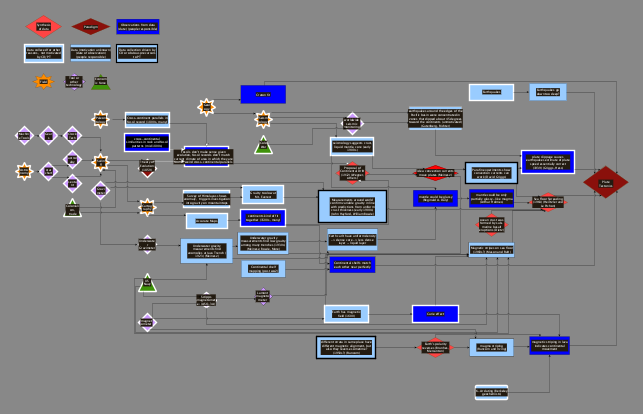
As I mentioned a few weeks ago I am working on a project on how scientific paradigms are developed. I generated a long list of questions and picked plate tectonics as my first case study. I immediately lost interest in the original questions and wanted to make a dependency graph/tech tree for the development of the paradigm, and this is just a personal project so I did that instead.

I didn’t reach a stopping point with this graph other than “I felt done and wanted to start on my second case study”. I’m inconsistent about the level of detail or how far back I go. I tried to go back and mark whether data collection was motivated by theory or practical issues but didn’t fill it in for every node, even when it was knowable. Working on a second case study felt more useful than refining this one further so I’m shipping this version. 

“Screw it I’m shipping” is kind of the theme of this blog post, but that’s partially because I’m not sure which things are most valuable. Questions, suggestions, or additions are extremely welcome as they help me narrow in on the important parts. But heads up the answer might be “I don’t remember and don’t think it’s important enough to look up”. My current intention is to circle back after 1 or 2 more case studies and do some useful compare and contrast, but maybe I’ll find something better.

(Readable version here)

And if you’re really masochistic, here’s the yEd file to play with.

Scattered Thoughts

Why I chose plate tectonics

  • It’s recent enough to have relatively good documentation, but not so recent the major players are alive and active in field politics.
  • It’s not a sexy topic, so while there isn’t much work on it what exists is pretty high quality. 
  • It is *the only* accepted paradigm in its field (for the implicit definition of paradigm in my head).
  • Most paradigms are credited to one person on Wikipedia, even though that one person needed many other people’s work and the idea was refined by many people after they created it. Plate tectonics is the first I’ve found that didn’t do that. Continental drift is attributed to Alfred Wegener, but continental drift is not plate tectonics. Plate tectonics is acknowledged as so much of a group effort wikipedia doesn’t give anyone’s name.

Content notes

  • This graph is based primarily on Plate Tectonics: An Insider’s History of the Modern Theory of the Earth, edited by Naomi Oreskes. It also includes parts from this lecture by Christopher White, and Oxford’s Very Short Introduction to Plate Tectonics.
  • Sources vary on how much Alfred Wegener knew when he proposed continental drift. Some say he only had the fossil and continental shape data, but the White video says he had also used synchronous geological layers and evidence of glacial travel.
    • I tried to resolve this by reading Wegener’s original paper (translated into English) but it only left me more confused. He predicted cracks in plates being filled in by magma, but only mentions fossils once. Moreover he only brings them up to point to fossils of plants that are clearly maladapted to the climate of their current location, not the transcontinental weirdnesses. He does casually mention “Concerning South America and Africa, biologists and geologists are in close agreement that a Brazilian–African continent existed in the Mesozoic”, but clearly he’s not the first one to make that argument.
    • I alas ran out of steam before trying Wegener’s book.
    • I was stymied in attempts to check his references by the fact that they’re in German. If you really love reading historic academic German and would like to pair on this, please let me know.
    • I stuck to just the fossil + fit data in the graph, because White is ambiguous when he’s talking about data Wegener had vs. data that came later.
    • White says the bathymetry maps showing the continental shelves had a much better fit than the continents themselves didn’t come out until after Wegener had published, but this paper cites sufficiently detailed maps of North America’s sea floor in 1884. It’s possible no one bothered with South America and Africa until later.
  • A lot of the data for plate tectonics fell out of military oceanography research. Some of the tools used for this were 100+ years old. Others were recently invented (in particular, magnetometers and gravimeters that worked at sea), but the tech those inventions relied on was not that recent. I think. It’s possible a motivated person could have gathered all the necessary evidence much earlier.
  • Sources also vary a lot on what they thought was relevant. The White video uses continental shelf fit (which is much more precise than using the visible coastline) as one of the five pillars of evidence, but it didn’t come up in the overview chapter of the Oreskes book at all.
  • This may be because evidence of continental drift (that is, that the continents used to be in different places, sometimes touching each other) is very different than evidence for plate tectonics (which overwhelmingly focuses on the structure of the plates and mechanism of motion). 

Process notes

  • At points my research got very bogged down in some of the specifics of plate tectonics (in particular, why were transform faults always shown perpendicular to mountain ridges, and how there could be so many parallel to each other?). This ended up being quite time consuming because I was in that dead zone where the question was too advanced for 101 resources to answer but advanced resources assumed you already knew the answer. In the end I had to find a human tutor.
  • This could clearly be infinitely detailed or go infinitely far back. I didn’t have a natural “done” condition beyond feeling bored and wanting to do something else. 
  • I only got two chapters into Oreskes and ⅔ through Very Short Introduction. 
  • I didn’t keep close track but this probably represents 20 hours of work, maybe closer to 30 with a more liberal definition of work. Plus 5-10 hours from other people.
  • In calendar time it was ~7 weeks from starting the Oreskes book to scheduling this for publishing.
  • You can see earlier drafts of the graph, along with some of my notes, on Twitter.

Acknowledgments

Thanks to several friends and especially Jasen Murray for their suggestions and questions, and half the people I’ve talked to in the last six weeks for tolerating this topic.

Thanks to Emily Arnold for spending an hour answering my very poorly phrased questions about transform faults.

Thanks to my Patreon patrons for supporting this work, you guys get a fractional impact share.

Impact Shares For Speculative Projects

Introduction

Recently I founded a new project with Jasen Murray, a close friend of several years. At founding the project was extremely amorphous (“preparadigmatic science: how does it work?”) and was going to exit that state slowly, if it at all. This made it a bad fit for traditional “apply for a grant, receive money, do work” style funding. The obvious answer is impact certificates, but the current state of the art there wasn’t an easy fit either. In addition to the object-level project, I’m interested in advancing the social tech of funding. With that in mind, Jasen and I negotiated a new system for allocating credit and funding.

This system is extremely experimental, so we have chosen not to make it binding. If we decide to do something different in a few months or a few years, we do not consider ourselves to have broken any promises. 

In the interest of advancing the overall tech, I wanted to share the considerations we have thought of and tentative conclusions. 

DALL-E rendering of impact shares

Considerations

All of the following made traditional grant-based funding a bad fit:

  • Our project is currently very speculative and its outcomes are poorly defined. I expect it to be still speculative but at least a little more defined in a few months.
  • I have something that could be called integrity and could be called scrupulosity issues, which makes me feel strongly bound to follow plans I have written down and people have paid me for, to the point it can corrupt my epistemics. This makes accepting money while the project is so amorphous potentially quite harmful, even if the funders are on board with lots of uncertainty. 
  • When we started, I didn’t think I could put more than a few hours in per week, even if I had the time free, so I’m working more or less my regular freelancing hours and am not cash-constrained. 
  • The combination of my not being locally cash-constrained, money not speeding me up, and the high risk of corrupting my epistemics, makes me not want to accept money at this stage. But I would still like to get paid for the work eventually.
  • Jasen is more cash-constrained and is giving up hours at his regular work in order to further the project, so it would be very beneficial for him to get paid.
  • Jasen is much more resistant to epistemic pressure than I am, although still averse to making commitments about outcomes at this stage.

Why Not Impact Certificates?

Impact certificates have been discussed within Effective Altruism for several years, first by Paul Christiano and Katja Grace, who pitched it as “accepting money to metaphorically erase your impact”. Ben Hoffman had a really valuable addition with framing impact certificates as selling funder credits, rather than all of the credit. There is currently a project attempting to get impact certificates off the ground, but it’s aimed at people outside funding trust networks doing very defined work, which is basically the opposite of my problem. 

What my co-founder and I needed is something more like startup equity, where you are given a percentage credit for the project, and that percentage can be sold later, and the price is expected to change as the project bears fruit or fails to do so. If six months from now someone thinks my work is super valuable they are welcome to pay us, but we have not obligated ourselves to a particular person to produce a particular result.

Completely separate from this, I have always found the startup practice of denominating stock grants in “% of company”, distributing all the equity at the beginning but having it vest over time, and being able to dilute it at any time, kind of bullshit. What I consider more honest is distributing shares as you go and everyone recognizes that they don’t know what the total number of shares will be. This still provides a clean metric for comparing yourself to others and arguing about relative contributions, without any of the shadiness around percentages. This is mathematically identical to the standard system but I find the legibility preferable. 

The System

In Short

  • Every week Jasen and I accrue n impact shares in the project (“impact shares” is better than the first name we came up with, but probably a better name is out there). n is currently 50 because 100 is a very round number. 1000 felt too big and 10 made anything we gave too anyone else feel too small. This is entirely a sop to human psychology; mathematically it makes no difference.
  • Our advisor/first customer accrues a much smaller number, less than 1 per week, although we are still figuring out the exact number. 
  • Future funders will also receive impact shares, although this is an even more theoretical exercise than the rest of it because we don’t expect them to care about our system or negotiate on it. Funding going to just one of us comes out of that person’s share, funding going to both of us or the project at large, probably gets issued new shares. 
  • Future employees can negotiate payment in money and impact shares as they choose.
  • In the unlikely event we take on a co-founder level collaborator in the future, probably they will accrue impact shares at the same rate we do but will not get retroactive shares. 

Details

Founder Shares

One issue we had to deal with was that Jasen would benefit from a salary right away, while I found a salary actively harmful, but wouldn’t mind having funding for expenses (this is not logical but it wasn’t worth the effort to fight it). We have decided that funding that is paying a salary is paid for with impact shares of the person receiving the salary, but funding for project expenses will be paid for either evenly out of both of our shared pools, or with new impact shares. 

We are allowed to have our impact shares go negative, so we can log salary payments in a lump sum, rather than having to deal with it each week.

Initially, we weren’t sure how we should split impact shares between the two of us. Eventually, we decided to fall back on the YCombinator advice that uneven splits between cofounders is always more trouble than it’s worth. But before then we did some thought experiments about what the project would look like with only one of us. I had initially wanted to give him more shares because he was putting in more time than me, but the thought experiments convinced us both that I was more counterfactually crucial and we agreed on 60/40 in my favor before reverting to a YC even split at my suggestion. 

My additional value came primarily from being more practical/applied. Applied work without theory is more useful than theory without application, so that’s one point for me. Additionally all the value comes from convincing people to use our suggestions, and I’m the one with the reputation and connections to do that. That’s in part because I’m more applied, but also because I’ve spent a long time working in public and Jasen had to be coaxed to allow his name on this document at all. I also know and am trusted by more funders, but I feel gross including that in the equation, especially when working with a close friend. 

We both felt like that exercise was very useful and grounding in assessing the project, even if we ultimately didn’t use its results. Jasen and I are very close friends and the relationship could handle the measuring of credit like that. I imagine many can’t, although it seems like a bad sign for a partnership overall. Or maybe we’re both too willing to give credit to other people and that’s easier to solve than wanting too much for ourselves. I think what I recommend is to do the exercise and unless you discover something really weird still split credit evenly, but that feels like a concession to practicality humanity will hopefully overcome. 

We initially discussed being able to give each other impact shares for particular pieces of work (one blog post, one insight, one meeting, etc). Eventually, we decided this was a terrible idea. It’s really easy to picture how we might have the same assessment of the other’s overall or average contribution but still vary widely in how we assess an individual contribution. For me, Jasen thinking one thing was 50% more valuable than I thought it was, did not feel good enough to make up for how bad it would be for him to think another contribution was half as valuable as I thought it was. For Jasen it was even worse because having his work overestimated felt almost as bad as having it underestimated. Plus it’s just a lot of friction and assessment of idea seeds when the whole point of this funding system is getting to wait to see how things turn out. So we agreed we would do occasional reassessments with months in between them, and of course we’re giving each other feedback constantly, but to not do quantified assessments at smaller intervals.

Neither of us wanted to track the hours we were putting into the project, that just seemed very annoying. 

So ultimately we decided to give ourselves the same number of impact shares each week, with the ability to retroactively gift shares or negotiate for a change in distribution going forward, but those should be spaced out by months at a minimum. 

Funding Shares

When we receive funding we credit the funder with impact shares. This will work roughly like startup equity: you assess how valuable the project is now, divide that by the number of outstanding shares, and that gets you a price per share. So if the project is currently $10,000 and we have 100 shares outstanding, the collaborator would have to give up 1 share to get $100.

Of course, startup equity works because the investors are making informed estimates of the value of the startup. We don’t expect initial funders to be very interested in that process with us, so probably we’ll be assessing ourselves on the honor system, maybe polling some other people. This is a pretty big flaw in the plan, but I think overall still a step forward in developing the coordination tech. 

In addition to the lack of outside evaluation, the equity system misses the concept of funder’s credit from Ben Hoffman’s blog post which I think is otherwise very valuable.  Ultimately we decided that impact shares are no worse than the current startup equity model, and that works pretty well. “No worse than startup equity” was a theme in much of our decision-making around this system. 

Advisor Shares

We are still figuring out how many impact shares to give our advisor/first customer. YC has standard advice for this (0.25%-1%), but YC’s advice assumes you will be diluting shares later, so the number is not directly applicable. Advisor mostly doesn’t care right now, because he doesn’t feel that this is taking much effort from him. 

It was very important to Jasen to give credit to people who got him to the starting line of this project, even if they were not directly involved in it. Recognizing them by giving them some of his impact shares felt really good to him, way more tangible than thanking mom after spiking a touchdown.

Closing

This is extremely experimental. I expect both the conventions around this to improve over time and for me and Jasen to improve our personal model as we work.  Some of that improvement will come from saying our current ideas and hearing the response, and I didn’t want to wait on starting that conversation, so here we are. 

Thanks to several people, especially Austin Chen and Raymond Arnold, for discussion on this topic.