
How much do cows suffer in the production of milk? I can’t answer that; understanding animal experience is hard. But I can at least provide some facts about the conditions dairy cows live in, which might be useful to you in making your own assessment. My biggest conclusion is that cows made better choices than chickens by making their misery financially costly to farmers.
Life Cycle
The life of a dairy cow starts as a calf. She is typically separated from her mother a few hours to a few days after birth and, to reduce disease risk, held in isolation. Cutting edge farms will sometimes house calves in pairs. This isolation is clearly stressful for a baby herd mammal and her mother, but I didn’t find any quantification of that stress that I trusted.
Calves will be bottlefed until weaning at 6-8 weeks (4-6 months earlier than beef calves). After weaning and vaccinations they can be introduced into a herd. At large farms (where most cows live), they will move in and out of different herds through their lifecycle. This is more stressful than being embedded with your friends for life, but again, I found no trustworthy quantification.
Heifers (unbred dairy cows) are first bred at 12-15 months, and calve 9 months later. After this, they will be on a ~yearly cycle of pregnancy, birth, and lactation (they will lactate through most of pregnancy). They will typically have 3 pregnancies before their milk production decreases and they are killed. An advantage cows have that egg chickens lack is that stress immediately and measurably decreases their economic productivity. This makes Cow Comfort big business, although if we can’t solve the sadist problem in nursing homes I don’t see how we can assume it’s solved in cows.
On average, ⅓ of dairy calves will go on to be dairy cows (herd size is constant or slightly shrinking in America despite increased demand, because productivity is increasing faster). ~2% will be raised for veal, some unknown percentage will be killed immediately, and most will be raised to be slaughtered for meat as adults. Early childhood stress probably hurts future meet cattles’ economic productivity as well, but because they switch farms while young, the farm raising them after birth has neither knowledge nor the incentive to minimize their stress.
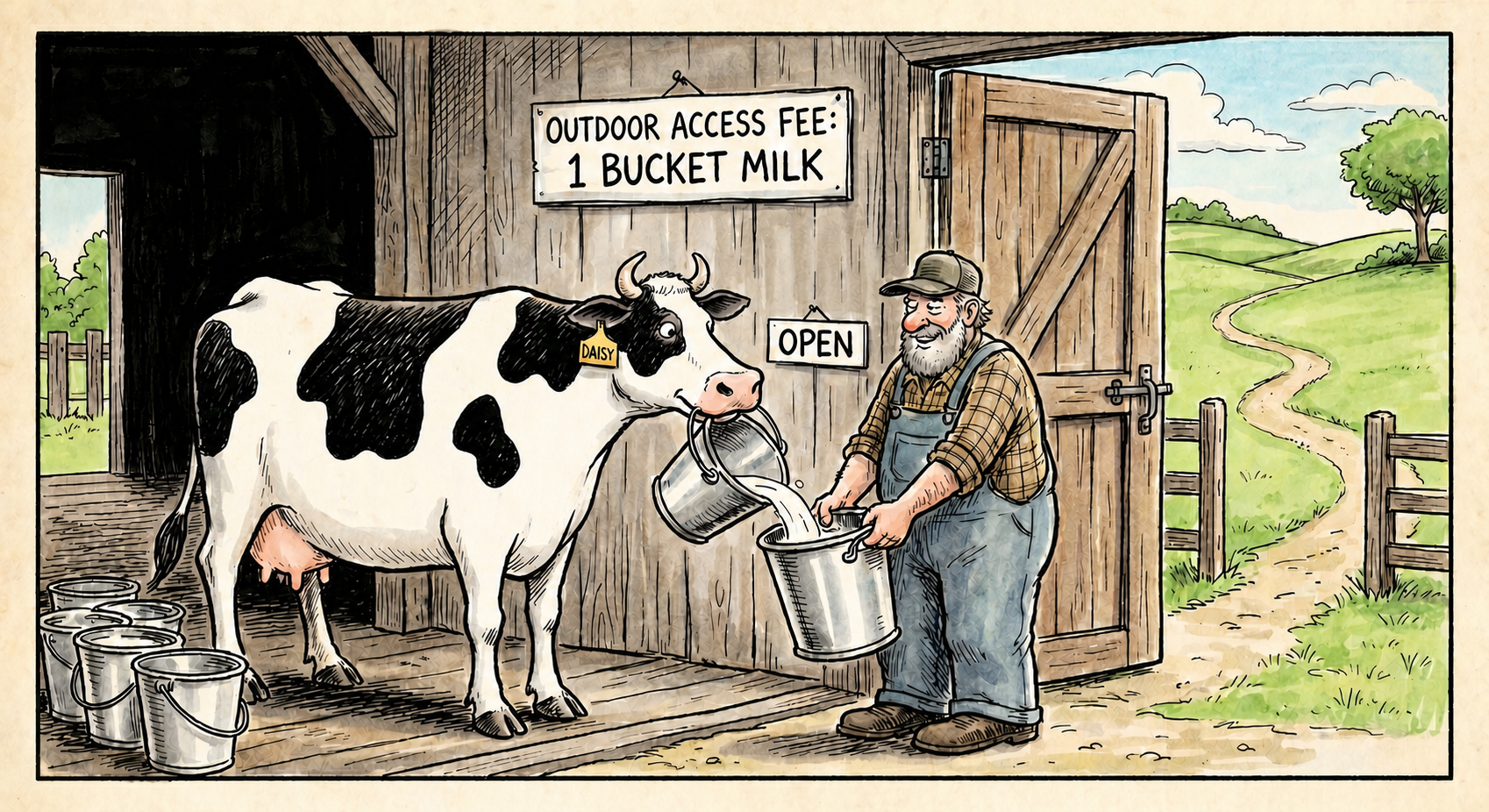
How much time do dairy cows spend outside?
My guess is that cows feel happiest in open pastures surrounded by their friends and sunshine and fresh grass. My judgement is already suspect, because one study showed cows prefer twilight to bright sunshine. But the same study showed they did really like to go outside, so let’s continue on that assumption.
It’s important to note that outside does not necessarily mean idyllic pasture. It can also mean a concrete exercise yard or feedlot. And no modern American dairy cow lives on grass alone, even if they live on a pasture. Their staggering milk production requires more calories than they could possibly get through grass alone.
Conventionally raised cows are not required to spend any time outside. Organic-certified cows must have at least 120 days of pasture time per year and year-round outdoor access of some kind. In practice, California cows get considerably more time outside than Wisconsin or New York cows, for the obvious reason.
The most recent data said that only 5% of lactating cows (which is almost all of them- cows lactate through most of their pregnancies) have access to pasture to graze. That paper was published in 2017 but it might be using older data. Given the wording it’s possible that the cows are given access during times without grass growth, but why would farmers do that? A 2007 study found that only 13% of cows had no outdoor access at all, and half had access to a pasture at least some of the time. So it looks like outdoor access is getting worse
By humaneness standard
You can buy milk with little stickers printed on it advertising a humaneness standard. What do these tell you about the cows’ outdoor life?
- American Humane Certified: does not require outdoor access of any kind for cows
- Certified Humane: cows must have access to outdoors, but not necessarily pasture.
- Organic: cows must graze pasture throughout the grazing season for their geographic location, derive at least 30% of dry matter intake from pasture, for a minimum of 120 days per year. I consider organic kind of bullshit, so I was surprised that it was such a strong demand for dairy cows.
- Global Animal Partnership 5-step
- Step 4+: on pasture >=120 days/year
- Step 5+: continuous pasture
- Animal Welfare Approved / A Greener World: requires continuous pasture living for cows except during actual fires. Emergencies exceeding 28 days require some sort of plan. I was unable to find any drinking milk with this label in the bay area, but there are a few stores with AWA cheese.
- Strauss Farms claims to meet organic standards and never use antibiotics. I have a pet theory that removing the option for antibiotics forces farms to treat animals better, because bad conditions engender disease and without the quick fix of antibiotics that can get very expensive.
When indoors, how confined are dairy cows?
Free stall barns are “standard” (personal communication) in the US. These barns lower their walls in good weather, giving cows access to fresh air but not any more space. They average 100 sq ft per cow, including both personal stalls and common areas. Is that enough? I have no idea.
Some humaneness standards ban tie stalls, but they’re not common in the US even with conventional cows.
What is the disease load of dairy cows?
Disease and injury are both common sources of misery and canaries for mistreatment. So how sick are dairy cows?
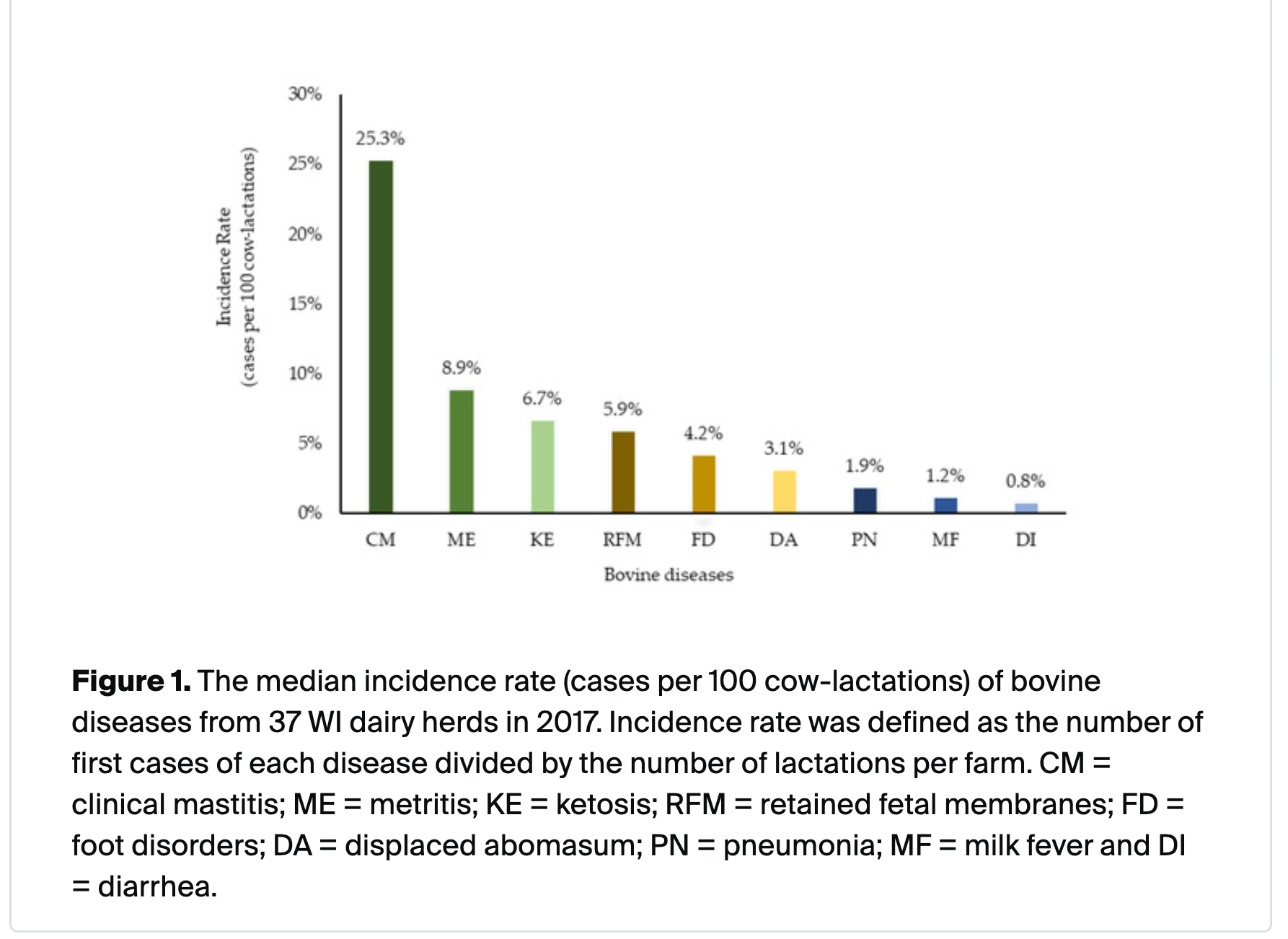
Note that this graph means : n% of cows experience that issue in a lactation cycle (almost a year), not that n% of cows are experiencing this issue at any given time, which is how I initially read it.
Mastitis is more common that the other issues combined, so I dug in further.
- A 2022 study of Wisconsin herds found 25% of cows in a lactation cycle got clinical mastitis (so ~once per year).
- Estimates for average time to cure mastitis:
- Mastitis requires throwing out milk and spreads easily, so farmers are pretty quick to cull chronically infected cows. 25% of culls are for mastitis or other udder problems.
- A 2014 paper found almost the exact same incidence
- Some larger percent have subclinical mastitis.
- In humans, mastitis is quite painful, but many women choose to go through it in order to have kids. OTOH, they get to keep those kids.
- I didn’t dig into this but New Zealand cows reportedly have much lower incidence of mastitis, so pasture raising or less intensive cultivation is probably beneficial.
Euthanasia
The time between experiencing enough suffering to justify euthanasia and the actual euthanasia is probably the most intense physical suffering a cow will experience. It would be useful to know how long that delay is. Unfortunately no one has looked.
We can try to make some guesses based on the ratio of unassisted deaths to euthanasia. In 2013 the data on deaths is as follows (note: they’re using the technical definition of cows, meaning they’ve had at least one pregnancy):

Most notable: calves are 2x as likely to die unassisted in small farms than large, but have ~the same likelihood of euthanization. For adult cows the gap is reversed and much smaller. It seems really unlikely those calves all had painless heart attacks, so we can assume days if not weeks or months of suffering.
How much socialization do dairy cows get?
Herd animals feel better in herds. How much do dairy cows get to indulge that instinct?
- As of 2011, 80% of dairy farms used individual housing for newborn calves, to limit disease spread. This is undoubtedly stressful to the calf, but I don’t trust any of the attempts to quantify exactly how stressful. Disease prevention is a serious issue, since as is ¼ of calves get Bovine Respiratory Disease (in CA).
- Pair housing of calves is economically productive and so probably gaining in prevalence.
- Dairy cows spend the bulk of their life in large herds. However:
- They’re isolated when sick and shortly before giving birth
- They are frequently moved between social groups, which is stressful. That stress is economically impactful and so selected against
- OTOH this paper found moving with a friend (as opposed to alone) changed behavior but not cortisol levels, so either friends don’t help or moving isn’t that stressful.
- They claim significant subgroup results for cows with only one pregnancy. In the absence of a reason for these cows to feel differently, I assume this is a statistical blip.
The Fate of Calves
Milk production also creates a lot of by-catch in the form of newborns that aren’t needed in the dairy herd. Their lives should be considered part of the consequences of dairy. So what are their lives like?
- Abby Shalek-Briski reports on new sex-sorting technology that allows farmers to produce exactly as many female dairy calves as they need to maintain their herd, and use the rest of the pregnancy slots to produce dairy-beef hybrid males who are raised to adulthood and slaughtered for meat. I didn’t research this, but my impression is that beef cattle have pretty good lives.
- In a private discussion, Abby said 18% of calves in the herds she works with are hybrids destined for non-veal meat, but there’s no nationwide data collection to nail it down further.
- ~30% of births go on to be dairy cattle
- Average 3 pregnancies/cow and American herds are stable or shrinking due to increased productivity.
- In 2024: 2.1% total went to veal nationwide
- 2018: 2.8% die young (California)
- Factory farms are worse than small owner-op farms
- The remaining calves are unknown or killed shortly after birth.
Missing
A few obvious sources of suffering I haven’t covered are medical procedures like debudding (horn removal), removal of extra teats, and branding.
Acknowledgements
Thanks to Emma McAleavy and Abby ShalekBriski for sharing their insider knowledge.
Thanks to anonymous client for funding this research.
 Aceso Under Glass