Luck based medicine: angry eldritch sugar gods edition

Introduction

Epistemic status: everything is stupid. I’m pretty sure I’m directionally right but this post is in large part correcting previous statements of mine, and there’s no reason to believe this is the last correction. Even if I am right, metabolism is highly individual and who knows how much of this applies to anyone else.

This is going to get really in the weeds, so let me give you some highlights

  • 1-2 pounds of watermelon/day kills my desire for processed desserts, but it takes several weeks to kick in.
    • It is probably a microbiome thing. I have no idea if this works for other people. If you test it let me know.
    • I still eating a fair amount of sugar, including processed sugar in savory food. The effect is only obvious and total with desserts. 
  • This leads to weight loss, although maybe that also requires potatoes? Or the potatoes are a red herring, it just takes a while to kick in? 
  • Boswellia is probably necessary for this to work in me, but that’s probably correcting an uncommon underlying defect so this is unlikely to apply widely. 
  • Stevia-sweetened soda creates desire for sugar in me, even though it doesn’t affect my blood sugar. This overrides the watermelon effect, even when I’m careful to only drink the soda with food.
  • My protein shakes + bars also have zero-calorie sweeteners and the watermelon effect survives them. Unclear if it’s about the kind of sweetener, amount, or something else.
  • Covid also makes me crave sugar and this definitely has a physiological basis.
  • Metabolism is a terrifying eldritch god we can barely hope to appease, much less understand. 

Why do I believe these things? *Deep breath* this is going to take a while. I’ve separated sections by conclusion for comprehensibility, but the discovery was messy and interconnected and I couldn’t abstract that out. 

Boswellia

Last October I told my story of luck based medicine, in which a single pill, taken almost at random, radically fixed lifelong digestion issues. Now’s as good a time as any to give an update on that. 

The two biggest effects last year were doubling my protein consumption, and cratering sugar consumption. I’m still confident Boswelia is necessary for protein digestion, because if I go off it food slowly starts to feel gross and I become unable to digest protein. I’m confident this isn’t a placebo because I didn’t know Boswelia was the cause at the time, so going off it shouldn’t have triggered a change. 

As I’ll discuss in a later section, Boswelia is not sufficient to cause a decrease in sugar consumption; that primarily comes from consuming heroic amounts of watermelon. The Boswellia might be necessary to enable that much watermelon consumption, by increasing my ability to digest fiber. I haven’t had to go off Boswellia since I figured out how it helps me, so I haven’t tested its interaction with watermelon. 

How does Boswellia affect micronutrient digestion? I have always scored poorly on micronutrient tests. I had a baseline test from June 2022 (shortly after starting Boswellia + watermelon), and saw a huge improvement in October testing (my previous tests are alas too old to be accessible). Unfortunately this did not hold up – my March and June 2023 tests were almost as bad as June 2022. My leading hypotheses are “the tests suck” and “the November tests are the only ones taken after a really long no-processed-dessert period, and sugar is the sin chemical after all”. I hate both of these options. 

If we use fuzzier standards like energy level, illness, and injury healing, I’m obviously doing much better. Causality is always hard when tracking effects that accumulate over a year. In that time there’s been at least one other major intervention that contributed to energy levels and mood, and who knows what minor stuff happened without me noticing. But I’d be shocked if improved nutrition wasn’t a major contributor to this. 

Illness-wise; I caught covid for the second time in late November 2022, and it was a shorter illness with easier recovery  than in April (before any of these interventions started). But that could be explained by higher antibody levels alone. I haven’t gotten sick since then (9 months), which would have been an amazing run for me pre-2022.

My protein consumption (previously 30-40g/day) spiked after I started Boswellia in May 2022 (~100g/day) and then slowly came down. Before November covid I was at ~70g/day. My explanation at the time was that my body had some repairs it had been putting off until the protein was available, and once those were done it didn’t need so much. It spiked again after November covid and only partially came down, I’m still averaging ~100g/day. I’m not sure if I still need that for some reason, or if I’m just craving more calories and satisfying that partially with protein. 

Watermelon

The cure to all my dieting woes?

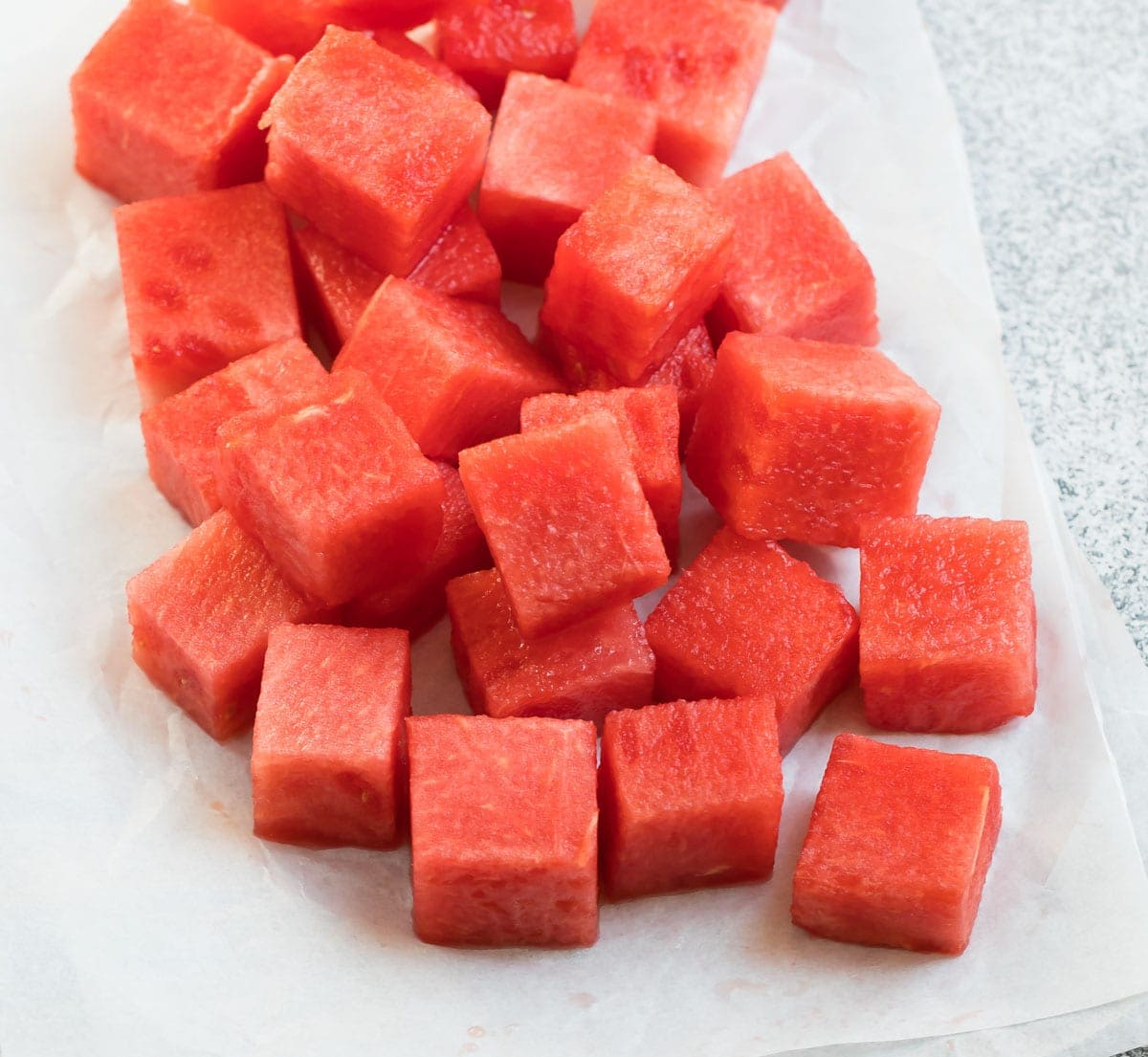
In spring 2022 I started eating 1-2 pounds of watermelon per day. This wasn’t a goal-oriented diet or anything, I just really like watermelon and finally realized the only limitations were in my mind. I started eating watermelon when it came into season, before I got covid in April 2022, but didn’t start the serious habit until the later half of my very long covid case. As previously discussed, that May my doctor prescribed me Boswellia in part to aid covid recovery, and a bunch of good things followed (including a disinterest in processed sugar), all of which I attributed to the Boswelia. 

The loss of interest in sugar was profound. It wasn’t just that I gained the ability to resist temptation; I mostly didn’t enjoy sugar when I had it. I went from a bad stress eating habit to just… not thinking of sugar as an option when stressed. 

My interpretation at the time was “sugar cravings were a pica for real nutrition, as soon as I could digest enough food they naturally went away, fuck you doctors”. It never occured to me the watermelon might be involved because in my mind it was categorized as “indulgence” not “intervention”.  Even if it had occured to me to test it, I know now the effect takes at least six weeks to kick in, and I wouldn’t have waited that long. Lucky for science, reality was going to force my hand. 

Around October I started wanting sugar again, although not as much as before. I put this down to stress, but that never really made sense: August saw me break my wrist and have a very stressful interpersonal issue without any return in cravings. Then in November I got covid again, and it again created intense sugar cravings, which improved some but never really went away. I thought maybe covid had permanently broken my metabolism. I played with the Boswellia dosing for a while but it didn’t seem to make a difference. Plus my protein digestion stayed the same the whole time, so it seemed unlikely Boswellia had just stopped working. 

In February 2023 I talked about this with David MacIver of Overthinking Everything, and noticed that the sugar cravings had returned a few weeks after watermelon had gone out of season. I created a graph from my food diary, and it became really obvious watermelon was the culprit.

The effect is even stronger than it looks, because watermelon has sucrose in it. Over summer my sucrose intake is 90% from fruit; over winter it’s dominated by junk. 

I figured this out in February 2023. Because I live in a port city in a miracle world, that was late enough in the season to get mediocre watermelon. It took a while to work, but that was true the first time as well (somewhere between 6 weeks and 12, depending on how you count covid time). And you can indeed see where this started on the graph. But five months later it is still replicating the previous year’s success. Sugar cravings were weaker but still present, and certainly came back when I was stressed. The weight loss was slow and stuttering where it had previously been easy.  That brings me to my next point.

Stevia-sweetened Soda

In January 2023 my doctor gave me a continuous glucose monitor to play around with. The thought process here was…exploratory.  Boswellia is known to lower blood sugar, and helped with (I thought) sugar cravings and many other issues. Covid causes sugar cravings in me, is known to hurt diabetics more, and causes lots of other problems, so maybe that points to blood sugar issues in me? Also I was kind of hoping the immediate feedback would nudge me to eat less sugar.

One of the foods I was most excited to test was 0-calorie soda. I’d always avoided diet soda on the belief that no-calorie sweeteners spiked your insulin and this led to sugar cravings that left you worse off. But when I tried stevia-sweeted Zevia with the GCM my blood glucose levels didn’t move at all, and I didn’t feel any additional drive to eat sugar (compared to my then-high baseline desire – remember this was while I was off watermelon and dessert was amazing). 

I was extremely excited about this discovery. I’d given up cola about 18 months before and missed it dearly. Now I had chemical and mathematical proof that no-cal soda was fine. When I had the cola again it made me so happy I was amazed I’d ever managed to give it up before. I began a 2-3 cans/day caffeine-free Zevia cola habit. 

This would have been 4-6 weeks before I restarted on watermelon. When the watermelon failed to repeat its miracle I suspected Zevia fairly quickly, but I really, really didn’t want it to be true so I tested some other things first. Finally I had ruled out too many other things, and had a particularly clarifying experience of sudden, strong cravings with nothing else to blame.  I gave up Zevia, and immediately lost all desire for sugar. In retrospect the low-sugar-desire days of the previous months were probably not random, but days I happened to not drink Zevia. 

Unfortunately this doesn’t obviously show up on the fructose vs sucrose graph and I don’t care enough to export the data and do real statistics. It also doesn’t show up cleanly on my weight graph, because weight is noisy and the effect operates at a substantial delay. But I’ve given it 7 weeks, and I’m definitely losing weight. The current streak is faster than anything I had last year, although it’s too soon to say if that will hold up. . . 

Zevia is sweeted with stevia, which seems like it should make stevia an enemy. But my protein shake is also sweetened with stevia (plus something else), and I had at least a bottle/day during the weight loss last year (this is one excuse I gave for testing other potential culprits before Zevia). Maybe the issue is the amount in Zevia, maybe drinking stevia with a lot of protein is better than separately, even when it’s with a meal. Maybe Mercury was in retrograde I give up. 

Potatoes and Weight Loss

The no-sugar effect had kicked in in earnest by late May 2022 (I didn’t start a food diary until late June that year, but confirmed the May date by looking at my grocery orders). In July 2022 I went on minimum viable potato diet, in which I ate a handful of baby potatoes every day and demanded nothing else of myself. Within a few days my caloric intake dropped dramatically, and I started to lose weight. This continued late fall, when watermelon went out of season. 

The post-potato weight loss was weird, and seemed much too large to be produced by a handful of potatoes. But it was such a strong effect that started so quickly after potatoes that it seemed impossible to be a coincidence. 

I mentioned before that the watermelon works on a delay. So maybe I just happened to start eating potatoes the day the watermelon effect kicked in (I don’t have exact timing for this – the first run is complicated by covid and the second by stevia soda and work stress). Maybe I need watermelon and potatoes for some stupid reason. Maybe that 100g of produce was a tipping point, but 100g of anything would have worked. Or maybe that’s just when the summer heat kicked in, since I’ve always eaten less when it was hot out. Maybe it’s not a coincidence the current weight loss kicked in shortly after finishing a stressful, air conditioned gig… 

Questions

What is happening with sugar?

The stevia effect appears to be same-day, often kicking in within a few hours and wearing off by the next day, so I assume that’s a metabolic issue. But not one reflected in blood sugar, according to the CGM. Unless the effect kicks in slowly (while also stopping the day I stop drinking it). 

The no-sugar effect watermelon takes 4-8 weeks to kick in, and another 4+ to cause weight loss. But between those milestones… I don’t want to brag, but it’s relevant so I think I have to. ~10 weeks after 1-2lbs of watermelon/day my feces become amazing. So amazing they look fake, like they were crafted for an ad for a fiber pill. Enormous without being at all painful because of their perfect consistency. Other bowel movements resent mine for setting unrealistic beauty standards, but they can’t help it, that’s just how they naturally look. 

Between the delay and the gold-ribbon poops, I’m pretty sure the watermelon effect works through microbiome changes. Maybe fiber, maybe feeding different bacteria, maybe changing the metabolism of the existing bacteria?

Are you one of those idiots who thinks processed sugar is different than natural sugar?

I regret that I have to answer this with “maybe”.  Processed is not well defined here, but it sure seems like a Calorie from watermelon hits me differently than a Calorie from marshmallows; even if they fuel the same amount of metabolism. My guesses for what actually matters are fiber, fructose vs sucrose, water content, and “fuck if I know”. If anyone tries a sugar water + fiber pills diet, please do let me know. 

I try to be careful to say I haven’t given up processed sugar, just processed desserts. Lots of savory dishes have a fair amount of sugar (not just carbs) in them. My guess is that if easy, sugar-free prepared food was available I wouldn’t miss the sugar, but in the real world it is too much work to cut it out and I seem to be doing okay as-is 

Does it have to be watermelon?

If I’m right about the fructose, fiber, and/or water, no, but I haven’t tested it. Watermelon does have a pretty favorable mix of those (grapes have way more sugar per gram), but its primary virtue is that it is obviously the best fruit and I’d struggle to eat that much of anything else on purpose, much less do so accidentally for months straight. In fact I did try to replace watermelon that winter, but couldn’t find anything I’d eat that much of.  

However someone on twitter pointed out that watermelon is unusually high in citrulline (which is used to produce arginine, which is metabolically important). There’s no way I could detect this trend against my overall increase in protein uptake, so I can’t do more than pass this on. If California fails to deliver truly year round watermelon my plan is carrots + citruilline pills, so maybe we’ll find out then.  

Why does Boswellia help protein digestion?

I don’t know. Digestion isn’t even included on the list of common effects of Boswellia. All any doctor will tell me is “something something inflammation”, as if I haven’t taken dozens of things with equally strong claims to reducing inflammation.

Last year a reader connected me with a friend who had some very interesting ideas about mast cell issues, and I swear I’m going to look into those any day now… 

Conclusion

Everything is stupid, nothing makes sense. If hadn’t lucked into a situation where I was using Boswellia, eating stupid amounts of watermelon, and consuming no Zevia I might never have found out this no-sugar-desire state and would be at least 30 pounds heavier. 

PS

If you find yourself thinking “this is great, I’m so sad Elizabeth only publishes a few extremely long posts per year about metabolism that prove nothing”, I have good news! The Experimental Fat Loss substack features multiple posts per month in exactly that genre. It mostly follows the author’s fairly rigorous dietary experiments, but lately he’s been taking case studies from other people as well. 

Dear Self; we need to talk about ambition

I keep seeing advice on ambition, aimed at people in college or early in their career, that would have been really bad for me at similar ages. Rather than contribute (more) to the list of people giving poorly universalized advice on ambition, I have written a letter to the one person I know my advice is right for: myself in the past.

The Letter

Dear Past Elizabeth,

Your life is, in some sense, a series of definitions of success. 

First you’re in early school, and success is defined for you by a handful of adults. You go where they say, do the assignments they say, when they say, and doing well means meeting the goals they set for you. Even your hippie elementary school gives you very few choices about life. You get choices in your leisure activity, but that (as they have explained to you) is leisure and thus unimportant, and there’s no success or failure in it. 

Then you get further in school, and the authorities give you some choice over the hoops you jump through. You can choose which book you write your report on or even what classes you take (within a predetermined set). This feels like freedom, but you’re in still a system someone else designed and set the win conditions for. You can fulfill a college distribution requirement with any history class at all- but you are going to take one, and the professor is the one determining if you succeeded at it. 

More insidiously, you’ll like it. Creating your own definition of success feels scary;enacting it feels impossible. The fact that school lays out neat little hoops for you to jump through is a feature.

Work (you’ll be a programmer) is where things get screwy. Programming contains multiple definitions of success (manager, principal, freelancing, development, testing, bigtech, start-up, money-maxing, altruistic projects…), and multiple ways to go about them. If your goals lie outside of programming altogether (art, parenting, travel..), it’s relatively easy to work out a way to fund it via programming while still having the time to do what you want. Not trivial, but have you seen what people in other jobs go through? With programming it’s at least possible.

But you like hoops. You’re comfortable with hoops. So you’re going to waste years chasing down various definitions of success within programming, and by the time you give up youwill be too exhausted to continue in it at all. I think you (I) should have considered “just chill while I figure shit out” much earlier, much more seriously. It was reasonable to give their way a try, just due to the sheer convenience if it had worked, but I should have learned faster.

Eventually you will break out of the Seattle bigtech bubble, and into the overlapping bubbles of effective altruism, lesswrong, and the bay area start-up scene. All of three of these contain a lot of people shouting “be ambitious!” and “be independent!”. And because they shout it so loudly and frequently you will think “surely, now I am in a wide open world and not on a path”. But you will be wrong, because “be ambitious (in ways the people who say this understand and respect)” and “be independent (in ways they think are cool and not crazy)” are still hoops and still determined by other people, just one more level meta.

Like the programming path, the legible independent ambition path works for some people, but not you. The things you do when pushed to Think Big and Be Independent produce incidental learning at best, but never achieve anything directly. They can’t, because you made up the goals to impress other people. This becomes increasingly depressing, as you fail at your alleged goals and at your real goal of impressing people. 

So what do we do then? Give up on having goals? Only by their definition. What seems to work best for us is leaning into annoyance or even anger at problems in the world, and hate-fixing them. 

You’ve always hated people being wrong, and it turns out a lot of things can be defined as “wrong” if you have the right temperament. Women’s pants have tiny pockets that won’t fit my phone? Wrong. TSA eating hours of my life for no gain? Wrong. Medical-grade fatigue? Wrong. People dying of preventable diseases? Extremely wrong. And wrong things are satisfying to fix.

A nice facet of this approach is that you can start small and it will naturally grow over time. Pocket extenders might give you a nice efficacy high at first, but soon you’ve built a tolerance and are taking on bigger and bigger wrongs just to feel alive. And you have more energy for that effort because of the problems you fixed earlier. 

A year ago I got really mad that people were becoming vegan without paying any attention to nutrition and decided to do something about it. That stopped being fun like a week in and was mostly a miserable slog. People yelled at me for doing it, which was pretty unpleasant. I was constantly on the verge of giving up but they were so wrong I couldn’t let it go. And then it ballooned into something huge. 

[Author’s note: The vegan epistemics sequence isn’t done yet. I kept finding one more post I needed before the big one, and eventually ran into a time-consuming commitment that ate my entire July and August. I hope to wrap this up soon, and I’m confident that something will be coming in the next month, but can’t rule out another 5 just-one-more posts.]

The spite-based path to impact and altruism is not the easiest road. Spite is a less fun emotion than hope, and makes fewer friends. But I also can’t bring myself to wish I didn’t have this drive, because it is my actual value system. Not caring if people destroy the commons would be easier in many ways but then the commons would be destroyed and that’s worse. 

It does seem good to have the option to be motivated by hope and not just anger-at-wrongness, and I’m experimenting with that now. I think it is working, but I don’t think I could have done it without the previous, spite-based projects.

Some specific advice

The following are a few tips I think might be generally useful as you think about how to spend your time. 

Plans don’t have to route through employment 

You’re never going to love programming. Trying was probably the right thing to do at the time, but I think you should have given up faster. Giving up would have been easier if you’d separated giving up on loving programming or succeeding in the career from funding your life via programming. You could have had many years of rest and vest if you’d been open to it. 

Would your life have been missing something? Yes. Was programming ever going to provide that thing? Not directly. But the free time and savings sure were helpful in the pursuit. 

Ways to identify fake ambition

Sometimes it’s hard to tell if you authentically want something, or are trying to impress people with how ambitious you are. Here are a few tricks I’ve picked up for distinguishing them.

  1. What do you feel when you think about shrinking the project?
    1. Anger, fear, or disappointment that the goal won’t be accomplished = seems like you care a lot, good sign for the project. 
    2. Relief = project seems like a lot of work. Consider if you’re up for that level of work before beginning (but the answer might be yes).
    3. Fear of failure = this is a terrible sign, unless you have some reason the smaller version is more likely to fail (if you do, try the question again with a version that is easier and more likely to succeed). If failure feels like a bigger threat for a project that is objectively easier, that’s a suggestion you are, on some level, not taking the big version seriously. If you were, it would be scarier.
    4. Fear of other people’s reaction = your primary motivation here is probably social. Knowing that, do you still want to go forward? The answer can be yes, although if so I hope the project is cheap.
  2. If you fail, will you or the people around you go “well what did you expect?” That would suggest your goal is unachievable from your current state.
    1. Another reason smaller projects can be scarier is that people will judge you more for failing. Don’t let this push you into too-big projects.
  3. If you fail, will it be educational? “No” is both a sign the project is too big (because you don’t understand it well enough) and a reason the project is too big (you’re going to pour all that energy in and not even get learning out?)
  4. How does concrete, accurate, actionable criticism make you feel? If it’s a real goal you should be delighted, because feedback helps you reach that goal faster. Or if you’re a little less evolved, not delighted, but at least it feels like a really productive massage or workout, where it hurts but you can tell it will be worth it. If you feel terrified, or angry, or especially unsupported, that suggests you care more about the social aspect of the project than its outcome.
  5. Does the project give you a satisfying feeling of contact with reality? That’s maybe a sign it’s a real goal, and definitely good in general.
    1. What does “contact with reality” mean? That is a very reasonable question I don’t have a good answer for, at least not in words. Hopefully you’ll know it when you see it.

Some of the people talking about ambition and independence mean it

You will never impress them until you give up on doing so.

One friend in particular got palpably more respect for you 5 seconds after you gave up on impressing him. Not “dismissed as irrelevant” or “overcame your need for” his approval, just “accepted the reality that it wasn’t going to happen and stopped putting energy into it.” 

I could end this story with “…and then eventually you did real things he respected a lot” but that’s kind of like telling people it’s fine to not worry about their weight because chilling out will cause them to lose weight. It’s sometimes true, but if this is going to work it needs to not matter. 

Comparison is the thief of joy until you find the right reference group

Respect from other humans is a fundamental need, and I don’t want you to attempt to live without it. I just want you to have an accurate scale. Luckily, life is going to provide one for you that you can live with.

I spent a lot of time in the bay area feeling stupid and lazy. This got worse and worse until I went to Andy’s wedding in 2018. Andy, while quite ambitious in his hippy way, was about as far outside the bay area ambition bubble as you could get.  During the reception I had a flash of insight that I only look stupid and lazy next to the brilliant and driven people I deliberately sought out because I am smart and kind of driven (but not as much as them). Next to Andy’s hippy friends I am a titan of industry.

This felt like a socially unacceptable cure for anxiety at the time, but I talked to Andy about it a few years later and he said “oh yeah, it’s always been clear you were the friend of mine most likely to be remembered after you die”. Which is is a pretty intense thing to say, and honestly kind of weird because at the time you met his hippy goals definitely outscaled your programming goals. But he definitely wasn’t mad.

I don’t want to lean too hard on this. The point isn’t “I’m better than them because I’m ambitious”. They’re living their own best lives that wouldn’t be improved if I started shouting at them about ambition or the glorious fight for epistemics. It’s just that I’m not failing all the time.

Sometimes procrastination is a workers’ strike

If you just don’t seem to be able to focus on something, consider that you might not actually want to do it and you should quit. Better yet, get curious about why you don’t seem to want to work on it, with “I hate it and want to quit” being one of many options. This will save you a lot of time and misery. 

Your taste will always exceed your ability

…which means things you make will always be disappointing relative to the image in your head. People will tell you the cure is to push through and do lots of stuff anyway (my favorites). There’s definitely something to that, but I have this nagging feeling that that’s only half a cure. It looks to me like “stop thinking and just ship it” is as much of an avoidance strategy as “you can’t ship things until they’re perfect”.

Every once in a while I ask the internet “hey, how do you tell when to release subpar work and when to keep improving?” and no one has ever given me a satisfactory answer. Hopefully I’ll have something for you in a few years.

Conclusion

You should give “let other people set your success criteria” a good shot. When it works it’s way easier than creating your own. But you should recognize when you’re doing it (even if one of the success criteria you’re trying to meet is “be independent”), and when it doesn’t work you should move on. 

Best of luck,

-Elizabeth

Apollo Neuro Results

Introduction

Two months ago I recommended the Apollo Neuro for sleep/anxiety/emotional regulation. A number of people purchased it based on my recommendation- at least 25, according to my referral bonuses. Last week I asked people to fill out a form on their experience.

Take-home messages:

  • If you are similar to people who responded to my first post on the Apollo, there’s a ~4% chance you end up getting a solid benefit from the Apollo.
  • The chance of success goes up if you use it multiple hours per day for 4 weeks without seeing evidence of it working, but unless you’re very motivated you’re not going to do that.
  • The long tail of upside is very, very high; I value the Apollo Neuro more than my antidepressant. But you probably won’t. 
  • There’s a ~10% chance the Apollo is actively unpleasant for you; however no one reported cumulative bad effects, only one-time unpleasantness that stopped as soon as they stopped using it. 

With Numbers

The following graphs include only people who found the Apollo and the form via my recommendation post. It does not include myself or the superresponders who recommended it to me. 

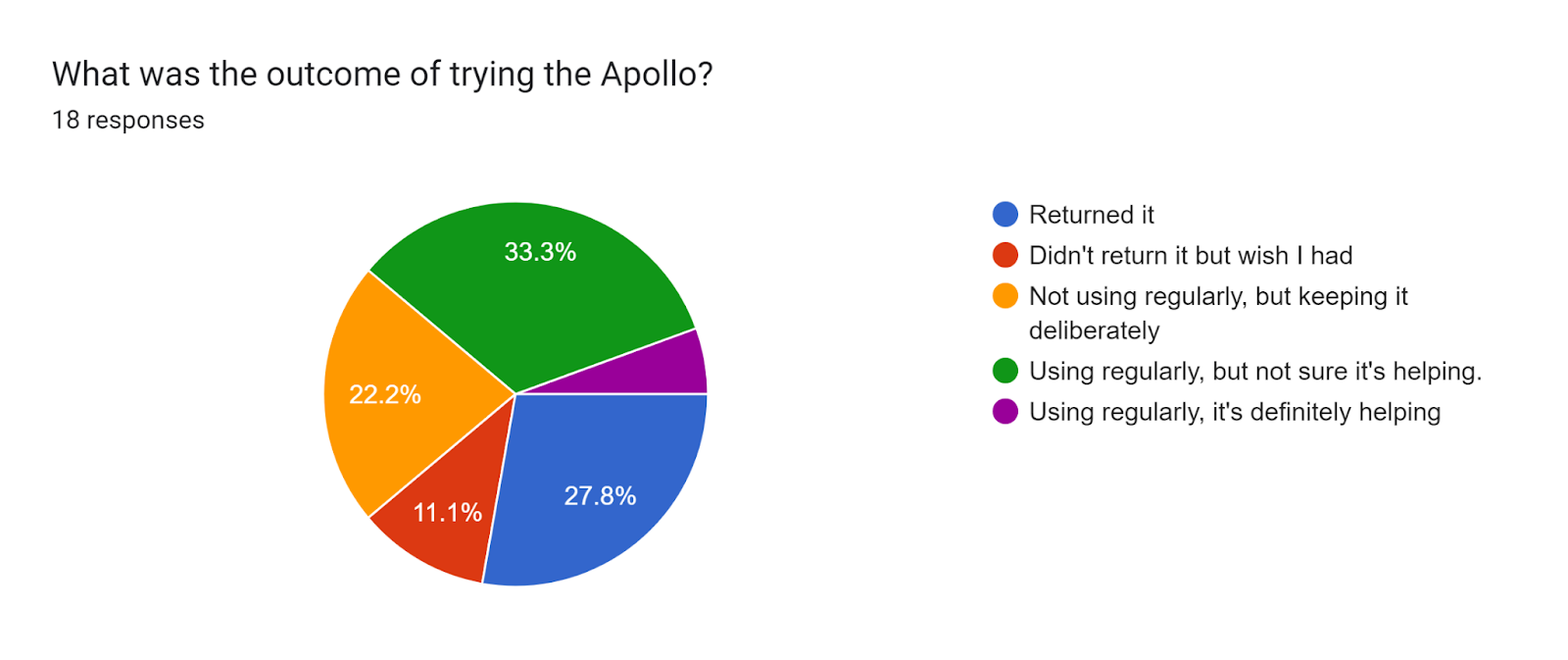
Forms response chart. Question title: What was the outcome of trying the Apollo?. Number of responses: 18 responses.

(that’s one person reporting it definitely helped)

An additional six people filled out an earlier version of the form, none of whom found it helpful, bringing the total to 24 people.

Obviously I was hoping for a higher success rate. OTOH, the effects are supposed to be cumulative and most people gave up quickly (I base this on conversations with a few people, there wasn’t a question for it on the form). Some of that is because using the Apollo wasn’t rewarding, and I’ll bet a lot of the problem stems from the already pretty mediocre app getting an update to be actively antagonistic. It probably is just too much work to use it long enough to see results, unless you are desperate or a super responder. 

Of people who weren’t using it regularly: 55% returned it, 20% failed to return it, and the remaining 35% chose to keep it. I think that last group is probably making a mistake; the costs of luck-based medicine add up, so if you’re going to be a serious practitioner you need to get good at cutting your losses. It’s not just about the money, but the space and mental attention. 

Forms response chart. Question title: If you didn't like it- what was your experience?. Number of responses: 13 responses.

Of 6 people in the earlier version of the form, 1-2 found it actively unpleasant. 

The downside turned out to be worse than I pictured. I’m fond of saying “anything with a real effect can hurt you”, but I really couldn’t imagine how that would happen in this case. The answer is: nightmares and disrupted sleep. In both cases I know of they only experienced this once and declined to test it again, so it could be bad luck, but I can’t blame them for not collecting more data. No one reported any ill effects after they stopped using it. 

I would also like to retract my previous description of the Apollo return policy as “good”. You do get most of your money back, but a 30-day window for a device you’re supposed to test for 28 days before passing judgment is brutal. 

It’s surprisingly hard for me to find referral numbers, but I know I spurred at least 25 purchases, and almost certainly less than 30. That implies an 80% response rate to my survey, which is phenomenal. It would still be phenomenal even if I’d missed half the purchasers and it was only a 40% response rate. Thanks guys. 

Life as a superresponder

Meanwhile, the Apollo has only gotten better for me. I’ve basically stopped needing naps unless something obvious goes wrong, my happiness has gone up 2 points on a 10 point scale (probably because of the higher quality sleep)1, sometimes my body just feels good in a way it never has before. I stress-tested the Apollo recently with a very grueling temp gig (the first time in 9 years I’ve regularly used a morning alarm. And longer hours than I’ve maybe ever worked), and what would have previously been flat out impossible was merely pretty costly. Even when things got quite hard I was able to stay present and have enough energy to notice problems and work to correct them. The Apollo wasn’t the only contributor to this, but it definitely deserves a plurality of the credit, maybe even a majority.

When I look at the people I know who got a lot out of the Apollo (none of whom were in the sample set because they didn’t hear about it from my blog), the common thread is that they’re fairly somatically aware, but didn’t start that way. I’m not sure how important that second part is: I don’t know anyone who is just naturally embodied. It seems possible that somatic awareness is either necessary to benefit from the Apollo, or necessary to notice the effects before your motivation to fight the terrible app wears off. 

Conclusion

The Apollo doesn’t work for most people, you probably shouldn’t buy it unless you’re somatically aware or have severe enough issues with sleep or anxiety that you can push through the warm-up period. 

  1. I don’t use a formal mood tracker. But I did have a friend I ask to send me pictures of their baby when I’m stressed or sad. I stopped doing that shortly after getting the Apollo (although due to message retention issues I can’t check how long that took to kick in). ↩︎

Adventist Health Study-2 supports pescetarianism more than veganism

Or: how the Adventist Health Study-2 had a pretty good study design but was oversold in popular description, and then misrepresented its own results.

When I laid out my existing beliefs on veganism and nutrition I asked people for evidence to the contrary. By far the most promising thing people shared was the 7th Day Adventist Health Studies. I got very excited because the project promised something of a miracle in nutrition science: an approximate RCT. I read the paper that included vegan results, and while it’s still very good as far as nutrition studies go it’s well below what I was promised, and the summaries I read were misleading. It’s not a pseudo-RCT, and even if you take the data at face value (which you shouldn’t) it doesn’t show a vegan diet is superior to all others (as measured by lifespan). Vegan is at best tied with pescetarianism, and in certain niche cases (e.g. being a woman) it’s the worst choice besides unconstrained meat consumption. 

I’m going to try not to be too sarcastic about this, the study really is very good data by nutrition science standards, but I have a sour spot for medical papers that say “people” when they mean “men”, so probably something will leak out.  Also, please consider what the state of nutrition science must be to make me call something that made this mistake “very good”.

Background

The 7th Day Adventists are a fairly large Christian sect. For decades scientists have been recruiting huge cohorts to study their diet, and publishing a lot of papers.

The Adventists are a promising group to use to study nutrition for lots of reasons, but primarily because the Church discourages meat, smoking, and drinking. So you lose the worst confounders for health, and get a population of lifelong, culturally competent vegetarians, which is a pretty good deal. Total abstinence from meat isn’t technically required – you’re allowed to eat kosher meat – but it’s heavily discouraged. 7DA colleges only serve vegetarian meals, and church meals will typically be vegetarian.

Some popular descriptions say that rules vary between individual churches, which could give you an almost RCT effect. AFAICT this isn’t true, and the paper I read never claimed it was. Both the internet and my ex-Adventist friend say that individual churches within the US (where the study took place)  vary a little in recommendations, but most of the variety in diet is based on individual choice, not local church rules. 

I was really hoping this project could shed light on what happened to people who had medical difficulties with plant-exclusive diets in plant-exclusive food cultures, but they didn’t try, and from the abundance of meat eaters within 7DA I’d guess the answer is that they eat animal products. Nor is the study very informative about naively switching to a plant-exclusive diet, since most members grow up in the culture and will have been taught a reasonable plan-based diet without necessarily needing to consciously think about it. 

The Adventist Health Studies program has produced a lot of papers over the years. I focused on Vegetarian Dietary Patterns and Mortality in Adventist Health Study 2, because someone commented on my last post and pointed to that paper as addressing veganism in particular (other papers look like they only consider vegetarianism, although they might be using it as an umbrella term). I also read the AHS-2 cohort profile, but not any of the other papers, due to time constraints. It’s possible I will raise questions those papers would have answered, but there are at least 15 papers and, as I’ll talk about later, I wasn’t feeling hopeful. 

So let’s talk about that one paper. It breaks people down into 2 main categories, one of which has 4 subtypes. The big category is “nonvegetarian”, which they defined as eating meat more than once per week (48% of the sample). If you eat meat less than or equal to once a week you qualify for some category of vegetarian. More specifically:

  • Vegan (8%): consumes any animal product <1/month.
  • Lacto-ovo-vegetarian (29%): unlimited consumption of eggs and milk, meat < 1/month.
  • Pesco-vegetarian (10%): unlimited fish, eggs, and milk, other meat < 1/month
  • Semi-vegetarian (6%): unlimited eggs and milk, meat+fish combined > 1/month but no more than 1/week.

I’m already a little 🤨 at lumping all four of those into one category, much less calling it vegetarian, but it will get worse. 

I wish we knew more about the specific diets of the nonvegetarians (although not enough to trawl through 20 papers hoping to find that data). Do they eat pork or shellfish, which violates Church requirements and would thus be a great marker for low conscientiousness? Are they eating Standard Shitty American Diet, or similar to the lacto-ovo-vegetarians but with meat 5x/month? 

Statistics

In this sample, eating lots of meat is clearly correlated with multiple activities known to impair health, like smoking and drinking. The paper attempts to back out those effects, but that’s impossible to do fully. You can back out 100 things and still miss the effect of traits that makes doing all those things more or less likely. That’s how you get results like “theater attendance reduces the risk of death even after controlling for a laundry list of confounders”.

The mortality results in this paper are controlled for: age, smoking, exercise, income, education level, marital status, alcohol consumption, and sleep.  In women they also adjusted for menopausal status and hormone therapy (vegans were ½ to ⅓ less likely to be on hormone therapy, compared to other groups).

What kinds of things does this leave out? Conscientiousness, religiosity (which has social implications), and overall concern for health (anything with enough of a cultural “health halo” will eventually show a correlation with long life, because it will be done more by people who care the most about health, and they’re likely also doing other things that help). It will also be confounded if poor health is the thing that causes people to consume more animal products. 

My statistician described their methods of backing out the confounding effects as “This isn’t what I would have done but it doesn’t seem unreasonable”, which easily puts this in the top 10% of medical papers I’ve asked him to evaluate. He didn’t scream in pain even a little bit. I can’t check their actual math without the raw data, but for purposes of this post I feel comfortable assuming they correctly adjusted for everything they listed.

Claims of vegetarianism’s benefits are greatly exaggerated

Note: most of these results don’t reach the level of statistical significance, but let’s ignore that for now. I’m also going to ignore concerns they failed to fully back out health effects with non-dietary causes, because even if they did, the data doesn’t support their own conclusions, much less the idea veganism is superior. 

The abstract says “Significant associations with vegetarian diets were detected for cardiovascular mortality, noncardiovascular noncancer mortality, renal mortality, and endocrine mortality. Associations in men were larger and more often significant than were those in women.”

Sure, if you count “unlimited fish” as vegetarian. 

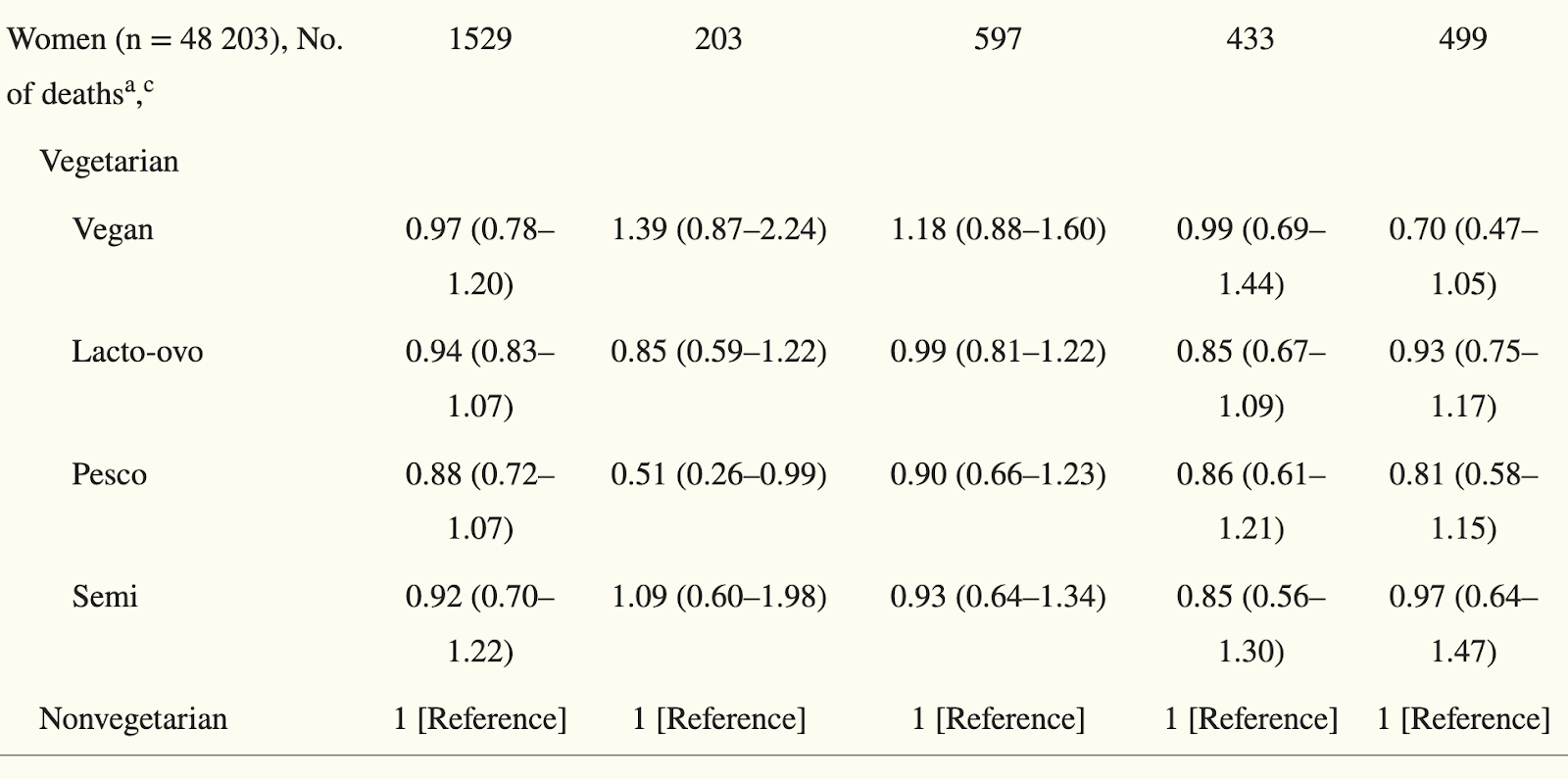
But it’s much worse than that. If you look at men, you see veganism’s hazard ratio is tied with pescetarianism, followed by other forms of vegetarianism, and then nonvegetarian. Seems unfair to quote this as total vindication for veganism, although it is definitely a blow against unrestricted meat eating.

But then we get to that niche group, women. This data is a little noisy because women only made up ⅔ of the sample, but you can nonetheless get a faint hint that veganism is barely distinguishable from unrestricted omnivorism, and the diet correlated with the lowest death rate is pescetarianism, with lacto-ovo-vegetarianism and semi-vegetarianism somewhere in the middle.

And again, that’s treating the confidence intervals as minimal, when in reality they heavily overlap with each other and with the nonvegetarian death rate. 

The extra weird thing here is that in men veganism was most helpful against cardiac issues, whereas in women it appears to be actively harmful to cardiac health. Any benefit veganism has in women comes from the “other death” category, whereas in men the “other death” category is where it loses ground against pescetarianism. 

The paper describes this as “Effects were generally stronger and more significant in men than women”, which is a weird way to say “women and men had very different results”. 

Why the gender gap?

Could be any number of things. Maybe nonvegetarian women had healthier diets than men in the same category (they cite another paper that checked and said there were no “striking differences” between the sexes within a given category, but I’m not feeling very trusting right now).  Maybe nutritional intake has a bigger impact on women due to menstruation and pregnancy. Maybe women were more likely to use veganism as cover for an eating disorder. Maybe they did the math wrong.  

Fish seem pretty good though

If you’re going to conclude anything from these papers, it’s that fish are great. At least as good as veganism in men, and better in women. I’m more inclined to trust that result than I otherwise would be, because pescetarianism has less of a health halo around it, as witnessed by seafood eaters having roughly the same prevalence of bad habits like smoking and drinking, relative to lacto-ovo-vegetarians and semi-vegetarians. My ex-Adventist friend confirms that veganism is viewed more favorably than pescetarian or semi-vegetarian in the community, although not compared to vegetarianism, which surprised me. 

So the benefits of pescetarianism are less likely to be downstream of being the choice of people who care a lot about health, or are highly consceintious. I briefly got motivated to eat more fish until I remembered I count as semi-vegetarian by their standards (and I’m female), so the gains are small even if you take the results at face value.

Nutrition is still really complicated, the study still has a bunch of flaws, I wouldn’t update too much on this even if it didn’t agree with my existing beliefs. But this clearly undercuts veganism as the healthiest choice for women, and doesn’t really support it for men either. 

Change my mind: Veganism entails trade-offs, and health is one of the axes

Introduction

To me, it is obvious that veganism introduces challenges to most people. Solving the challenges is possible for most but not all people, and often requires trade-offs that may or may not be worth it.  I’ve seen effective altruist vegan advocates deny outright that trade-offs exist, or more often imply it while making technically true statements. This got to the point that a generation of EAs went vegan without health research, some of whom are already paying health costs for it, and I tentatively believe it’s harming animals as well. 

Discussions about the challenges of veganism and ensuing trade-offs tend to go poorly, but I think it’s too important to ignore. I’ve created this post so I can lay out my views as legibly as possible, and invite people to present evidence I’m wrong. 

One reason discussions about this tend to go so poorly is that the topic is so deeply emotionally and morally charged. Actually, it’s worse than that: it’s deeply emotionally and morally charged for one side in a conversation, and often a vague irritant to the other. Having your deepest moral convictions treated as an annoyance to others is an awful feeling, maybe worse than them having opposing but strong feelings. So I want to be clear that I respect both the belief that animals can suffer and the work advocates put into reducing that suffering. I don’t prioritize it as highly as you do, but I am glad you are doing (parts of) it.

But it’s entirely possible for it to be simultaneously true that animal suffering is morally relevant, and veganism has trade-offs for most people. You can argue that the trade-offs don’t matter, that no cost would justify the consumption of animals, and I have a section discussing that, but even that wouldn’t mean the trade-offs don’t exist. 

This post covers a lot of ground, and is targeted at a fairly small audience. If you already agree with me I expect you can skip most of this, maybe check out the comments if you want the counter-evidence. I have a section addressing potential counter-arguments, and probably most people don’t need to read my response to arguments they didn’t plan on making. Because I expect modular reading, some pieces of information show up in more than one section. Anyone reading the piece end to end has my apologies for that. 

However, I expect the best arguments to come from people who have read the entire thing, and at a minimum the “my cruxes” and “evidence I’m looking for” sections. I also ask you to check the preemptive response section for your argument, and engage with my response if it relates to your point. I realize that’s a long read, but I’ve spent hundreds of hours on this, including providing nutritional services to veg*ns directly, so I feel like this is a reasonable request. 

My cruxes

Below are all of the cruxes I could identify for my conclusion that veganism has trade-offs, and they include health:

  • People are extremely variable. This includes variation in digestion, tastes, time, money, cooking ability… 
  • Most people’s optimal diet includes small amounts of animal products, but people eat sub-optimally for lots of reasons and that’s their right. Averting animal suffering is a better reason to eat suboptimally than most. 
  • Average vegans and omnivores vary in multiple ways, so it’s complicated to compare diets. I think the relevant comparison healthwise is “the same person, eating vegan or omnivore” or “veganism vs. omnivorism, holding all trade-offs but one constant”.
  • For most omnivores who grew up in an omnivorous culture, going vegan requires a sacrifice in at least one of: cost, taste (including variety), health, time/effort.
    • This is a mix of capital investments and ongoing costs – you may need to learn a bunch of new recipes, but if they work for you that’s a one time cost.
    • Arguments often get bogged down around the fact that people rarely need to sacrifice on all fronts at once. There are cheap ways for (most) people to eat vegan, but they either take effort and knowledge, or they’re bad for you (Oreos are vegan). There are vegan ways for most people to be close to nutritionally optimal, but they require a lot of planning or dietary monotony.
    • Some of the financial advantage for omnivores is due to meat subsidies that make meat artificially cheap, but not all of it, and I don’t know how that compares to grain subsidies.
  • There are vegan sources of every nutrient (including B12, if you include fortified products). There may even be dense sources in every or almost every nutrient. But there isn’t a satisfying plant product that is as rich in as many things as meat, dairy, and especially eggs. Every “what about X?” has an answer, but if you add up all the foods you would need to meet every need, for people who aren’t gifted at digestion, it’s far too many calories and still fairly restrictive.
    • “Satisfying” matters. There are vegan protein shakes and cereals containing ~everything, but in practice most people don’t seem to find these satisfying.
    • There isn’t a rich vegan source of every vitamin for every person. If there are three vegan sources and you’re allergic to all of them, you need animal products.
    • The gap between veganism and omnivorism is shrinking over time, as fortified fake meats and fake milks get better and cheaper. But these aren’t a cure-all.
      • Some people don’t process the fortified micronutrients as well as they process meat (and vice-versa, but that’s irrelevant on an individual level).
      • Avoiding processed foods or just not liking them is pretty common, especially among the kind of people who become vegan. 
      • Brands vary pretty widely, so you still need to know enough to pick the right fortified foods.
      • Fake meats are quite expensive, although less so every year.
        • I want to give the people behind fake meat a lot of credit. Making meat easier to give up was a good strategy for animal protection advocates.
  • Veganism isn’t weird for having these trade-offs. Every diet has trade-offs. I can name many diets I rank as having worse average trade-offs than veganism or a lower ceiling on health.
    • Carnivore diet, any monotrophic diet, ultralow calorie diets under most circumstances, “breathetarian”, liquid diets under most circumstances, most things with “cleanse” or “detox” in the name, raw foodism…
    • And even then, several of these have someone for whom they’re the best option.
  • The trade-offs vary widely by person. Some people have the digestive ability and palate of a goat and will be basically fine no matter what. Some people are already eating monotonous, highly planned diets and removing animal products doesn’t make it any harder. Some people are already struggling to feed themselves on an omnivore diet, and have nothing to replace meat if you take it away.
    • Vegan athletes are often held up as proof veganism can be healthy, with the implication that feeding athletes is hard mode so if it works for them it must work for everyone. But being a serious athlete requires a lot of the same trade-offs as veganism: you’re already planning diets meticulously, optimized for health over taste, with little variety, and taking a lot of supplements. If there are plant foods that work for you, swapping them in may be barely a sacrifice. Also, athletes have a larger calorie budget to work with.
  • Lots of people switch to vegan diets and see immediate health improvements.
    • Some improve because veganism is genuinely their optimal diet.
    • Others improve because even though their hypothetical optimal diet includes meat, the omnivore diet they were actually eating was bad for them and removing meat entirely is easier than eating good forms in moderation.
    • Others improve because they are putting more effort into their vegan diet, and they would be doing even better if they put that much effort into their omnivore diet.
    • Others see short-term improvement because animal products have both good points and bad points, and for some people the bad parts decay faster than the good parts. If your cholesterol goes down in a month and your B12 takes years to become a problem, it is simultaneously true that going vegan produced an immediate improvement, and that it will take a health toll.
  • Vegetarianism is nutritionally much closer to omnivorism than it is to veganism.
  • There exist large clusters of vegans who do not talk about nutrition and are operating naively. As in, no research into nutrition, no supplements, no testing, no conscious thought applied to their diet.
    • One of these clusters is young effective altruists whose top priority is not animal welfare (but nonetheless feel compelled to go vegan). 

Those are my premises. Below are a few conclusions I draw from them.  I originally didn’t plan on including a conclusion, but an early reader suggested my conclusions were milder than they expected and it might be good to share them. So: 

  • People recruiting for veganism should take care to onboard people in a responsible way. This could be as simple as referring people to veganhealth.org frequently enough that they actually use it.
    • Recruiting means both organized efforts and informal encouragement of friends. 
  • Diet issues are a live hypothesis suggested to vegans with health problems, especially vague, diagnosis-resistant ones.
    • This one isn’t vegan specific, although I do think it’s more relevant to them.
  • False claims about vegan nutrition should be proactively rejected by the vegan community, in both formal and informal settings, including implicit claims. This includes:
    • Explicit or implicit claims veganism is healthy for everyone, and that there is no one for whom it is not healthy.
    • Explicit or implicit claims veganism doesn’t involve trade-offs for many people. 
    • Motte and baileys of “there is nothing magic about animal products, we can use technology to perfectly replace them” and “animal products have already been perfectly replaced and rendered unnecessary”.

My evidence

One is first principles. Animal products are incredibly nutrient dense. You can get a bit of all known nutrients from plants and fortified products, and you can find a vegan food that’s at least pretty good for every nutrient, but getting enough of all of them is a serious logic puzzle unless you have good genes. Short of medical issues it can be done, but for most people it will take some combination of more money, more planning, more work, and less joy from food. 

“Short of medical issues” is burying the lede. Food allergies and digestion issues mean lots of people struggle to feed themselves even with animal products; giving up a valuable chunk of their remaining options comes at a huge cost.

[Of course some people have issues such that animal products are bad for them and giving them up is an improvement. Those raise veganism’s average health score but don’t cancel out the people who would suffer]

More empirically, there is this study from Faunalytics, which found 29% of ex-vegans and ex-vegetarians in their sample had nutritional issues, and 80% got better within three months of quitting. Their recorded attrition rate was 84%, so if you assume no current veg*ns have issues that implies a 24% of all current and former veg*ns develop health issues from the diet (19% if you only include issues meat products cured quickly). I’m really sad to only be giving you this one study, but most of the literature is terrible (see below).

The Faunalytics study has a fair number of limitations, which I went into more detail on here. My guess is that their number is a moderate underestimate of the real rate, and a severe underestimate of the value for naive vegans in particular, but 24% is high enough that I don’t think the difference matters so I’ll use that for the rest of the post.

Evidence I’m looking for

The ideal study is a longitudinal RCT where diet is randomly assigned, cost (across all dimensions, not just money) is held constant, and participants are studied over multiple years to track cumulative effects. I assume that doesn’t exist, but the closer we can get the better. 

I’ve spent several hours looking for good studies on vegan nutrition, of which the only one that was even passable was the Faunalytics study. My search was by no means complete, but enough to spot some persistent flaws among multiple studies. I’ve also spent a fair amount of time checking citations made in support of vegan claims, only to find the study is either atrocious or doesn’t support the claim made (examples in the “This is a strawman…” section). There is also some history of goalpost moving, where an advocate cites a study, I criticize it, and they say it doesn’t matter and cite a new study. This is exhausting. 

I ask that you only cite evidence you, personally, find compelling and are willing to stand by, and note its flaws in your initial citation. That doesn’t mean the study has to be perfect, that’s impossible, but you should know the flaws and be ready to explain why you still believe the study. If your belief rests on many studies instead of just one (a perfectly reasonable, nee admirable, state), please cite all of them. I am going to be pretty hard on people who link to seriously flawed studies without disclosing the flaws, or who retract citations without updating their own beliefs.

A non-exhaustive list of common flaws:

  • Studies rarely control for supplements. I’m tentatively on board with supplements being enough to get people back to at least the health level they had as an omnivore, but you can’t know their effect with recording usage and examining the impact.
  • I’ve yet to see a study that controlled for effort and money put into diet. If vegans are equally healthy but are spending twice as much time and money on food, that’s important to know.
  • Diet is self-selected rather than assigned. People who try veganism and stick with it are disproportionately likely to find it easy.
    • I don’t expect to find a study randomly assigning a long term vegan diet, but I will apply a discount factor to account for that. 
  • Studies are snapshots rather than long-term, and so lose all of the information from people who tried veganism, found it too hard, and quit.
    • Finding a way around this is what earned Faunalytics my eternal gratitude.
  • Studies don’t mention including people with additional dietary challenges, which I think are a very big deal.
  • Veganism status is based on self-identification. Other studies show that self-identified vegans often eat enough meat to be nutritionally relevant.
  • Studies often combine veganism and vegetarianism, or only include vegetarians, but are cited as if they are about veganism alone. I think vegetarianism is nutritionally much closer to omnivorism than veganism, so this isn’t helpful.
  • All the usual problems: tiny samples, motivated researchers, bad statistics. 
  • Some studies monitor dietary intake levels rather than internal levels of nutrients (as measured by tests on blood or other fluids). There are two problems with this:
    • Since RDA levels run quite high relative to average need, this is unfairly hard on vegan diets. 
    • Nutrition labels aren’t always corrected for average bioavailability, and can’t be corrected for individual variation in digestion. Plant nutrients are on average less bioavailable (although I think there are broad exceptions, and certainly individuals vary on this), so that’s perhaps too easy on plant-based diets.
  • Most studies are done by motivated parties, and it’s too easy to manipulate those. I wouldn’t have trusted the Faunalytics study if it had come from a pro-meat source.

A non-exhaustive list of evidence I hope for:

  • Quantifying the costs (across all dimensions) of dietary changes, even if the study doesn’ control for them
  • AFAICT there is no large vegan culture- the closest is lacto-vegetarian with individuals choosing to aim higher, and cultures that can’t afford meat often. Evidence of cultures with true, lifelong veganism (excluding mother’s milk) would be very interesting.
  • Studies that in some way tracking people who quit veganism, such that it could detect health issues driving people to quit. 
  • What happens to health when a very poor community earns enough to have access to occasional meat?
  • What happens when people from a lacto-vegetarian or meat-sparse culture move to a meat-loving one?
  • Studies on the impact of vegan nutritional education- how much if any does it improve outcomes?
  • What happens to people who are forced to give up animal products suddenly, for non-ethical reasons? I’m thinking of things like Alpha-gal Syndrome creating an immune response to red meat, adult onset lactose intolerance, or moving to a country that deemphasizes meat.
  • Ditto for the reverse.
    • I’m especially interested in people with dietary difficulties.
  • Studies comparing veganism and vegetarianism, especially in the same person.

 Preemptive responses to counter-arguments

There are a few counter-arguments I’ve already gotten or expect to get shortly, so let me address them ahead of time. 

“You’re singling out veganism”

Multiple people have suggested it’s wrong for me to focus on veganism. If I build enough trust and rapport with them they will often admit that veganism obviously involves some trade-offs, if only because any dietary change has trade-offs, but they think I’m unfairly singling veganism out.

First off, I’ve been writing about nutrition under this name since 2014. Earlier, if you count the pseudonymous livejournal. I talk about non-vegan nutrition all the time. I wrote a short unrelated nutrition post while this one was in editing. I understand the mistake if you’re unfamiliar with my work, but I assure you this is not a hobby I picked up to annoy you.

It’s true that I am paying more attention to veganism than I am to, say, the trad carnivore idiots, even though I think that diet is worse. But veganism is where the people are, both near me and in the US as a whole. Dietary change is so synonymous with animal protection within Effective Altruism that the EAForum tag is a wholly-owned subsidiary of the animal suffering tag. At a young-EA-organizer conference I mentored at last year, something like half of attendees were vegan, and only a handful had no animal-protecting diet considerations. If keto gets anywhere near this kind of numbers I assure you I will say something.

“The costs of misinformation are small relative to the benefits of animals”

One possible argument for downplaying or dismissing the costs of veganism is that factory farming is so bad anything is justified in stopping it. I’m open to that argument in the abstract, but empirically I think this isn’t working and animals would be better off if people were given proper information. 

First, it’s not clear to me the costs of acknowledging vegan nutrition issues are that high. I’ve gotten a few dozen comments/emails/etc on my vegan nutrition project of the form “This inspired me to get tested, here are my supplements, here are my results”. No one has told me they’ve restarted consuming meat or even milk. It is possible people are less likely to volunteer diet changes, although I do note I’m not vegan.

But even if education causes many people to bounce off, the alternative may be worse. 

That Faunalytics study says 24% of people leave veg*nism due to health reasons. If you use really naive math, that suggests that ignoring nutrition issues would need to increase recruitment by 33%, just to break even.  But people who quit veganism due to health issues tend to do so with a vitriol not seen in people leaving for other reasons. I don’t have numbers for this, but r/exvegans is mostly people who left for health reasons (with a smattering of people compelled by parents), as are the ex-vegans angry enough to start blogs. Even if they don’t make a lifestyle out of it, people who feel harmed are less likely to retry veganism, and more likely to discourage their friends.

I made a toy model comparing the trade off of education (which may lead people to bounce off) vs. lack of education (which leads people to quit and discourage others). The result is very sensitive to assumptions, especially “how many counterfactual vegans do angry ex-vegans prevent?”. If you put the attrition rate as low as I do, education is clearly the best decision from an animal suffering perspective. If you put it higher it becomes very sensitive to other assumptions. It is fairly hard to make a slam-dunk case against nutritional awareness, but then, (points at years of nutrition blogging) I would say that.

“The human health gains are small relative to the harms to animals” 

I think this is a fair argument to make, and the answer comes down to complicated math. To their credit, vegan EAs have done an enormous amount of math on the exact numeric suffering of farmed animals. But honest accounting requires looking at the costs as well.

“The health costs don’t matter, no benefit justifies the horror of farming animals”

This is a fair argument for veganism. But it’s not grounds to declare the health costs to be zero.

It’s also not grounds to ignore nutrition within a plant-based diet. Even if veganism is healthy for everyone and no harder a switch than other diets, it is very normal for dietary changes to entail trade-offs and have some upfront costs.  The push to deny trade-offs and punish those who investigate them (see below) is hurting your own people. 

“This is a strawman, vegans already address nutrition” 

I fully acknowledge that there are a lot of resources on vegan nutrition, and that a lot of the outreach literature at least name-checks dietary planning. But I talk to a lot of people (primarily young EAs focused on non-animal projects) with stories like this one, of people going vegan as a group without remembering a single mention of B12 or iron. I would consider that a serious problem even if I couldn’t point to anything the movement was doing to cause it.

But I absolutely can point to things within the movement that create the problem. There are some outright lies, and a lot more well-crafted sentences that are technically correct but in aggregate leave people with deeply misleading impressions. 

While reading, please keep in mind that these are formal statements by respected vegans and animal protection organizationss (to the best of my ability to determine). All movements have idiots saying horrible things on reddit, and it’s not fair to judge the whole movement by them. But please keep that context in mind while reading: these were not off-the-cuff statements or quick tweets, but things a movement leader thought about and wrote down. 

  • There are numerous sources talking about the health benefits of veganism. Very few of them explicitly say “and this will definitely happen with no additional work from you, without any costs or trade-offs”, but some do, and many imply it.
    • Magnus Vindling, who has published 9 books and co-founded the Center for Reducing Suffering, says :”Beyond the environmental effects, there are also significant health risks associated with the direct consumption of animal products, including red meatchicken meatfish meateggs and dairy. Conversely, significant health benefits are associated with alternative sources of protein, such as beansnuts, and seeds. This is relevant both collectively, for the sake of not supporting industries that actively promote poor human nutrition in general, as well as individually, to maximize one’s own health so one can be more effectively altruistic.”
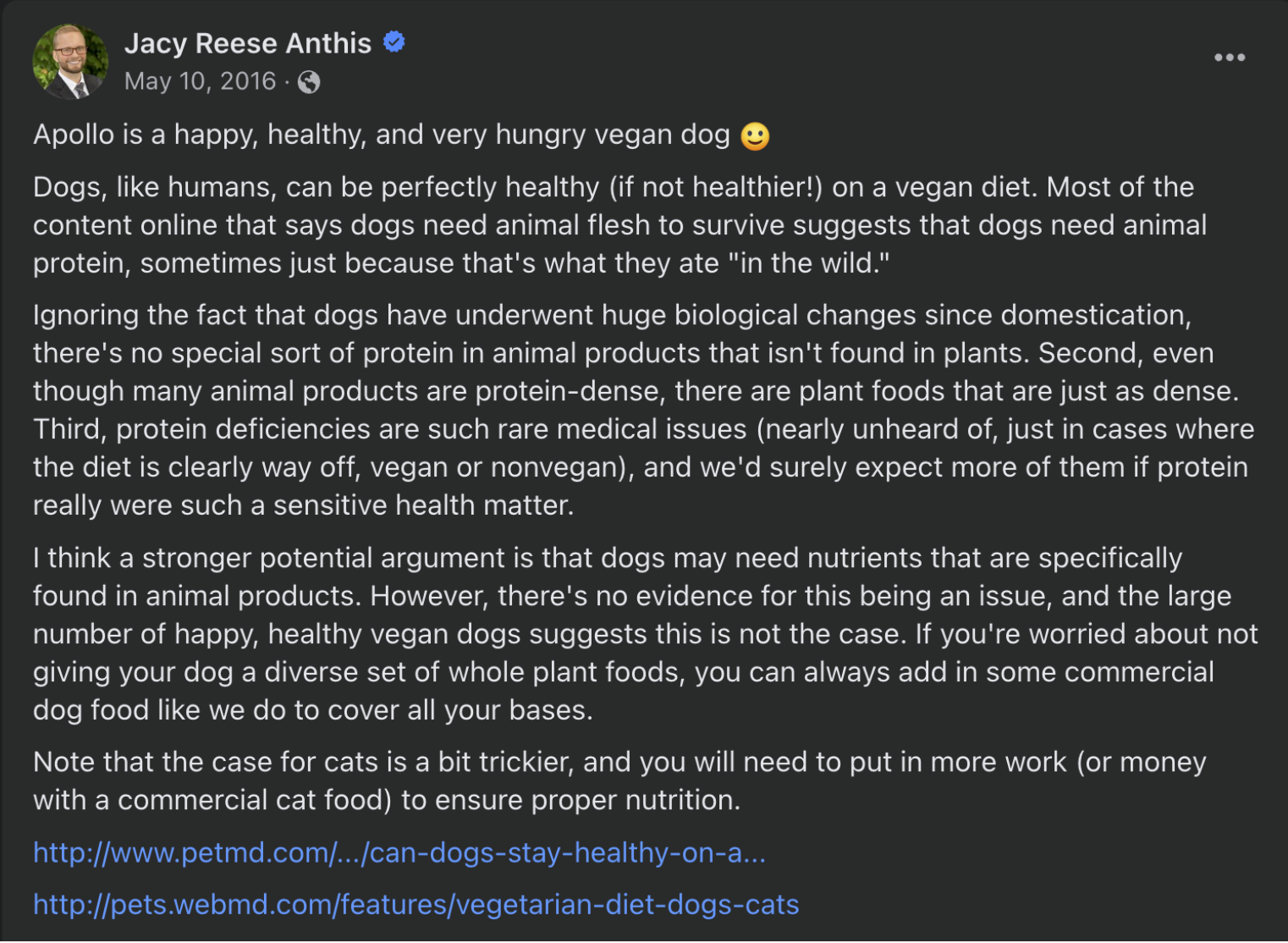
  • This Facebook post from Jacy Reese Anthis, saying vegan dogs and cats can be perfectly healthy. Jacy was a leader among animal EAs until he left for unrelated reasons in 2019. He cites two sources, one of which supports only a subset of his claims, and the other of which actively contradicts them.
      • Apologies for the tiny image, WordPress is awful. If you right-click>open in new tab it will load a larger version.
    • His first source does say veganism can work, in dogs, but says nothing about cats.
    • His second source cites one person who says her cat is fine on a vegan diet but she doesn’t tell vets about it. The veterinarians quoted say dogs can be vegetarian and even vegan with some work. The statement on cats is ambiguous: it might be condemning only vegan diets, or both vegan and vegetarian. It rules out even vegetarian diets for young or breeding animals.

      The piece ends with “When people tell me they want to feed [their pet] a vegan diet, I say, ‘Get a goat, get a rabbit”.
    • Normally I would consider a 7 year old Facebook off-limits, but Jacy has a blue check and spent years doing very aggressive vegan advocacy on other peoples’ walls, most of which he has since deleted, so I think this is fair game. 
  • There is a related problem of motte-and-baileying “one day we will be able to have no-trade-off vegan diets, thanks to emerging technologies” and “it’s currently possible with no trade offs right this second”, e.g.: “Repudiating what “obligate carnivore” means – Kindly, but stridently, we have to correct folks that obligate carnivore stems from observation, not a diet requirement. This outdated thinking ignores the fundamental understanding of biochemistry, nutrition, and metabolism, which has only developed since the initial carnivore classification.”
  • In Doing Good Better, EA leader Will MacAskill advocates for a vegan diet to alleviate animal suffering, without mentioning any trade-offs. In isolation I don’t think that would necessarily be the wrong choice; the book is clearly about moral philosophy and not a how-to guide. But it is pushing individuals to change their personal diet (as opposed to donating to vegan recruitment programs), so I think it should at least mention trade-offs.
    • Apologies for the tiny image, WordPress is awful. If you right-click>open in new tab it will load a larger version.
  • Animal-ethics.org name-checks “a balanced diet” but the vibe is strongly “veganism is extra health with no effort”:
    • “According to the Academy of Nutrition and Dietetics, a well-planned vegan diet is nutritionally adequate and appropriate for individuals during all stages of the life cycle, including pregnancy, lactation, infancy, childhood, and adolescence, and for athletes.1 Everyone should have a balanced diet to be healthy, not only vegans. In fact non-vegans may well have unbalanced diets which are not good for their health. In order to be healthy we don’t need to consume certain products, but certain nutrients. Vegans can ingest those nutrients without having to eat animal products.”
    • “Being vegan is easier than you may think. Finding vegan food and other alternative products and services that do not involve animal exploitation is increasingly easier. It is true that some people may experience a lack of support from their family or friends or may find it extra challenging to stop eating certain animal products. However, other people can help you with that, especially today, given that internet and social networks have made it possible to get information and help from many other people. It is important to identify the factors that may be hindering your transition to veganism and look for assistance and encouragement from other people.”
    • Do I need to consult a doctor or nutritionist before becoming vegan?
      While this can be useful, as in the case of a planned non-vegan diet, it is not necessary. A vegan diet is suitable for people of all ages and conditions. A vegan nutritionist may help plan custom menus to meet specific requirements – for instance, if you are an athlete or if you want to gain or lose a lot of weight as a vegan. It is always advised to consult a nutritionist regularly for a check-up. However, it is important to note that some nutritionists are biased and don’t know a lot about vegan nutrition. Note also that medical doctors are often not experts on nutrition.”
  • EA-Foundation says veganism requires “appropriate planning”, but that this is easy 
  • That Faunalytics vegan study, which I mostly loved, contains the following: “Former vegetarians/vegans were asked if they began to experience any of the following when they were eating a vegetarian/vegan diet: depression/anxiety, digestive problems, food allergies, low cholesterol, an eating disorder, thyroid problems, protein deficiency, B12 deficiency, calcium deficiency, iron deficiency, iodine deficiency, vitamin A deficiency, vitamin D deficiency, zinc deficiency. The findings show that: – 71% of former vegetarians/vegans experienced none of the above. It is quite noteworthy that such a small proportion of individuals experienced ill health.”
    • 29% isn’t small. You can argue that’s an overestimate, but they’re accepting the 29% number, and are saying it doesn’t matter. 

Why is this so hard to talk about?

This is probably the least important section. I’m including it mostly in the hope it lowers friction in the object-level conversation. 

The stakes are so high

Hardcore vegan advocates believe we are surrounded by mass torture and slaughter facilities killing thousands of beings every day. That’s the kind of crisis that makes it hard to do really nuanced math people may use to justify ignoring you. 

Vegans are sick of concern trolls

Vegans frequently have to deal with bad-faith interrogation of their choices (“wHxt ABuoT proTEIn?!?!”). I imagine this is infuriating, and I’ve worked really hard to set myself apart by things like investing hundreds of hours of my time, much of which was unpaid, and working to get vegans the nutrition they needed to stay healthy and vegan.

Typical minding/failure of imagination

People who find veganism easier are disproportionately likely to become and stay vegan. That’s what the word “easy” means. Then some of them assume their experiences are more representative than they are, and that people who report more difficulty are lying. 

E.g. this comment on an earlier post (not even by a vegan- he was a vegan’s partner) said “there is nothing special one needs to do to stay healthy [while eating vegan]” because “most processed products like oat milk, soy milk, impossible meat, beyond meat, daiya cheese are enriched with whatever supplements are needed”. Which I would describe as “all you need to do to stay healthy while vegan is eat fortified products”. That’s indeed pretty easy, and some people will do it without thinking. But it’s not nothing, especially when “no processed foods” is such a common restriction. Sure enough, Faunalytics found that veg*ns who quit were less likely (relative to current veg*ns) to eat fortified foods. 

That same person later left another comment, conceding this point and also that there were people the fortified foods didn’t work for. Which is great, but it belonged in the first comment.

Or this commenter, who couldn’t imagine a naive vegan until an ex-vegan described the total ignorance they and their entire college EA group operated under. 

Lies we tell omnivores

Ozy Brennan has a post “Lies to cis people”. They posit that trans advocates, faced with a hostile public, give a story of gender that is simplified (because most people won’t hear the nuance anyway), and prioritizes being treated well over conveying the most possible truth. The intention is that an actual trans person or deeply invested ally will go deeper into the culture and get a more nuanced view. This can lead to some conflict when a person tries to explore gender with only the official literature as their guide.

Similarly, “veganism requires no sacrifice on any front, for anyone” is a lie vegans tell current omnivores. I suspect the expectation, perhaps subconscious, is that once they convert to veganism they’ll hang around other vegans and pick up some recipes, know what tests to get, and hear recommendations for vegan vitamins without doing anything deliberately. The longer sentence would be “for most people veganism requires no sacrifice beyond occasional tests and vitamins, which is really not much work at all”. 

But this screws over new vegans who don’t end up in those subcultures. It’s especially bad if they’re surrounded by enough other vegans that it feels like they should get the knowledge, but the transmission was somehow cut off. I think this has happened with x-risk focused EA vegans, and two friends described a similar phenomenon in the straight-edge punk scene

Failure to hear distinctions, on both sides

I imagine many people do overestimate the sacrifice involved in becoming vegan. The tradeoff is often less than they think, especially once they get over the initial hump. If omnivores are literally unable to hear “well yes, but for most people only a bit”, it’s very tempting to tell them “not at all”. But this can lead even the average person to do less work than they should, and leaves vegans unable to recognize people for whom plant based diets are genuinely very difficult, if not impossible.

Conclusion

I think veganism comes with trade-offs, health is one of the axes, and that the health issues are often but not always solvable. This is orthogonal to the moral issue of animal suffering. If I’m right, animal EAs need to change their messaging around vegan diets, and start self-policing misinformation. If I’m wrong, I need to write some retractions and/or shut the hell up.

Discussions like this are really hard, and have gone poorly in the past. But I’m still hopeful, because animal EAs have exemplified some of the best parts of effective altruism, like taking weird ideas seriously, moral math, and checking to see if a program actually worked. I want that same epistemic rigor applied to nutrition, and I’m hopeful about what will happen if it is. 

Thanks to Patrick La Victoire and Raymond Arnold for long discussions and beta-reading, and Sam Cotrell for research assistance.

Product Endorsement: Food for sleep interruptions

Do you wake up before you want to and struggle with getting back to sleep when you do? One thing (out of many) that can cause this is low blood sugar*. If this is your issue, it is easily solved by eating high-fat, high-protein food.

My evidence on this is purely anecdotal; I learned this from r/adviceanimals in 2012, so the intellectual pedigree is weak. But I added ~one full sleep cycle to my night when I tried it, which lasted for years until I was forced to stop due to medication requiring an empty stomach (I now use ketone esters). A month ago my dad went from “3-5 hours/night, 3 hours awake, maybe more sleep after that” to “8-9 hours of near-continuous sleep, 1 night per fortnight a mere 6 hours” by keeping peanut butter by his bed. Downside: he’s now useless for testing the magic vibrating bracelet I’m so hyped about.

This is very easy to test. Keep some nuts by your bed; if you wake up, eat some. If you fall back asleep, congratulations on fixing your problem. There are more complicated things you can do with your evening diet to try and prevent early wake-ups entirely but I feel very muddled about these and don’t have good suggestions.

If you’re doing intermittent fasting, ketone esters (affiliate link) don’t work for many people but are great if you’re one of the lucky ones (I am), and ~don’t count as eating. MCT oils (affiliate link) work on the same principle and so may be an alternative, but I haven’t tested them personally.

I am not a doctor, anything with a real effect can hurt you, be careful not to choke or attract ants, etc. 

*It’s not clear to me if this is actually low blood sugar as measured glucose in your bloodstream, or naturopathic “low blood sugar”, meaning problems you fix by eating, but I don’t care. 

Playing with Faunalytics’ Vegan Attrition Data

I’ve been looking for data on nutrition-related health problems in vegans, and it has been hard going. By far the best I’ve found has been this 2014 survey from Faunalytics (a data science org focused on animal protection), which finds 29% of ex-vegans + vegetarians had health issues plausibly traced to veganism, but that study is still missing several factors I care about. I made up a model to see how those factors might affect the answer, and found the answer was “moderately, but not enough to change anyone’s plans”.

This is mostly intended for me to reference later, I expect most people to skip it.

I want to give Faunalytics a lot of credit here. They used a professional survey provider to poll a large number of people (11,399, although most of them wasted as they had never been veg*n), and AFAICT the survey was well designed for their goals. They were extremely forthcoming in sharing their raw data and provided some assistance in interpretation (although ultimately not enough to make it usable for me 😞 ). 

But even though they are the best I’ve found, the data is still pretty limited (~1100 ex-veg*ns), and the questions weren’t optimized for my inquiry.  I dislike that they combined vegans and vegetarians into a single category (which I label veg*nism here), but I think that was a very understandable combination of sample size issues and the fact that very few vegans don’t pass through vegetarianism. I can’t pull data out of thin air, but I can at least use guesstimate to get a range of how those factors might affect the answer.  So I made a model that linearly applied a number of factors I think are important. This is really crude, and some of the factors shouldn’t be linear, but it was a place to start. 

This is pretty informal. You could easily argue I missed important factors, or assigned the ones I made up the wrong value. I encourage you to make that argument in comments, or play with the model yourself. 

We’ll start with Faunalytics’ (page 6) raw number, which showed 29% of ex-veg*ns reported coming down with a problem plausibly attributed to their diet.  

But I care about all veg*ns, not just those who quit. In this sample, 16% of people who had ever tried veg*nism were still at it.  You could assume that set have never had health problems, or they would eventually hit the same 30%, or somewhere in between. Faunalytics showed current veg*ns tend to have been on the diet longer than the average time-to-quit of ex-veg*ns, and have better nutrition and supplementation, so “the same amount” seems much too high. I set it to 0 to 20% (log-normal distribution – so biased towards the low end).

[This still focuses on the number of self-identified vegans, not vegan-months or total animal products consumed over time, but that’s an even bigger can of worms]

How do we know diet was to blame for health issues? One easy way is to look at the percentage of people who got better when they resumed eating meat, which Faunalytics reports to be 80% improved within 3 months: I assume all of those were caused by veg*n diet. What about people still impaired after 3 months of resuming consumption of animal products? Probably some will get better later, some will never improve but the problem was still caused by veg*n diet, some have a problem veg*nism didn’t cause but will make worse (e.g. they developed a nut allergy and it made veg*nism too hard) and some have a completely unrelated problem that they are misattributing to veg*n diet. I guessed the diet-related proportion was 5-50% (of the 20% not responding in three months), with a normal distribution (so biased towards the average of that range).

Health is the most sympathetic reason to quit veg*nism, so we should expect people to overreport it. Except that the percentage of people who described themselves as quitting over health reasons (26%) was smaller than the percent who reported at least one health issue easily caused by veg*nism (29%), although higher than percent of people who developed those issues and then recovered within 3 months of resuming meat consumption (23%). I estimated the percentage of reported-health issues that were fake as 0-50%, with log-normal distribution. 

Survey organizers tend to get the results they want, and Faunalytics is an animal protection org. They outsourced the actual survey administration, which is helpful but not a total fix. I guessed that they biased results 0-50% too low, with a log-normal distribution.

I am most interested in people practicing a veg*n diet naively (meaning: they did zero research and thought into nutrition), but that 29% includes all knowledge and effort levels (although in practice current veg*ns were more likely to be eating well). I added a factor for “if naive”, and guessed the size of the impact if *everyone* was naive was between 0 and 100% (meaning, no-effect to double effect – 100% isn’t the top of the scale here), with a log-normal distribution.

People often identify as veg*n while consuming animal products, which improves their nutrition.  The first study I found said 50% of vegetarians admitted to eating meat while identifying as vegetarian – but that included people who ate meat even once, which isn’t necessarily enough to matter nutritionally. On the other hand, this is the kind of thing people are likely to underreport. I added a multiplier for that and guessed it to be an additional 10%-50%, with a log-normal distribution.

Not all issues caused by veg*nsim get diagnosed or properly traced to diet. I added a multiplier for that, +10% to 40%, with a log-normal distribution.

If you combine all my wild-ass guesses, you get…. 37% (0%-56%) of veg*ns eventually developing health issues from their diet. That’s already higher than Faunalytics’ 29%, but remember my denominator includes current veg*ns and theirs doesn’t. The comparable number, looking only at people who quit and assuming everyone who develops health issues quit over them, is 44%,which is 65% higher than Faunanalytic’s estimate. 

I’m especially interested in vegans (but not vegetarians) who enter the diet naively. I made up numbers for these as well, and ultimately got 95% (17%-100%) of naive vegans developing health issues. I know too many healthy (so far) naive vegans for that to seem right, so I changed my assumptions and got it down to 56% (3%-88%), which seems plausible if you use a strict definition of naive.

What does this mean? Primarily that I feel better about my intuition that Faunalytics is underestimating the extent of the problem, but because I already considered 30% a big deal there’s no qualitative shift in how I think about it.  If you have different intuitions, you test out them out in guesstimate.

Lessons learned from offering in-office nutritional testing

Introduction

I’ve talked previously about my concerns with nutritional deficiencies in effective altruists who go vegan for ethical reasons, especially those who don’t have a lot of contact with the broader vegan culture. No one else seemed very concerned, so I launched a tiny project to test people in this group and see if they were in fact deficient. This is a report on the latest phase of the project. 

To cut to the chase:

  • It was very easy to find lots of deficiencies, although due to a severely heterogenous sample and lack of a control group this doesn’t provide useful information about if veganism is at fault.
  • Finding these deficiencies probably leads to useful treatment, but not as much as I’d hoped.
  • There are still a lot of operational issues to work out. My guess is that the ideal would require more work (to encourage participants to act on their results) or less (by focusing on education but not providing testing). 
  • I am currently looking for a co-founder to properly investigate the impact of veganism on nutrition. 

My main question here was “is there low-hanging fruit in treating nutritional deficiencies in this group, and if so how do we pluck it?” An important part of that is “how prevalent are deficiencies?”, but I had substantially more uncertainty around “do people treat deficiencies you find?” and “does the treatment lead to improvements in anything we actually care about?” That prioritization (and budget issues) led the experimental design to focus on operational issues and outcomes, and deprioritized getting the kind of clean data that would let me compare vegan and non-vegan outcomes. Similarly this write-up is mostly focused on showing the problem exists at all and building metis of investigation and treatment, rather than estimating prevalence. 

Which is to say to to everyone planning on @ing me to complain about the sample size, heterogeneity, or mediocre statistics: you are right that this sample is not very informative about base rates of deficiencies in vegans or anyone else. If someone claimed it was, they would be committing an epistemic sin. However, this particular post is focused on “how much effort is it to get nutritional issues addressed, and is that effort worth it?”. Given that, any complaints about the terrible sampling will be considered to be offers of assistance in running the much larger study that could answer the prevalence question

Background 

(if you’ve read the previous posts, this will be review)

Last year I worked in a co-working space focused on existential risks, which is anything that might really end everything. Because x-risk is a popular topic within the effective altruism movement, many participants in the space were EAs. Another big topic within effective altruism is animal suffering, especially farmed animal suffering. This has led many EAs in the office to go vegan or at least vegetarian for ethical reasons, without making animals the focus of their lives. And when I asked them, many had put no thought into how to give up animal products in a healthy way.

Which of course would have been fine if they were eating well. My personal opinion is that most people’s optimal diet contains small amounts of animal products, but lots of people are eating suboptimally for lots of reasons and I don’t consider it my problem. But the number of fatigue and concentration issues were… I don’t actually know if they were high. I don’t know what baseline to compare them to. But it wasn’t low enough to reassure me. Neither did the way the vegans talked about nutrition, and in particular the fact that more than one person was doing keto vegan and still wasn’t investigating nutrition. 

None of this meant there was necessarily a problem, but I was suspicious. So I got a small grant to solve this with numbers. 

First I tried broad spectrum testing, which led me to identify iron deficiency as the main concern.

Then I did a short investigation into the actual costs of iron deficiency, which motivated a number of people to get tested, some of whom got in touch after the fact. 

In my last post I implied I was stopping the project, and wrote next steps as if someone else would be doing them. I ended up getting a follow on grant so pushed forward with round two on my own, which is what this post is about. 

Round 2 concrete steps

I followed the steps laid out in my previous post almost exactly.

  1. I brought in a company to draw blood from participants in the Lightcone office. This was expensive, probably 2-4x having people buy lab orders online, which is still more expensive than doctor-ordered tests with insurance.
    1. I say I brought them in – I in fact hired someone to handle the company and interface with participants. Aaron Silverbook was great, pretty much best case scenario for hiring a subcontractor, although still not as good as an invested co-founder.
  2. Based on previous results and nutritional folk wisdom my test priorities were ferritin (the best proxy for iron), B12, and Vitamin D. I threw in some other iron tests because they were very cheap.
  3. We had applicants fill out a form detailing their diet and any fatigue issues.
  4. Aaron picked 20 participants and made a schedule for testing them. Prioritization was: Fatigue issues > vegan > vegetarian > whoever happened to be in the office that day.
    1. This was my favorite part of having a contractor because scheduling involved some very intense math around prioritization and availability and from my perspective it was no work at all.
    2. Prioritizing people with fatigue issues probably made the immediate impact higher, and was useful for estimating the upper bound of possible impact, but ruined the sample for calculating base rates. It means I can’t really compare vegans vs. omnivores, because both were selected for having potentially-nutrition-caused problems. I had hoped to maybe compare vegans with fatigue to omnivores with fatigue, because the tired vegans had more nutritional issues that would be pretty suggestive, but ultimately didn’t have enough data to bother.
    3. I flat out didn’t have enough money to do a good study capable of establishing high confidence prevalence rates, even if that had been my primary goal. Putting aside sample size, good sampling requires getting representative participants, many of whom have no reason to get tested. They’re not intrinsically motivated, so you have to pay them to get tested. 
  5. The company comes into the office. There are a bunch of day-of headaches that Aaron handles beautifully and I am completely uninvolved with because he is good at his job.
  6. Results go out. Some participants received results over email, some were told to go to the company’s portal, some may never have gotten a notification at all. More on this in the Difficulties section.
  7. I ask Aaron to get results from participants to me, for analysis. This goes less well- I wasn’t sufficiently clear on what information I wanted in the form, and he’s gotten busy with other stuff and had less time to devote to my project, which has already gone longer than anticipated due to issues with the lab. Response rate is poor- we eventually get 13 people out of 20.
  8. I send out a second form asking for more information, and a bunch of emails harassing people to do both forms. Response rate continues to be poor, only 8 people this time. 
  9. 3 months after testing I followed up with the people with the worst scores to see if they had gotten treatment.

Project Difficulties

Other People’s Fault

I cannot say enough bad things about BayAreaPLS, the company we hired to come into the office and do testing.

First and most importantly, they just forgot to run the ferritin test for half the participants. They did the other tests, there was no reason to not do that one in particular, they just… didn’t. Their initial attempt to make up for this was an offer to not charge me for tests they didn’t do. I pushed back fairly hard and they agreed to some actual discounting. It’s been 2.5 months and they have yet to send me that follow-up invoice, which I guess is technically good for me but makes me feel worse overall.

Second, the results were hard to retrieve. Some participants never got results at all even after following the instructions, and I have no way to debug whose fault that is. Others didn’t bother to retrieve results because it was too hard. The happiest people were the ones who got their results over email, which is a HIPAA violation the company claims to have done by accident. Much like the lack of the second invoice, the emailed results are technically good for me but leave me more concerned about the company.

Even for people who did get results it took almost two weeks, which was not great for momentum.

Lastly the company used different deficiency thresholds for different people. They say this was based on sex and age, but they didn’t get that information from everyone (sounds like incompetence on their part), so some people got a list of thresholds. It ended up creating a moderate amount of confusion and friction, especially because I couldn’t tell what variation came from age/sex (which I mostly want to ignore) vs. the norms of a particular test (which I very much don’t). People are slow to act on results in general so the additional friction was quite costly. 

My Fault or Inherent Difficulties

Not all of these were literally caused by me, but they all fall under “my responsibility to anticipate and handle”.

I mentioned in my last post that some participants were kind of insistent on getting a lot of help from me, even after I explicitly told them something was outside my bailiwick and needed a doctor. I tried to fix that this time by hiring Aaron. That worked on that one issue, but made it harder to catch new problems. If the plan had been for people to directly show me their results and receive coaching I would have caught the missing test values much earlier. I’m not sure there is a way to have someone available enough to get all the relevant questions from participants without also having to deal with a bunch of irrelevant ones, including inappropriately persistent ones. The difference between the two just isn’t obvious with the knowledge most participants have, and emotions run so high around health stuff.

It’s hard to estimate the rate of acting on results because the people who don’t act are less likely to fill out the follow-up surveys, but my sense is it’s not good, and probably <50%. I also strongly suspect the rate of acting on results would have been higher if there had been in-person follow-up. 

The guidelines I sent participants emphasized vitamin D and ferritin because it didn’t occur to me anyone could see an anemia result on the page and not rush to treat it, but at least two people scored as anemic and, as of three months later, had not treated it. 

The lab obeyed HIPAA enough to only send results to participants, not directly to me, so I needed participants to forward them. Of 20 participants, 13 did so. Only 8 participated in the separate follow-up questionnaire (arguably my fault for asking for two separate forms, but there was good reason to ask for results quickly and do the follow-up a little later). 20 people with varying motivations for testing was never going to be strong evidence for anything systemic, but the low response rate makes it even harder to draw conclusions.

My emails to participants sometimes went to spam, possibly due to use of BCC, which was necessary to meet the privacy commitments I made in the application.

What were the total costs? 

As a ballpark:

  • ~$270 per participant (if they had done all the tests for everyone).
  • 0.5 hours per participant, including follow-up and the disruption to their schedule. If you want to be really conservative you could call this an hour to account for the disruption from transitions.
  • ~10 hours of Aaron’s time
  • ~20 hours of my time
  • $30 per deficient person for supplements (not covered by the study)

If you value everyone’s time roughly the same, that means that to break even we need to save one person 30 hours + ~$5700 (ignoring the information gained). 

If you want to complicate that math you can add any of: discount rate on time or money, exchange rate between ops time/my time/participant time, cost of unnecessary or counterproductive treatment, knowledge gained from this round can make the next round cheaper, the fact that most of my time went to a write-up that shouldn’t really be billed to participants, but a better program would have spent more time with participants.

Results and Benefits

Test Results

I should remind you here that the sample was a mix of 20 ethical EA vegans, vegetarians, people with fatigue issues, and people who happened to be in the office. Even a very large sample wouldn’t be perfectly predictive unless you had the exact same mix of participant types, and this sample was tiny. So the right way to look at these results is “is this enough to think there’s a problem?” and “did people do helpful things with the information?” not “at what exact rate does this population develop ferritin issues?”

With those caveats, here is the data from participants that reported back. I have ferritin results for 8 people and all other results for 13. 

  • 85% reported energy problems
  • 15% were honest-to-god anemic
  • 65% had low ferritin (30% clinically deficient) (none of the anemic people had ferritin tests done, so there is no overlap between this group and the anemics. There were non-anemic people without ferritin tests, so I assume this is a coincidence)
  • 60% had low vitamin D (15% clinically deficient)
  • A total of 80% had low scores in at least one of hemoglobin, ferritin, or vitamin D
  • 0% had low B12 (many were on supplements, but I haven’t correlated that with serum B12 levels because at this sample size and heterogeneity there is no point)

Some of the non-reporting was random due to the lab’s incompetence, but it’s not impossible unhealthy participants were more likely to report back. If you want to be extremely conservative and assume every missing value was A+ healthy, the results are still quite concerning: 

  • 10% anemic
  • 25% low-in-my-opinion ferritin, 10% clinically deficient (still no overlap with the anemics)
  • 35% low-in-my-opinion vitamin D, 10% clinically deficient
  • B12 is still great, good job everyone

I Lead This Horse To Water – You Won’t Believe What Happened Next

But finding results isn’t very meaningful if no one acts on them. Of the 8 people who filled out the follow-up survey, 75% changed either diet or supplements, and 1 additional person kept going with supplements they would otherwise have dropped. I assume this is overreporting because people who changed things are more likely to respond, but if you assume none of the nonresponders did anything that’s still 30% of people changing something.

Of the 5 who changed something and answered the relevant question, 40% said they thought they saw an improvement (~1 month after they received results). I don’t consider that particularly strong evidence in either direction- it can take time for deficiencies to heal, but it’s also easy to placebo yourself into seeing an improvement that isn’t there. The real test will be the six-month follow-up. 

Three months after testing I followed up with the two identified anemics to make sure they were getting treatment. Neither was, despite having health issues plausibly caused by anemia. They’ve both indicated vague plans to follow up now that I’ve pushed them on it. 

Is in-office testing worth it?

I believe this round of testing was better than not doing in-office testing, but there is a lot of room for improvement.

My absolute wild-ass-guess is that this saved between one and ten people (out of twenty participants) from anemia or a moderate iron deficiency, and this improved their life and productivity by 10% to 100% (mean around 20%). I acknowledge these are large ranges, but some problems are bigger than other problems. I’m ignoring vitamin D entirely here because I haven’t even attempted to quantify its value and its ardent fanclub has poisoned the literature.

Even in the worst case, a 5% chance at a 10% improvement is a big deal, so I think this was obviously worth it from a participant perspective. I think it’s a toss-up if it would be worth it for apparently healthy omnivores: my expected value for them is much lower, but people don’t always realize they’re operating at a deficit and catching them requires testing actually-healthy people as well.

I said above that we needed to save someone 30 hours + $6000 for the project to break even. Even one successfully treated anemic will blow that out of the water, so I don’t feel the need to do the more complicated math with discount rates and relative value of time, especially because any future round should either be less work or have a higher response rate.

Of course “break even” isn’t a very high bar. To go even further out on a limb: the median case of mild anemia easily costs someone two hours/day (source: had anemia one time).  This testing easily caught the anemia at least six months before it would otherwise have been caught (because everyone who was going to get tested on their own did so when I published my iron post).  That is, at a bare minimum, 360 hours someone otherwise wouldn’t have had. That’s a pretty great return rate for 40 hours (my time + Aaron’s time + participant time) +$6000.

Was the project overall worth it?

I would bet on yes, although a lot of information has yet to come in. 

I expect this project to have 6 lasting impacts:

  1. The treated health problems of participants.
  2. The secondary impact via participants’ work. 
  3. Public blog posts I write. My iron deficiency post, which motivated many people to get tested themselves, quite possibly more than received tests directly.
  4. Knowledge of how to do this more in the future. 
  5. Influence on Effective Altruism vegan culture.
  6. Animal suffering averted by making veganism more sustainable for participants.

#1 is what I calculated above, and think was already a sound success although not resounding.

#2 and #3 require making assessments of all individuals who received testing from the project or due to blog posts I wrote. That’s a combination of “vast amounts of missing information” and “judging individual merit” that makes it really uncomfortable to talk about in a public post. 

To be totally honest I’m on an “everything is bullshit” kick right now so deep in my soul I don’t think this paid off, but intellectually I think my standards are too high and this was a better project than average project in the space of existential risk. 

#4 and #5 depend on other people following up on this project. I absolutely believe they should, for all the other reasons but also because the return via #6 seems pretty good- health reasons are a common reason vegans go back to eating meat [It was hard to find a good source, but this shitty source says 26%. I’ll acknowledge that’s probably an overestimate, since health is the most virtuous reason to go back to eating meat.]

I can’t estimate #6 myself. I’m not familiar enough with vegan literature to sort good from bad here, and it wasn’t my main goal.

Then there are costs. The total grant was for a little less than $25k. I didn’t track my time very closely to avoid depressing myself, but my compensation is going to work out to a fraction of my normal hourly rate. If you count foregone client work you could argue the true cost was as high as $50k. 

My gut feeling is the project was straightforwardly worth it if you don’t track the foregone work. If you do, impact is dependent on having at least one of:

  • At least one of the impaired and successfully treated participants goes on to do high-impact work.
  • The iron post inspires at least 40 tests total, with a similar rate of finding and treating problems.
  • Follow-up projects exist and do good work. 
  • This work leads to more veganism, and you value that a lot. 

So can we blame veganism for the deficiencies?

This study doesn’t say anything one way or the other, which means I still think yes but you shouldn’t change your opinion based on the results. The sample is too small and skewed to compare deficiency rates in vegans and nonvegans. There were energetic omnivores with deficiencies and tired vegans with perfect scores so it’s clearly not deterministic. 

Next steps

I see three possible follow ups to this project:

Nutrition blogging

This is my default, although I don’t plan on writing many of these because there is only so much low hanging fruit and people have a very limited attention budget.  I have to be very judicious in what I suggest.

Mass testing to investigate deficiencies in effective altruism populations

Get the money to test a large enough representative sample, and run the tests with a proper control to actually estimate the cost of nutritional veganism. 

This is most useful if there are EA vegan leaders who won’t act on nutritional concerns now but would if the study demonstrated a problem. If this is you, I would love to talk to you about what you would consider sufficient to act on. 

Assuming the demand for this information is there, I still don’t think I want to run this project alone. First, it is a lot of work. Second…I know I said “assuming demand is there”, but I can’t picture a scenario where demand exists but no animal EAs consider this project worth working on. A collaborator would be both proof of investment and much better positioned than I am to get the information acted on. 

To that end, here is an ad for a co-founder. I will post it on this blog in a few days.

In office testing with real nutritional counseling

This can work, but only in a limited number of situations. You need a reason  (uninformed veganism, high fatigue rates) to suspect nutritional issues in lots of people sharing a space. There needs to be a reason people aren’t getting tested themselves that won’t also inhibit follow up (probably lack of money and existing relationship with a doctor). And even then it’s more of a hits-based model than a sure thing.  

My decision is easy because the office I was working out of closed, and in general I think most of the people in the bay area I would want to help have already been reached. The market is saturated for at least a year. There are other offices elsewhere in the world, and if you want to run this yourself I’m happy to act in an advisory capacity (especially if you share data), but it can’t really be an ongoing project in any one city. 

Conclusion

I finished most of this post planning on it being the end of my part of the project. I had hopes I would convince someone else to pick up the torch, and maybe even act as an advisor, but it seemed like the biggest problem was participant motivation, which I don’t feel equipped to solve. It was while I was writing this that I realized I wasn’t ready to let the broader issue of vegan nutrition go. I still believe the problem that offended my morals and epistemics is there and worth acting on.

But doing so is still very annoying, which is why I’m looking for someone to partner with on this. Someone who can handle the parts I’m bad at, point out where I’m wrong, and interface with the vegan EA community to get the results acted upon. If you’re interested, please reach out to elizabeth@acesounderglass.com.

Thank you to the Survival and Flourishg Fund for funding this research, and Lightcone Infrastructure for hosting the grant and testing. I inflicted this draft on a number of people but want to especially thank Gavin Bishop. Daniel Filan didn’t beta read this post but he did vegan-check my co-founder ad and suggest the title “I Lead This Horse To Water – You Won’t Believe What Happened Next”.

Product Endorsement: Apollo Neuro

Short version: This $310 vibrating bracelet dramatically improved my sleep and moderately improved my emotional regulation. The return policy is pretty liberal so if this seems at all appealing I recommend trying it, or one of the cheaper alternatives I haven’t investigated. Between now and Mothers’ Day they are $300. 

[note: the link I use here is an affiliate link that gives you a $40 discount and me a $50 Amazon gift card] 

EDIT 2023-06-07: they recently updated the Android app and it’s quite bad now. It stalls while loading, or connecting to the device, and I swear it’s sometimes playing the wrong program. It’s still easily worth it for me, but if you’re on the fence I would wait until the new app is polished.

Backstory

As a strong believer in luck-based medicine, I have a pretty liberal threshold for trying shit Facebook advertises to me. Most of it is crap, but every once in a while there is something amazing that justifies all the work and return fees. Previous purchases include resistance band clips that measure force applied, sleep-safe headphones that claimed to measure your HRV, and an infrared heat massage. But when I first looked at the Apollo Neuro’s website, it was too dumb even for me. The explanation for how it worked was a mix of absent and stupid, and the rush to provide scientific evidence was somehow worse than nothing. I only tried it because a friend raved about it. He had also thought it sounded deeply stupid and only bought it because his friend raved about it, and I can only assume she also thought it was stupid until someone raved about it to her, in a great circle of life. Now it is your turn to be told it sounds stupid but it works.

[For some people. My sample size is only three people.]

Benefits to me

My sleep improved a lot. I don’t have precise metrics for this because fitbit is stupid, but 1-3 times a week I wake up feeling drugged (positive valence) because my muscles are so relaxed. This never happened before the neuro unless I took actual drugs*. I also estimate my number of remembered wake-ups has been ~halved. 

The Neuro has about 8 hours of battery. When I started using it I always woke up with the battery drained, meaning I’d activated it repeatedly. I now wake up with it at 70-90% charge, partially because I wake up less and thus am not turning it back on, and partially because I use less intense vibration.

[*TBF I regularly take supplements for sleep, so what I really mean here is “unless I took more drugs than baseline”]

My emotional regulation improved as well. There were a number of stressful things I handled better than my baseline. Some of this is subjective, but there are a few things with obvious before-pictures. Most notably:

I have pretty bad medical anxiety, due most notably to dental malpratice leaving me with painful nerve damage, but also some other stuff. Last fall I had a doctor’s appointment on Friday, followed by friend’s child’s medical emergency on Saturday that, due to their newness to the country, I needed to be in charge for. I did it, but I was wrecked for at least a day afterwards, possibly more, and my partner had to put in a lot of emotional energy helping me recover. ~4 weeks into using the Apollo Neuro I had a dentist appointment in the afternoon, followed 8 hours later by a friend’s medical emergency requiring my attention and eventually a 3AM field trip to the ER for which I was the only available driver. I did have a little freak out once I was home, but I recovered to normal faster than I did from the incident in the fall despite that having been a less intense day with more help. 

I also found myself more decisively liking and disliking things, and noticing when things shifted. At parties the transition from “I’m enjoying this” to “I’m done” is clearer, without a lot of “maybe I should hold out and it will get better”. 

Mechanics

The website is stupid, so let me tell you how it really works. The Neuro is shaped like a watch with a large rectangular face. You can wear it around your wrist or ankle with a band, or clip it to clothes. When activated, it vibrates with oscillating intensity. There are 7 programs with varying oscillation patterns and durations: the wake-up program lasts five minutes with a short peak and shifts between off and on quickly, sleep spends longer in both phases and shifts between them much more slowly. Sleep is the longest program but also lowers intensity over time. You can configure the peak intensity but not duration or pattern, which I feel very oppressed by. 

You can change intensity, and pause and restart the last program from the watch, but to choose a program you need the smartphone app. It is impossible to use the watch without a smartphone, which is a serious quality of life issue for those of us with insomniac older relatives. 

The website talks about cumulative effects a lot, and is clearly pushing you to try for several weeks before judging it. There’s even some gamification for the first N hours. This felt to me exactly as necessary as a punch card from a heroin dealer. I loved it from the moment I put it on and found the little badges cheapening of my relationship with my device. But the cumulative effects part was true: as previously mentioned I needed less and less work from the Neuro to sleep, and lowered the intensity setting over time. When I first started most of the programs besides sleep and wake-up ran together, but at 6 weeks in I started really distinguishing the other programs and having strong preferences about which program, which changed over time. 

The website also advertises the Apollo for concentration problems, but I don’t know anyone who’s really tested that.

One thing I want to give the Apollo is that there is no subscription fee. You give them money and they give you the whole product and app. That should be standard but very much isn’t in the as-seen-on-FB crowd.

Cheaper Alternatives?

The Neuro is very expensive and seems like it can’t possibly cost that much to manufacture. For me paying them for the R+D was worth it. It would even have been worth a second one at the same inflated price, had my sleep not improved to the point I didn’t need it. 

Back when I thought I would need a second one to cover a full night of sleep I looked around for cheaper alternatives. None of them quite worked and I gave up when I no longer personally needed it, but if you’re motivated some might be worth checking out. 

The Senate works on a similar principle, but is no cheaper. Its programs are only 10 minutes, which is much too short for me. 

I tried a few sexual vibrators but even those with intermittent patterns transition from on to off much too quickly, which is how I figured out the gentle transition is so important. Presumably there are some that transition gently but I have no idea how to search for them. 

There are apps to vibrate your phone but they are mostly ad-ridden messes I couldn’t deal with. The one I managed to test had the same problem as the sexual vibrators. 

Products aimed at babies: these mostly run on external batteries, but they can be pretty cheap and many don’t require a smart phone. If you try any of these let me know because the alternative is teaching my elderly aunt to use a smart phone and I am not looking forward to it.

Conclusion

This product is very much in “immensely valuable to some people, price and quality of life issues limit its market for now”. If you have anxiety or sleep issues I seriously recommend trying it; the return fee looks to be about $20, although they’re less forthcoming than one might hope. If money is an issue or you’re just feeling curious you could also try the vibrating baby soothers. Amazon sells several and returns are usually free. 

If you do try the Apollo or any other product in the category I’d love to hear from you so I can share the information (please decide in your heart if you want to share your results before you try it, to avoid biasing the data). You can report your experience here

Thanks to my Patreon patrons for supporting this write up, and J for suggesting the Apollo to me in the first place.