Epistemic Spot Check: The Demon Under the Microscope (Thomas Hager)

Description

How much would it suck to be the guy who invented sulfa drugs? You dedicate your life to preventing a repeat of the horrors you saw in the war, succeed in that and so much more, and then 10 years later some idiot leaves a petri dish open and completely replaces you as the father of man’s triumph against bacteria.  Actually he left the lid off before you found your thing, but ignored the result until you hit it big because everyone knew you couldn’t fight disease with chemicals, until you proved you could.  It’s the ultimate silver medal.  The Demon Under the Microscope is the tale of that guy.

It’s by the same author (Thomas Hager) as The Alchemy of Air.  It’s also set in the same corporation, and about field that was transforming from science to industry.  The writing style is similar.  I originally didn’t intend to fact check this book very hard because I already knew what to expect from the author (a little too invested in the subject but basically accurate), but the habit is too ingrained at this point and I couldn’t keep reading until I’d checked out the first few chapters.

Evaluation

Claim: “Domagk [the researcher] had the ability to see. He watched everything, noted slight variations, quietly filed it all away.”  (p. 18).

The wounds themselves he accepted as the results of war. But the infections that followed—surely science could do something to stop those. He focused on the bacteria, his personal demons, “these terrible enemies of man that murder him maliciously and treacherously without giving him a chance.” “I swore before God and myself,” he later wrote, “to counter this destructive madness.”  (p. 20).

Who knows but it’s pretty.  Someone in the same position as thousands of others (in this case a WW1 medic), caring more , and going to fix it (via sulfa drugs) is my moral aesthetic.  Of course there could be another surgeon in the same place with just as much care and potential who got blow up or gassed.  The Alchemy of Air prioritized poetry over provability, so I don’t entirely trust this, but I like it.

Claim: Cholera was a big problem for German soldiers.

This would be a weird thing to make up, but I’m a little confused.  There had been a cholera vaccine for over 20 years by that point.

Claim: Gas gangrene is bad.

True.

Claim: Sir Almroth Wright created a typhoid vaccine that was deployed during WW1, saving may lives.  During WW1 he established a laboratory researching wound infections.

True.  He was also prescient enough to foresee the risk of drug-resistant bacteria.  Of course he also thought that bacteria were associated with but not the cause of disease, and that scurvy was caused by poorly preserved meat.  Being right is hard.

Claim: Doctors at the time thought that a dry wound was more resistant to infection; however dryness inhibited white blood cells and thus ultimately increased infections. They also thought wounds needed to be completely covered to prevent reinfection, but this created the ideal environment for anaerobic bacteria like Clostridium perfringens (which causes gas gangrene).

True. I was surprised to find ideal wound moistness still isn’t entirely settled, but the book’s description seems essentially in good faith.  Demon goes on to say that by the 1920s, doctors believed they were basically powerless and their job was to get the body’s own healing systems a pillow and some tea.  They took this so far that:

“A physician doing drug research was a physician taken away from patient care. There was an unsavory aspect to a physician’s developing a drug for money. There were ethical questions about testing drugs on patients. Developing new drug therapies smacked of a return to the discredited age of bleedings and purgings.”

To repeat: researching new treatments was considered distasteful at best and morally outrageous at worst.  And brain differentiation was once considered phrenology redux.  I just don’t think we’re very good at seeing where medicine is going (p40).

Claim: Section on Leeuwenhoek. 

True but missing time data.  Given that everything discussed so far happened in the range of 1890-1920, I would have have explicitly mentioned I was going 250 years into the past.  As it was, the only reason I noticed was that I recognized some of the names on the list of Leeuwenhoek’s contemporaries. The kindle edition may have made this worse.   But everything Hager actually says on Leeuwenhoek’s work in inventing the microscope seems accurate.

Claim: [crickets] (no page)

There’s no false statements, but I found the absence of discussion of the 1918 Spanish Flu epidemic puzzling.  Demon’s narrative is that seeing the horror of infected wounds in World War 1 drove Domangk to dedicate his life to preventing them.  Spanish Flu killed 5% of the entire world over the course of three years, and had a massive effect on troop movements and training in WW1.  From a military perspective it might have been more important.  We know now that the flu is really hard to vaccinate against, but at the time they didn’t even know it was a virus.  If you were a motivated medic looking for something to care about, Spanish Flu was a really obvious choice.  Demon mentions Spanish Flu in passing but not as an influence on Domangk, and that feels incomplete to me. Why gangrene in particular, when there were so many horrors happening at the time?

Claim: Streptococcus is the cause of everything bad.

True.  I knew it was possible to die from a scratch, but reading about everything strep causes really made me appreciate how few technological innovations are between us humans and mass die offs.  Strep causes childbed fever, St. Anthony’s Fire, meningitis, scarlet fever, pink eye, necrotizing fasciitis… Strep is the cockroach of human-infecting bacteria.  And for a while, all we had to do was take a pill and it was completely harmless.

Of course now we have MRSA (Methicillin-resistant Staphylococcus aureus) (whose natural habitat is the hospital, just like strep).  And multiply resistant gonorrhea.  And tuberculosis resistant to most known antibiotics.  The bad old days are on our heels, is what I’m saying.

One weird thing is I finished this book with the vague impression that sulfa drugs had saved a lot of lives but not actually knowing how many.  This article estimates that sulfa drugs led to a 2-3% drop in overall mortality, which translated to a 0.4-0.7 year increase in life expectancy.  That only covers up until 1943: presumably it had a bigger impact as distribution increased, or at least would have if penicillin had not taken over.

Overall Verdict

Pretty good, with some oversights.  Like Alchemy of Air the beginning is the best part, and if you find your attention flagging I’d just let it go.  I found the subject matter more innately interesting than Alchemy of Air but the writing a little less so.  Demon spends less time on the personal lives of the scientists, which was a selling point for my roommate but a disappointment for me.

This post supported by Patreon.

Dreamland: bad organic chemistry edition

I am in the middle of a post on Dreamland (Sam Quinones) and how it is so wrong, but honestly I don’t think I can wait that long so here’s an easily encapsulated teaser.

On page 39 Quinones says “Most drugs are easily reduced to water-soluble glucose…Alone in nature, the morphine molecule rebelled.”  I am reasonably certain that is horseshit.  Glucose contains three kinds of atoms- carbon, oxygen, and hydrogen.  The big three of organic chemicals.  Your body is incapable of atomic fusion, so the atoms it starts with are the atoms it ends up with, it can only rearrange them into different molecules.  Morphine is carbon, oxygen, hydrogen, and nitrogen, and that nitrogen has to go somewhere, so I guess technically you can’t reform it into just sugar.  But lots of other medications have non-big-3 atoms too (although, full disclosure, when I spot checked there was a lot less variety than I expected).

This valorization of morphine as the indigestible molecule is equally bizarre.  Morphine has a half-life of 2-3 hours (meaning that if you have N morphine in your body to start with, 2-3 hours later you will have N/2).  In fact that’s one of the things that makes it so addictive- you get a large spike, tied tightly it with the act of ingestion, and then it goes away quickly, without giving your body time to adjust.  Persistence is the opposite of morphine’s problem.

This is so unbelievably wrong I would normally assume the author meant something entirely different and I was misreading.  I’d love to check this, but the book cites no sources, and the online bibliography doesn’t discuss this particular factoid.  I am also angry at the book for being terrible in general, so it gets no charity here.

Georgia Bill SB 81

Georgia recently tried to restrict schedule II-and-higher prescription drugs (schedule I is already illegal to prescribe).  The internet reported this as “requiring ADHD patients to get a new prescription every five days” and yelled a lot because you are literally requiring extensive logistical work to treat a medical condition defined as being bad at planning and follow through (not to mention the money).  Georgia made some changes, which were reported as “ADHD prescription rule removed from bill, restrictions now focus on opioids”.

Reading the text of the bill (unclear if this is the draft either news article was talking about), neither of these appear to be accurate.  The bill doesn’t actually ban longer prescriptions, just leaves open the option to sue providers if they don’t either check a statewide database of prescriptions, or give a restricted supply.  Even then the 5 day rule only applied to the first prescription for adults (although every prescription for children) (line 275).  If you think the government should be in the business of restricting access to certain drugs in the first place (which I don’t), requiring doctors to make sure you don’t already have a prescription seems totally reasonable.  And they explicitly said prescribers should prescribe whatever was in the patients’ best interests, they just needed to note the justification for a new prescription of longer than 5 days.

Well, kind of.  The full text is “Nothing in this paragraph shall limit a prescriber who, in his or her professional 289 medical judgment, determines that more than a five-day supply of a Schedule II, III, IV, 290 or V controlled substance is medically necessary for palliative care or to treat a patient’s 291 acute medical condition, chronic pain, or pain associated with a cancer diagnosis.” (line 288).  This leaves out anyone with a chronic condition that isn’t pain that requires scheduled drugs.  This includes ADHD, but also sleep disorders, anxiety requiring benzodiazepines, epilepsy, being a trans man, and diarrhea.

[Controlling anti-diarrhea drugs is not quite as insane as it sounds, if you believe the government has a role restricting mind-altering substances.  Your gut and brain use a lot of the same neurotransmitters, so anything that affects your gut neurology and can get passed the blood-brain barrier will affect the brain as well.]

I would be surprised if the Georgia state legislature did this deliberately to hurt people with Irritable Bowel Syndrome.  My best guess is someone basically forgot that there are scheduled drugs besides opioids, and used the terms interchangeably in the bill.  Which actually concerns me much more, because it means the bill was written by someone who doesn’t understand medicine very well.


Life Imitates Coloring Books

Apparently real life is not like Trauma Center and tumors don’t come with fun perforated lines showing you where to cut.

I was shocked too
I was shocked too

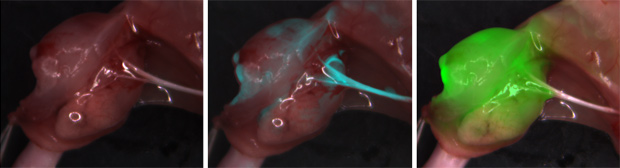
Real cancer looks almost identical to the tissue that spawned it, which makes it easy to cut too much or too little.  Luckily, science is on it.  Here is a TED talk by Tal Danino about releasing bacteria that can only live in tumors, and fluoresce when they reach a certain density:

This is meant as a diagnostic tool.  But once you know cancer is there, separating it from the tissue is still an issue.  For that I direct you to Quyen Nguyen’s work with florescent stains.  Her lab produces a variety of stains in different colors which stain different tissues (she demos on cancer and nerves) to show surgeons what to and not to cut

neonnerves

Status Through Disbelief

Reading The Remedy, or really anything about the time after formalized western medicine but before the germ theory of disease, is an exercise in terror or frustration.  How could anyone think attending a childbirth with autopsy gunk on your hands was a good idea?  Or leaches.  Who looked at those and said “I’ll bet those will make people healthier”?

My first reaction reading The Colony, about a Hawaiian leper colony founded shortly after the germ theory became entrenched, was “oh no doctors, you overapplied the lesson.”  Leprosy has an epidemiology a lot like tuberuclosis: long periods between infection and symptoms, and an ease of spreading that means everyone is constantly exposed to it.  This makes it look like an inborn condition, not a contagion.  Leprosy and TB are actually pretty closely related too.  I assumed that doctors looked at their failure with TB and overcorrected.  It didn’t work because only a small fraction of people are suspectible, and (it’s implied although never stated outright) they will be exposed to it whether symptomatic patients are quarantined or not.

Then I remembered that shunning lepers* predates germ theory by a couple of thousand years.   Ancient and medieval people were completely capable of identifying disease as contagious and instituting a separation.  So why didn’t industrial-age doctors?

Then I remembered that while the peasantry considered it obvious that disease was contagious and should be shunned, they considered it equally obvious that leprosy was punishment from God for sin and the black plague could be avoided by killing Satan’s minions, the cats.  Nobody talks about all the things everyone knew that doctors correctly disbelieved in.

Without a lot of proof, I strongly suspect that doctors signaled intellectual rigor and membership in the medical class by disbelieving things the peasantry believed.  Believing things the peasantry does believe doesn’t signal either of those things even if the belief is correct.  No one gets credit for believing eating food is good and eating Belladonna is bad.  If you’re not very careful in that environment, it’s easy for peasants’ belief in something to become evidence against it.

This is similar to the process of the toxoplasma of rage, in which people signal membership in an ingroup by loudly believing its most dubious claims.  I also highly suspect it’s what’s going on with dietary constraint and toxins.  It is obviously true that what you eat matters, some things you put in your body will damage your cells, getting rid of them is good, and there are things you can take to get rid of them.  It’s called heavy metal poisoning and chelation.  Or if you’re Huey the dopamine dog, chocolate and activated charcoal.  But dietary constraints and belief that specific things were bad for you got associated with special snowflakenes, so you can signal intellectual rigor by dismissing them.  This despite the fact that nutrition obviously makes a difference in your health, that humans vary across many dimensions and there’s no reason to assume they wouldn’t vary across digestion and nutritional needs.  Likewise things we put in our mouth obvious have the capacity to hurt us and there’s no reason to assume we have an exhaustive list of those, or that they’re identical across all humans.

In D&D terms: people are advertising their will save bonus by how credible an idea they can disbelieve.  No one wants to be this guy:


[Thor rushes Loki, only to run through the illusion and trap himself in the cage]

Disbelieving everything is an easy way to be right most the vast majority of the time.  For every correct idea that’s an almost infinite number of wrong ones, and even those that are true are incomplete (see: physics, Newtonian).  But if everyone disbelieves everything, we will never discover anything new.

I’m not in a position to criticize anyone for being frustrated at people for being wrong.  I lived that life for a long time.   But I try to counter it now by remembering that humans aren’t really capable of distinguishing “laughably wrong” from “correct, and world changing” without investing a lot of energy.  If there aren’t negative externalities and they’re not asking anything from me, their investment  in their crackpot idea is something like an insurance policy for me, or a lottery ticket.  Most won’t pay off, but when they do I’ll be glad they were there.

“Minimal negative externalities” and “at no cost to me” are important caveats.  Children need vaccinations, and I don’t want the government paying for medicinal prayer.  But if a functional, taxpaying citizen wants to spend their own money to get their chakras realigned every six months?  Yelling at them seems like a waste of energy.  Hell, they may have a genetic variation that enhances the placebo effect to the point it is medically significant.  The human brain is weird and we don’t even know what all the pieces are, much less how they work.  If someone investigates something that’s a positive for me, even if all they do is conclusively prove it doesn’t work.

chakras

You can believe people are wrong, you don’t have to accept all ideas as equally valid.  But what I would suggest, and what I’m attempting to do myself, is to make the amount of energy you put into your disbelief proportional to the harm the idea causes, not its wrongness.  To have wrong ideas drop out of sight, resurfacing only if they cause problems or turn out to be a winning lottery ticket.   I think that on net this leads to a better world, and in the meantime I’m calmer and less annoyed.

*Which really means shunning anyone with skin discoloration, ancient people not being entirely up on their bacteriology.

Heart Rate Variability

Heart Rate Variability is one of those things that has such an obvious meaning I feel dumb asking follow up questions, but is consistently used in ways that confuse me.  It sounds a lot like arrhythmia, which is bad, but The Willpower Instinct consistently refers to it as good.  Plus it refers to it changing in ways that must be measured instantaneously, but changes in variability have to be measured over time, right?

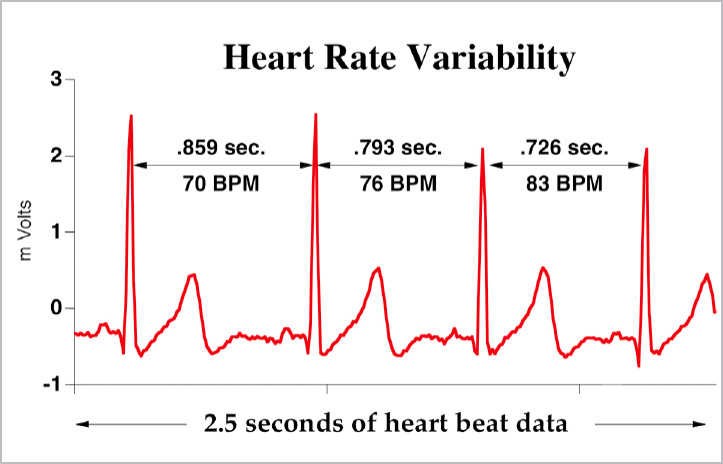
Here is what I have figured out: we (I) think of the heart as beating to A Rhythm, which is your BPM.  The rhythm can speed up or slow down, but it’s still a rhythm.  A deviation from that is an arrhythmia, which is Bad.  We (I) think this because the wikipedia article on sinus rhythm basically says it, and because the article on HRV implies it’s measured in five minute increments over 24 hours, which means it’s basically a measure of range.  But at least some of the time HRV refers to beat-to-beat variation, and it’s being measured in response to an immediate stimulus (although, maddeningly, no one specifies the time period).

HRV_300
four heart beats, separated by .859, .793, and .726 seconds.

Your parasympathetic (relaxed/restorative) nervous system sends signals to your heart to decrease your heart rate.  Your sympathetic (fight/flight/freeze) system sends signals to increase it.  High parasympathetic activity also seems to be associated with high variability, at least to a point.  My personal guess is that high variability indicates both systems are operating and interacting, while low variability indicates one has taken over, and that your body is somewhat biased towards a higher rate, so it takes a bigger push from the parasympathetic to get the rate down.  Having one system dominate is not always bad: when you are running from a tiger, your heart should beat as fast as possible and redirect blood from digestion and immune system to muscles.  And when you are truly safe, the parasympathetic tells your body it can safely pay off it’s technical debt.  But often having both, and being able to switch between the two, is useful.

There’s  a lot of data showing high heart rate variability is increased by known Good Things (meditation, exercise), and low HRV is associated with bad things (alcoholism, PTSD), but I don’t see hard enough data on causality that I’m confident of the direction.

Motion Sickness

The typical explanation for motion sickness is that your inner ear and your eyes disagree about whether or not you are moving, your body interprets it as food poisoning, and prepares to throw up.  This does not quite make sense to me, because it fails to explain any of the following:

  1. Why being a passenger is so much worse than being the driver.
  2. Why playing video games (eyes say movement, ears say stationary), reading in a bus (eyes say stationary, ears say moving) and riding a roller coaster (eyes and ears both say moving very fast)  produce the same feeling.
  3. Why smooth rides (subways, no-turbulence airplanes) are so much easier than busses, or why highways are easier than stop and go traffic.
  4. Apparently other people consider nausea a stomach issue, but for me it’s very much a head issue.  Motion sickness also gives me headaches.  What’s up with that?  Why is it so tightly correlated with sinus pressure?
  5. Why does low blood sugar feel so much like motion sickness?
  6. I’ve never experienced this, but television assures me heavy drinking produces the same effect.  Why?
  7.  Why does motion sickness give me temperature fluctuations.

I’ve heard a partial explanation for #3, which is that your inner ear actually senses acceleration, not movement, so a steady velocity doesn’t feel like movement.  And we have a very compelling proximal explanation for #6: the difference in density between water and alcohol stimulates your inner ear both as you get drunk and as you sober up.  So obviously the inner ear is very involved in this, but how?

Alternate hypothesis: motion sickness is designed to keep you from eating, because your body is not in a good state to digest. One way that can happen is if your sympathetic nervous system (responsible for fight-or-flight-or-stand-there-being-really-anxious) has kicked in, because it redirects blood flow and energy to things that are immediately useful in escaping from tigers (muscles, senses) and away from things that solve future you problems like digestion and the immune system (which are regulated by the parasympathetic nervous system).

Both the sympathetic and parasympathetic systems are regulated by the hypothalamus.  For fun I googled “hypothalamus motion sickness” and the first result was this rat based study,* which put rats in a “animal centrifuge” to induce motion sickness. I couldn’t find video of a rat centrifuge, but NASA helpfully provided video of a dog centrifuge.  It looks not quite as bad as a tilt a whirl, although the rats were exposed to double gravity so I should probably cut them some slack.

During their amusement park adventures, the rats experienced a spike in histamine production in the hypothalamus (how cool is it that we can continuously measure that?), and caused the rats to display characteristic motion sick rat behavior.  Inhibiting histamine production or removing the inner ear (the part that detects motion) caused both of these to disappear.  Histamines also help regulate body temperature, so that’s #7.  This suggests that anti-histamines would be useful at fighting motion sickness.  The good news is that this is correct, the bad news is that they make you sleepy and possibly give you Alzheimer’s.   That’s fine for any one time but I don’t want to make a lifestyle out of taking them.

A website my laptop unfortunately ate the link to has a subtly different explanation:  your brain tracks motor movement via an efference copy, creates a prediction of what sensory changes that should create, and they compares that to the actual sensory input.  Motion sickness might be your brain saying “these are too different, abort, abort”, or buckling from the intensity of calculation needed to reconcile the input.

I have always wondered why I/people hold my (our) breath during times of stress.  Unless you’re being hunted by a xenomorph right that second, oxygen deprivation is not helpful.

An artist's rendering of when holding your breath is useful
An artist’s rendering of when holding your breath might be useful

The most convincing hypothesis I’ve found is that your brain can only do so many calculations per second, compensating for breathing takes calculation, so you stop breathing.  That this rapidly starves your brain of oxygen, lowering the number of calculations you can do, is exactly the kind of long term thinking I expect from the human body which, lest we forget, takes in air and food through the same hole.  If both breath-holding and nausea can be caused calculation overload, we would expect the same things to cause them both. I can think of two things that do exactly this off the top of my head- sparring (but not drills) in martial arts, and playing Katamari, both of which involve complex spatial reasoning.  These are not great examples because there’s a lot of confounding variables, like extreme physical exertion while being hit in the stomach.

To summarize my speculation:  sensory input requiring too high a rate of calculation points you towards your sympathetic nervous system, which makes you nauseous so you won’t eat while you’re not capable of digesting.

This suggests that anything that kicks you towards the parasympathetic system should reduce motion sickness.  Unfortunately the parasympathetic and sympathetic systems run on the same neurotransmitters, so looking at the relevant drugs does not provide useful information.

This also suggests that anything that lowers the number of calculations you need to do will be helpful.  BCMC tested a heads up display that showed users their head position relative to the horizon.

Studies found it overwhelmingly helpful, although I haven’t dug into that paper in detail yet.  Unfortunately there’s no way to purchase the technology, so I’m left hoping someone picks up the patent.

In conclusion: we don’t really know what causes motion sickness and that there’s no known really good treatmen.  I am going to experiment with consciously tracking my head position relative to horizon and with rhythm games (which help integrate sensory data).

*The second result appears to be the exact same experiment, done 10 years earlier, with the exact same result.  It’s nice to see something reproducible.

Xylitol for sinusitis

I’m taking on sinus inflammation because it’s a major contributor to my motion sickness, which is a major contributor to making commuting suck, and commuting is one of very few things that can actually depress your hedonic set point (psychologist talk for “make you miserable”).  My doctor has suggested xylitol nasal spray, which she claims inhibits irritation in the sinus cavities.  Quick googleing reveals it’s also considered useful for bacterial plagues on the teeth and in the arteries.  Let’s dig in.

Xylitol’s main claim to fame is as a calorie-less sweetener in humans. The claim is that it kills (many but not all strains of) bacteria via the same mechanism:  it can’t be converted into energy, so the bacteria starve to death.  This has to be to be missing a step.  Bacteria are surrounded by billions of molecules they can’t digest all the time, and they survive that.  If xylitol is to have an affect it must not only be indigestible, but inhibit digestion of actual sugar.  Off the top of my head there’s two ways that could happen.  In the human body, sugar is moved around by the blood.  If xylitol takes a sucrose molecule’s ticket to a particular area, there will be less sugar there for bacteria to eat.  The downside of this is that you might starve out your own cells.  Another option is that bacteria cells themselves become confused by xylitol.  The ideal would be if xylitol fit into a sugar receptor but couldn’t be taken into the cell, so the receptor was blocked indefinitely.  Or if it was taken in it could trigger a “yup, we got a sugar” reaction that caused the cell to take in sugar later, but I’m not sure why a bacteria would ever turn down calories.

I found a lot of studies on xylitol and dental use.  Most of what I learned is that dental abstracts are more like teasers than summaries, not cluttering up the space with numbers or sometimes even conclusions.  Overall there seems to be a mild consensus for xylitol mildly inhibiting cavities, although it’s certainly not a substitute for fluoride.  Also I totally should have been chewing xylitol while I was recovering from surgery, since is almost certainly disrupts oral plaques, although I worry about what it would do to the intestinal biome.

What about sinuses?  I found a lot of very small studies, but 5 studies of size n are not equivalent to one study of size 5n.  You don’t know how many more studies of size n were done but not published.

This study and this one found decreases in medical severity (as measured by the SNOT-20 score.  Yes that’s it’s real name), but not self-reported pain (as measured by the less well named VAS score).  This study in rabbits was well controlled (if small) and found significant decreases in bacteria.

rabbit
Rabbits self-reported pain scores were ambiguous

This study found that a nasal decongestant spray worked better than xylitol or saline spray, which worked about equally as well.  Nontheless it’s conclusion was that [name brand of xylitol spray] was an effective treatment for nasal congestion.  It also spelled spray with an ‘e’ .  Twice.

One interpretation of these results is xylitol helps impedes infection but irritates the sinuses such that there’s no change in pain levels.  Another is that people are really good at suppressing conscious knowledge of pain.  My experience has been I’m really good at suppressing moment-to-moment awareness of pain but I do notice when asked (which is how I went weeks without treating my dental neuralgia, and then suddenly noticed I was at 8 on the pain scale), and that the pain has a great deal of effect on my behavior and happiness whether I acknowledge it or not.   And if I keep using xylitol I need to change my brand to one that, when it buys positive press in a supposedly objective forum, spells its own name correctly.

Review: The Remedy: Robert Koch, Arthur Conan Doyle, and the Quest to Cure Tuberculosis (Thomas Goetz)

I love this book so much I gave it to my cats to cuddle, which would have made a more impressive visual if I hadn't gotten the kindle version.
I love this book so much I gave it to my cats to cuddle, which would have made a more impressive visual if I hadn’t gotten the kindle version.

I don’t even know where to start.  This book was fun to read and I felt like I learned a lot.  It covered both the specific facts of Robert Koch’s quest to prove germ theory and cure tuberculosis, and provided a good general sense of how science and medicine move forward and don’t.

A couple of specifically interesting points: doctors fought germ theory tooth and nail.  They also rejected stethoscopes as technological interlopers to be disposed of because they threatened the doctors importance, while using so many leaches prosperous countries had to import them.  The naive interpretation is “doctors are idiots, their reluctant to use quantified self data is proof they haven’t changed.”  This is the first time I’ve seen any hint as to why they found germ theory so implausible.  In the particular case of tuberculosis, everyone was exposed all the time, and it took the infection years to become symptomatic.  Preventing any one exposure wouldn’t have had noticeable results.  Another early-identified bacteria was Anthrax, which didn’t follow a typical exposure pattern either.  The doctors still come out looking pretty bad for refusing to wash their hands between autopsies and childbirth, but marginally less than they might have.

I knew this already, but it was good to have a reminder that the first person to suggest the germ theory of disease, Ignez Summelweis, died in an insane asylum.  This either means that people with truly visionary ideas can be broken when we reject them, or germ theory was so crazy it took a crazy person to see it.  Goetz doesn’t mention it but according to my dad Summelweis was also an asshole, which I try to remind myself every time someone mean says something I disagree with.

Remember last week when I suggested using microchips to force people to finish their antibiotics?  Several friends seriously questioned the effect of that, since they didn’t estimate the contribution of unfinished antibiotics to antibiotic resistance as very high.  The Remedy says that the current protocol for drug resistant TB is to have a medic visit a patient every day for 6 -24 months to observe them taking their pills, because drug resistant TB is that big a problem and the pills are that unpleasant.  So at least in that situation swallowable microchips would be an enormous improvement.

Apparently syphilis is always the [nationality] disease, where the nationality is not the speaker’s.  French is the most popular, but far from the only

I’ve always found the methods section the most boring of any paper or textbook.  I want to know what we learned, not how.  But The Remedy (and to a lesser extent Neanderthal Man, which I reviewed last week) made it seem interesting.  I’m still not terribly interested in microscopy, but it was deeply interesting to see how advances in technology enabled scientific advances.  Using or inventing new technology is how you move the world forward.  And when I thought about it, the modern field that most reminds me of the wide-open-ness of microbiology in the mid 1800s is programming.  That is where I get the most sense of possibility.  I still really care about translational health (in fact this book taught me that that is the word for what I am trying to do with this blog) and mental health, but I am feeling more and more like staying in programming would be the best way to accomplish that.

The Science of Blood Types

Yesterday I made an offhand remark that the Red Cross was so persistent in stalking me because I was O-.  Here’s why that’s important:

Your red blood cells can have two different proteins on them (A or B), or both, or neither.  If you receive a transfusion with red blood cells with a protein you don’t have, your immune system will mark it as a foreign invader and attack it.  If you get too much of these cells, you will die.  Parallel to this is another protein Rh factor, which you either have (Rh+) or you don’t (Rh-).  A- means you have A proteins, but not B or Rh factor.  If you are Rh- and receive Rh+ red blood cells, same problem.

foxindogs
You cannot bluff the immune sytem.

O- red blood cells have no immune-triggering proteins on it, and so can be given to anyone.  That makes O- blood extremely useful when you don’t have time to type a patient, or have limited carrying capacity.  Moreover, O- red blood cells are the only type O- patients can accept.  So O- is often the first to run out.

You might think this makes donations from AB+ people pointless, but that is not the case.  Their red blood cells are of limited use, but their blood plasma (which is the part that contains the antigens that trigger attacks on foreign matter) contains no antigens to any blood type.  Meanwhile everything looks like an invader to my O- plasma, and it will react accordingly.  This also means you can only do whole blood donations between complete type matches.  A B+ person can take my red blood cells, but would need plasma from someone else.

And that is why typed-matched blood is preferred and donations of all types are necessary.