I was approached by a client to research the concept of 20% time for engineers, and they graciously agreed to let me share my results. Because this work was tailored to the needs of a specific client, it may have gaps or assumptions that make it a bad 101 post, but in the expectation that it is more useful than not publishing at all, I would like to share it (with client permission).
Side project time, popularized as 20% time at Google, is a policy that allows employees to spend a set percentage of their time on a project of their choice, rather than one directed by management. In practice this can mean a lot of different things, ranging from “spend 20% of your time on whatever you want” to “sure, spend all the free time you want generating more IP for us, as long as your main project is completely unaffected” (often referred to as 120% time) to “theoretically you’re free to do whatever, but we’ve imposed so many restrictions that this means nothing”. I did a 4-hour survey to get a sense of what implementations were available and how they felt for workers.
A frustration here is that almost all of what I could find via Google searches were puff-pieces, anti-puff-pieces, and employees complaining on social media (and one academic article). The single best article I found came not through a Google search, but because I played D&D with the author 15 years ago and she saw me talking about this on Facebook. She can’t be the only one writing about 20% time in a thoughtful way and I’m mad that that writing has been crowded out by work that is, at best, repetitive, and at worst actively misleading.
There are enough anecdotal reports that I believe 20% time exists and is used to good effect by some employees at some companies (including Google) some of the time. The dearth of easily findable information on specific implementations, managerial approaches, trade-offs, etc, makes me downgrade my estimate of how often that happens, vs 20% time being a legible signal of an underlying attitude towards autonomy, or a dubious recruitment tool. I see a real market gap for someone to explain how to do 20% time well at companies of different sizes and product types.
But in the meantime, here’s the summary I gave my client. Reminder: this was originally intended for a high-context conversation with someone who was paying me by the hour, and as such is choppier, less nuanced, and has different emphases than ideal for a public blog post.
To the extent it’s measured, utilization appears to be low, so the policy doesn’t cost very much.
In 2015, a Google HR exec estimated utilization at 10% (meaning it took 2% of all employees’ time).
In 2009, 12 months after Atlassian introduced 20% time, recorded utilization was at 5% (meaning employees were measured to spend 1.1% of their time on it) and estimated actual utilization was <=15% (Notably, nobody complains that Atlassian 20% is fake, and I confirmed with a recently departed employee that it was still around as of 2020).
Interaction with management and evaluation is key. A good compromise is to let people spend up to N hours on a project, and require a check-in with management beyond that.
Googlers consistently (although not universally) complained on social media that even when 20% time was officially approved, you’d be a fool to use it if you wanted a promotion or raises.
However a manager at a less famous company indicated this hadn’t been a problem for them, and that people who approached perf the way everyone does at Google would be doomed anyway. So it looks like you can get out of this with culture.
An approval process is the kiss of death for a feeling of autonomy, but letting employees work on garbage for 6 months and then holding it against them at review time hurts too.
Atlassian requires no approval to start, 3 uninvolved colleagues to vouch for a project to go beyond 5 days, and founder approval at 10 days. This seems to be working okay for them (but see the “costs” section below).
Costs of 20% time:
Time cost appears to be quite low (<5% of employee time, some of which couldn’t have been spent on core work anyway)
Morale effects can backfire: Sometimes devs make tools or projects that are genuinely useful, but not useful enough to justify expanding or sometimes even maintaining them. This leads to telling developers they must give up on a project they value and enjoyed (bad for their morale) or an abundance of tools that developers value but are too buggy to really rely on (bad for other people’s morale). This was specifically called out as a problem at Atlassian.
Employees on small teams are less likely to feel able to take 20% time, because they see the burden of core work shifting to their co-workers. But being on a small team already increases autonomy, so that may not matter.
Benefits of 20% time:
New products. This appears to work well for companies that make the kind of products software developers are naturally interested in, but not otherwise.
The gain in autonomy generally causes the improvements in morale and thus productivity that you’d expect (unless it backfires), but no one has quantified them.
Builds slack into the dev pipeline, such that emergencies can be handled without affecting customers.
Lets employees try out new teams before jumping ship entirely.
Builds cross-team connections that pay off in a number of ways, including testing new teams.
Gives developers a valve to overrule bug fixes and feature requests that their boss rejected from the official roadmap.
There are many things to do with 20% time besides new products.
Small internal tools, QOL improvements, etc (but see “costs”).
Learning, which can mean classes, playing with new tools, etc.
Decreasing technical debt.
Non-technical projects, e.g. charity drives.
Other notes:
One person suggested 20% time worked better at Google when it hired dramatically overqualified weirdos to work on mundane tech, and as they started hiring people more suited to the task with less burning desire to be working on something else, utilization and results decreased.
20% or even 120% time has outsized returns for industries that have very high capital costs but minimal marginal costs, such that employees couldn’t do them at home. This was a big deal at 3M (a chemical company) and, for the right kind of nerd, big data.
Thanks to the anonymous client for commissioning this research and allowing me to share it, and my Patreon patrons for funding my writing it up for public consumption.
Three weeks ago, I announced a plan to fast from the 25th to the 27th, in honor of Nikolai Vavilov and the staff of his botany institute, several of whom starved to death in the service of ending famine (and were partially successful, although far from the sole contributors). The goal was to test/improve my own ability to do hard things in the service of worthy projects.
I had wanted to put much more research in the original post than I did, but decided it was more important to get the announcement out quickly and I should save something for the day-of post anyway. Since then, a lot has happened. Over three weeks I had 3 or 4 urgent demands around the size of “my furnace is maybe poison and my landlord is being difficult about it”. Everything is fine now, but it was a lot of effort to get it that way. I also had some emergency work drop in my lap for an extremely worthy project. I’m glad I got the opportunity to contribute and I’d make the same decision again but it ate up all of the slack I had left. And then my cell phone broke.
The immediate impact of this is there’s I’m not writing the highly researched post on Vavilov I wanted to. The internet is full of articles of the quality I could produce in the time I have available, there’s no reason to add to them.
But the more important impact is that I said I wanted to test my ability to do hard things, and then I did that, before the fast even started. My capacity was not as high as I wanted but more than I feared, and my capacity to respond to my limits gracefully instead of failing explosively exceeded my hopes.
So in a lot of ways the purpose of the fast has already been served. I thought about letting myself out of it, but there are a few dimensions this month hasn’t tested and I still want to play with those. However in light of the fact that I am starting from a place of much lower slack and much higher time value than anticipated, I will be removing some of the rules, such as “I have to work a normal workday” and “I have to do at least one physical activity”. Those rules were for someone who didn’t expend all her reserves doing intense cognitive work on no notice while angry people made horrible noises banging on her furnace for three days straight. As of writing this (Monday night) I haven’t made up my mind on relaxing the calorie restriction to allow for ketone esters, which for me are a small source of calories that greatly reduce the cognitive and emotional costs of fasting.
Tomorrow (the 26th) is the 69th anniversary of Nikolai Vavilov’s death. The day after is the 68th anniversary of the end of the siege of Leningrad, which meant the institute staff no longer needed to starve themselves to protect their seed bank. I will be fasting from 10PM tonight (the 25th) to 10AM on the 27th, but no promises on doing more than that. And if that high-value project needs more no-notice immediate-turnaround work from me and the ketone esters aren’t enough, I don’t even promise to keep fasting. Because this was never about pain for pain’s sake, it was about testing and increasing my ability to follow through on my own principles, and one of those principles is “don’t pointlessly incapacitate yourself when high impact time-sensitive work is waiting”.
“…it was hard to wake up, it was hard to get on your feet and put on your clothes in the morning, but no, it was not hard to protect the seeds once you had your wits about you. Saving those seeds for future generations and helping the world recover after war was more important than a single person’s comfort.”
As part of my ongoing effort to improve my cost/benefit ratio on social media, I’m nudging myself away from intellectual mosh pit platforms like Facebook and Twitter, and towards blog posts, articles, videos essays, etc. Really longform consumption (e.g. books) remains about the same, my limitations on that are mostly my insistence on fact-checking nonfiction and very narrow tastes in fiction, this post is about changing what I reach for when I’m bored in a line. Towards that goal I have made a few changes, which I list here roughly in ascending order of how much effort they were:
Put all of my screens in greyscale. If you only try one thing on this list, make it this one. It takes five seconds to test once you have instructions, and the relief for me was immediate and has lasted days so far. Every time I have to turn color on to look at graphs I resent it.
Windows users: you’re on your own I only use Windows for games.
Discovered the existence of Focus Mode for android, which allows you to use the internet but disables notifications.
All of the Focus Mode instructions require several clicks into a deep menu. You can access it more easily by enabling the relevant fast-access card, using the instructions for older Android phones above.
Moved all my short-OODA-loop apps off my phone home in favor of long-OODA-loop apps.
The newly defavored apps include obvious candidates like Twitter, but also all messaging apps and Chrome itself.
The new stars include my article aggregator, as well as very long-form content like Kindle, Audible, and PodCatcher.
The home screen continues to hold non-content-consumption apps I want to access quickly, like Maps, Calendar, etc.
Resumed use of a read-it-later tool, which lets me save cool articles I see on social media to be consumed when I’m in a better head space (I can’t switch between reading microblogs and regular blogs quickly – different headspace ).
Switched to an RSS reader that lets me read things out of order without marking earlier articles as Read.
Combined my RSS feeds, email newsletters, and saved articles in a single service (that lets me read in any order) so I can choose from all my essay-length options at once. This was a stupid amount of effort and yak shaving and it’s not pretty but I got it working. Most of this post will be about that.
How to Combine All Article-Length Content
The following instructions work with both Inoreader and Feedly. I eventually chose Inoreader but it was a close call and your mileage may vary.
You have two options for saving arbitrary content to your new aggregator.
Inoreader has a built-in feature to do this with a Chrome plugin, but there’s no way to see saved articles and RSS articles in the same list. So if that’s important for you…
Sign up for Pocket, the leading read-it-later app, and configure Pocket to put your saved articles on an RSS Feed, then add that RSS feed to Inoreader per normal.
Install the save to Pocket extension in your browser to make it easy to add to the feed as you come across things you want to read at some point (note: not available for Android, so I have to manually copy the URL and open the Pocket app).
All articles in the saved-to-Pocket feed will show in Inoreader as having the same author (“my content feed”) and they won’t have the body of the article, only the title and header image. I really care about having all of my articles in the exact same place, but if you don’t, just using save-to-Inoreader will save you several steps.
You will either need to set up a new email for every subscription (which Inoreader supports, although you’ll need to upgrade past 20 subscriptions) or they will all be listed as having the same author.
Or use a newsletter-to-RSS conversion tool like kill-the-newsletter.com, and add the resulting RSS feed to Feedly. Unless substack lets you configure separate emails for each subscription this will still require you to set up forwarding.
Tada! With a mere 20 minutes of work and a small monthly fee you have a system that combines all of your article-length-content in one place. Inoreader and Feedly both support Youtube channels and podcasts as well, although I haven’t tested those out.
Rejected Options
Pocket
Pocket bafflingly doesn’t support RSS input. You can hack it with IFTTT or Zapier, but each RSS feed counts as its own applet so you reach the $10/month plan very quickly. This is slightly cheaper than the Feedly pro plan but more than Inoreader, plus paying Inoreader gets rid of ads.
Pocket allows you to forward individual emails to it, but because Gmail requires forwarding address confirmation you can’t automate forwarding to pocket from Gmail. You could fix this with a newsletter-to-RSS converter and then IFTTT/Zapier, but that’s a lot of work.
Feedly
I originally settled on Feedly before making one final sweep and choosing Inoreader instead. The driving concern was that Feedly required me to be on tier 3 ($12) rather than Inoreader’s tier 2 ($6). Inoreader’s browser plugin was also better, letting you subscribe while on a blog’s homepage, where Feedly requires you to not only go to its own page to add feeds, but track down the actual feed URL rather than figuring it out from the blog’s homepage URL (which is surprisingly hard because RSS is out of favor and most readers can guess, so the RSS feed is rarely displayed prominently).
I do like the Feedly Android app a little more; Inoreader has not adjusted to Pixel’s lack of a back button and eats the replacement gesture, but I liked the webapp more so stuck with Inoreader.
Feedly Pro+ (required to get newsletter forwarding) boasts an AI assistant I assume is terrible. Inoreader has easily accessible filters and prioritization rules that I haven’t tested. Between the two of these I predict I get more value out of Inoreader, but I could be wrong.
Lastly, Feedly promised me a trial and immediately charged me for an annual subscription, so they can die in a fire.
Everyone Else
This is a spreadsheet where I went through every read-it-later service I could find, looking for RSS native support. None of them had it. It is possible there is another RSS reader with better bookmarking or newsletter support, but I am exhausted and Inoreader is working so I stopped looking.
Content note: this post contains discussion of starvation.
I aspire to be a person who does good things, and who is capable of doing hard things in service of that. This is a plan to test that capacity.
I haven’t been in a battle, but if you gave me the choice between dying in battle and slowly starving to death, I would immediately choose battle. Battles are scary but they are short and then they are over.
If you gave me a chance to starve to death to generate some sufficiently good outcome, like saving millions of people from starvation, I think I would do it, and I would be glad to have the opportunity. It would hurt, but only for a few weeks, and in that time I could comfort myself with the warm glow of how good this was for other people.
If you gave me a chance to save millions of people by starving, and then put food in front of me, I don’t think I could do it. I would do okay for a few days, maybe a week, but I worry that eventually hunger would incapacitate the part of my brain that allows me to make moral trade-offs at my own expense, and I would wake up to find I’d eaten half the food. I want to think I’d manage it, but if the thought experiment gods didn’t let me skip the hard part with more proactive measures, I’m not confident I could.
During the siege of Leningrad, scientists and other staff of the Institute of Plant Study faced the above choice, and to the best of our knowledge, all of them chose hunger. 12 of them died for it, the rest merely got close (English language sources list 9 deaths, which is the number of scientists who died in service of the seed bank but not the total number of people). They couldn’t kill themselves because they were needed to protect the food from rats and starving citizens. Those survival odds are better than the certain death of my hypothetical, but they didn’t have the same certainty of impact either, so I think it balances out.
That’s heroism enough, but a fraction of what’s present in this story. Those scientists worked at an institute founded by Nikolai Vavilov, a Soviet botanist who has the misfortune to be right on issues inconvenient to Joseph Stalin. Vavilov’s (correct) insistence that his theories could feed Russians and those of Stalin’s favored scientist couldn’t got him arrested, tortured, and sent to a gulag, where he eventually starved to death.
In 1979 the seeds Vavilov and his staff protected covered 80% of the cropland of Russia (I have been unable to find more recent number). Credit for scientific revolutions is hard to apportion, but as I reckon it Valilov is responsible for, at a minimum, tens of millions people living when they would have starved or never born, and the number could be closer to a billion.
Nikolai Vavilov is my hero.
In honor of Nikolai Vavilov, I’m doing a ~36 hour calorie fast from dinner on 1/25 (the day before Vavilov died in the gulag) to breakfast on 1/27 (the end of the siege of Leningrad). Those of you who know me know this is an extremely big deal for me, I do not handle being hungry well, and 36 hours is a long time. This might be one of the hardest things I could do while still being physically possible. Moreover, I’m not going to allow myself to just lie in bed for this: I’m committing to at least one physical activity that day (default is outdoor elliptical, unless it’s raining), and attempting to work a normal schedule. I expect this to be very hard. But I need to demonstrate to myself that I can do things that are at least this hard, before I’m called on to do so for something that matters.
If this story strikes a chord with you to the point you also want to observe Valilov + associates’ sacrifice, I’d enjoy hearing how. I have enough interest locally (bay area California) that there’s likely to be a kick-off dinner + reading the night of the 25th. It would also be traditional for a fasting holiday to end in a feast, but 1/27 is a Thursday and other people have normal jobs so not yet clear how that’s going to shake out.
Thanks to Clara Collier for introducing me to the story of Vavilov and his institute, Anna Tchetchetkine for finding Russian-languages sources for me, and Google translate for being so good I didn’t need Anna to translate any further.
It’s the holidays, which means it’s also “teach technology to your elderly relatives” season. Most of my elderly relatives are pretty smart, and were technically advanced in their day. Some were engineers or coders back when that was rare. When I was a kid they were often early adopters of tech. Nonetheless, they are now noticeably worse at technology than my friends’ 3 year old. That kid figured out how to take selfie videos on my phone after watching me do it once, and I wasn’t even deliberately demonstrating.
Meanwhile, my aunt (who was the first girl in her high school to be allowed into technical classes) got confused when attempting to use an HBOMax account I’d mostly already configured for her (I think she got confused by the new profile taste poll but I wasn’t there so I’ll never be sure). She pays a huge fee to use Go Go Grandparent instead of getting a smartphone and using Uber directly. I got excited when an uncle seemed to understand YouTube, until it was revealed that he didn’t know about channels and viewed the subscribe button as a probable trap. And of course, there was my time teaching my PhD statistician father how to use Google Sheets, which required learning a bunch of prerequisite skills he’d never needed before and I wouldn’t have had the patience to teach if it hadn’t benefited me directly.
[A friend at a party claimed Apple did a poll on this and found the subscribe button to be a common area of confusion for boomers, to the point they were thinking of changing the “subscribe” button to “follow”. And honestly, given how coy substack is around what exactly I’m subscribing to and how much it costs, this isn’t unreasonable.]
The problem isn’t that my relatives were never competent with technology, because some of them very much were at one point. I don’t think it’s a general loss of intelligence either, because they’re still very smart in other ways. Also they all seem to have kept up with shopping websites just fine. But actions I view as atomic clearly aren’t for them.
Meanwhile, I’m aging out of being the cool young demographic marketers crave. New apps appeal to me less and less often. Sometimes something does look fun, like video editing, but the learning curve is so steep and I don’t need to make an Eye of The Tiger style training montage of my friends’ baby learning to buckle his car seat that badly, so I pass it by and focus on the millions of things I want to do that don’t require learning a new technical skill.
Then I started complaining about YouTube voice, and could hear echoes of my dad in 2002 complaining about the fast cuts in the movie Chicago.
Bonus points: I watched this just now and found it painfully slow.
I have a hypothesis that I’m staring down the path my boomer relatives took. New technology kept not being worth it to them, so they never put in the work to learn it, and every time they fell a little further behind in the language of the internet – UI conventions, but also things like the interpersonal grammar of social media – which made the next new thing that much harder to learn. Eventually, learning new tech felt insurmountable to them no matter how big the potential payoff.
I have two lessons from this. One is that I should be more willing to put in the time to learn new tech on the margin than I currently am, even if the use case doesn’t justify the time. Continued exposure to new conventions is worth it. I have several Millennial friends who are on TikTok specifically to keep up with the youths; alas, this does not fit in with my current quest for Quiet.
I’ve already made substantial concessions to the shift from text to voice, consuming many more podcasts and videos than I used to and even appearing on a few, but I think I need to get over my dislike of recordings of my own voice to the point I can listen to them. I made that toddler training montage video even though iMovies is a piece of shit and its UI should die in a fire.This was both an opportunity to learn new skills and manufactured a future inspiration when things are hard.
Second: there’s a YouTube channel called “Dad, How Do I?” that teaches basic householding skills like changing a tire, tying a tie, or making macaroni and cheese. We desperately need the equivalent for boomers, in a form that’s accessible to them (maybe a simplified app? Or even start with a static website). “Child, how do I…?” could cover watching individual videos on YouTube, the concept of channels, not ending every text message with “…”, Audible, etc. Things younger people take for granted. Advanced lessons could cover Bluetooth headphones and choosing your own electronics. I did some quick math and this is easily a $500,000/year business.
[To answer the obvious question: $500k/year is more than I make doing freelance research, but not enough more to cover the difference in impact and enjoyment. But if you love teaching or even just want to defray the cost of video equipment for your true passion, I think this is promising.]
My hope is that if we all work together to learn things, fewer people will be left stranded without access to technical tools, and also that YouTube voice will die out before it reaches something I care about.
Lots of people are getting covid boosters now. To help myself and others plan I did an extremely informal poll on Twitter and Facebook about how people’s booster side effects compared to their second dose. Take home message: boosters are typically easier than second shots, but they’re bad often enough you should have a plan for that.
The poll was a mess for a number of reasons, including:
I didn’t describe the options very well, so it’s 2/3 freeform responses I collapsed into a few categories.
There was a tremendous variation in what combination of shots people got.
It’s self-reported. I have unusually data-minded friends which minimizes the typical problem of extreme responses getting disproportionate attention, but it doesn’t eliminate it, and self-report data has other issues.
I only sampled people who follow me on social media, who are predominantly <45 years old, reasonably healthy, reasonably high income, and mostly working desk jobs.
I specified mRNA but not the manufacturer; Moderna but not Pfizer boosters are smaller than the original dose.
Nonetheless, the trend was pretty clear.
Of people who received three mRNA shots from the same manufacturer, comparing their second shot to their third:
12 had no major symptoms either time (where major is defined as “affected what you could do in your day.” It specifically does not include arm soreness, including soreness that limited range of motion)
2 had no major symptoms for their second shot but had major for their third
Not included in data: one person who got pregnant between their second and third shot
23 had major symptoms for their second shot, and the third was easier
This includes at least one case where the third was still extremely bad and 2-3 “still pretty bad, just not as bad as the second”
Three cases fell short of “major symptoms” for the second, but had an even easier third shot
11 people had similar major symptoms both times
2 had major symptoms for second shot, and third was worse
Of people who mix and matched doses
2 had no major symptoms either time
4 had no major symptoms for their second shot but had major symptoms for their third
Not included: 1 reported no symptoms for the first two and mild symptoms for the third
4 had major symptoms for their second shot, and their third was easier
2 people had major symptoms both times
1 had major symptoms for their second shot, and their third was worse
Last year I discovered, much to my chagrin, that always-on internet socializing was costly for me. This was inconvenient both because I’d spent rather a lot of time singing the praises of social media and instant messaging, and because we were in the middle of a global pandemic that had made online socializing an almost physical necessity. I made the decision at the time to put off changing my social media diet, and that was correct. But now there is in-person socializing again, and I’m changing how I use social media and messaging. I wanted to talk about this process and how great it was for me, but kept being nagged by the thought that the internet was full of essays about how the internet is bad, all of which I ignored or actively fought with, so what was going to make mine so special?
I decided to use the one thing I had that none of the other writers did: a detailed understanding of my past self. So I wrote a letter to past me, explaining how social media was costlier than she knew (even though she was right about all of the benefits), and how she could test that for herself to make a more informed decision. To help as many Elizabeths as possible, I tried to make the letter cover a wide range in time, although in practice it’s mostly focused on post-smart-phone life.
Dear Past Elizabeth,
I know you have read a lot of things calling social media bad. Your reasons for disagreeing with them are correct: social media has been an incredible gift to you, you have dodged many of the problems they’re describing, and you’re right to value it highly. You’re also right that many of the people bragging about how hard they are to communicate with are anti-socially shifting the burden of communication to other people.
But.
Social media (and always-on instant messaging, which is a different, mostly worse, problem) has some costs you’re not currently tracking. I would like to help you understand those costs, so you can make different choices on the margin that leave you happier while preserving the benefits you get from social media, not all of which you’ve even experienced yet (is it 2015 yet? Approximately every job you get from this point on will have your blog as a partial cause. After 2017 you won’t even have interviews, people will just say “I read your blog”).
To be more specific: you have indeed curated your feed such that Facebook is not making you angry on purpose. You are not ruining relationships getting in public fights. You are not even ruining your mood from seeing dumb stuff very often. Much of what you see is genuinely interesting and genuinely connective, and that’s great. The people you connect with are indeed great, and you are successfully transitioning online connections into offline. I’m not asking you to give that up, just to track the costs associated with the gains, and see what you can do on the margins to get more benefits at less cost. To that end I’m going to give you a model of why internet socializing is costly, and some tools to track those costs.
I’m not sure how far back this letter is going, so I’m going to try to address a wide range of ways you might be right now. Also, if it’s late 2019 or early 2020, you can just put this letter on a shelf for a bit. If it’s mid 2020 and you’re confused by this, congratulations on being in the better timeline.
Currently you’re calculating your costs and benefits by measuring the difference in your mood from the time you receive a notification to the time you act on it. It’s true that that change is on average positive, and sometimes exceedingly so. But it ignores the change from the moment before you received the notification to the moment after. Notifications are pretty disruptive to deep thoughts, and you pay that cost before you even notice. But momentary disruptions aren’t even the whole cost, because the knowledge that interruptions could come at every time will change your mental state.
It’s as if you had a system that delivered electric shocks to notify you that food was newly available. You are right that you need food to live, and a system that delivers it to you is good. But electric shocks are still unpleasant, and fear of electric shocks will limit the states you will allow your brain to get into. You can’t write off the costs of electric shocks just because food is good, and because most criticisms of the system focus on the food being bad. I know you’re on board with the general principle behind this analogy, because you already believe it for open offices, and that people who find open offices costless are fooling themselves. I’m so sorry to be the one to tell you that you are exactly the same, only with messaging instead of shared offices.
The easiest way to see this is to get yourself in a state where you can’t be interrupted, and observe your mood then. There is an incredibly beautiful, relaxing state I call Quiet that you are definitely not experiencing often enough. Once you have reached that state, you can observe how your mood changes as you move into a state where you can be interrupted, and again as you are interrupted.
Noticing these changes and their signifiance requires a certain minimum level of ability to emotionally introspect. If you don’t have this yet, developing it is your highest priority- not just for concerns around social media, but for your life in general. Building emotional introspection was a very gradual process for me, so it’s hard to give you instructions. In this timeline I had guidance from specific individuals which may not be replicable, but something in the space of somatic experiencing therapy is probably helpful. Waking the Tiger and The Body Keeps the Score are the classically recommended books. They’re pretty focused on trauma, which is not actually the goal here, but oh well. Other people report success doing this with meditation, but it never seemed to work for me.
Once you have that awareness, you want to practice getting in and out of Quiet so you can notice the changes in your feelings. I’ve included a few activities for producing Quiet, just to gesture at the concept, and a longer list at the end of this letter.
Unless otherwise stated, a given activity needs to be the only thing you are doing, and you need to have disabled all potential interruptions, including self-inflicted interruptions like Facebook. For tasks that use electronics, this means either putting them in airplane mode or having a dedicated device that doesn’t get notifications.
Eventually you can buy a thing for this. It’s fine but not amazing.
Learn a physical skill. Drawing on the Right Side of the Brain is good for absorption, and once you achieve a minimum skill level you can watch tutorials on youtube as long as you turn off every source of interruption.
Some of the frustration of drawing can be alleviated by getting an electronic device for drawing. I looked into this, and an iPad just is the best choice. You might want to have one of these ready to go by February 2020.
Read a book you’re really into (Kindle or physical).
FYI, you should reread things more often. The hit rate on new books is quite low and some of your favorites are really good
If it’s an activity that leaves your hands open and you absolutely need something to do with your hands you can add in jigsaw puzzles, coloring, cardio exercise, or low-end cleaning work.
Exercise in general is pretty good for Quiet, and you can even put on some entertainment, but it needs to be a single work you commit to, not all purpose access to your phone.
After you absorb yourself in one of these for a while (20-90 minutes), you’ll be in a very different state. Calmer, more focused, more serene. The volume on the world will be turned down. You’ll feel more yourself and less mixed with the rest of the world. Also you’ll crave Facebook like a heroin junkie. Give in to that. You just gave a weak muscle an intense workout and it’s appropriate to let it rest. As you do that, pay attention to which parts of you feel what ways. Something will be gained by using Facebook, but also something will be lost, and this is a time to learn those patterns so you can optimize your choices in the future.
My guess is as time goes on you/I will build the muscle and spend more time in Quiet and less in noise. To be honest I haven’t gotten terribly far in that process, but it seems like the kind of thing that happens and I just can’t imagine the correct amount of online socializing for us is zero.
So far what I’ve talked about is mostly the dangers of apps that give notifications: alerts that draw your attention and thus incur a cost even if you dismiss them. You might be thinking “that doesn’t apply to social media, if I keep it closed by default and l only look when I feel like it.”. First of all, you are wrong. This is because you are not a unified agent: parts of you will want to check FB while other parts are hurt by it, and removing the option to do so will enable the FB-impaired parts to more fully relax (just like it’s easier to relax in an office with a door). But second, even if that weren’t true, social media has some inherent costs even when every individual post is incredibly valuable.
This is hard to describe and I’m mostly hoping you’ll notice it yourself once you pay attention and have something to contrast it with. But to gesture at the problem: every topic switch means booting up a new context, new thoughts, stores of existing information etc. Social media means doing this once every 4 seconds. You’ve avoided a lot of the classic pitfalls by studiously not reacting when Facebook showed you bad opinions, but by teaching it to only show you interesting things you’ve made the intellectual mosh pit aspect worse. At least Facebook gives you breathers in the form of baby photos: Twitter is non stop interesting dense things.
Oh yeah, you’re gonna get into Twitter in 2020, and it will be the right decision. Yes, I’m very confident about 2020 in particular.
Anyways, I’m pretty sure the ideal amount of high-stimulus jumping between topics is not zero, but I’ve yet to get low enough to find the optimum. If you achieve Quiet and find yourself craving the stimulation of social media, and it feels good during and after, I think you should trust that. But I don’t think you’re capable of an informed decision on the tradeoff until you get more information.
In addition to the activities mentioned, a few tips and tricks that might make this whole process easier for you:
As you scale down your current process, you’ll lose the thing that makes you answer email and texts in a timely manner. Make sure to create a new habit of actually answering emails and texts at a chosen time.
You’re gonna worry that making yourself unreachable will make you miss messages that are genuinely urgent and important. There is a phone setting to let messages from certain people through, or any phone number that calls 2x in 15 minutes. It’s okay to use that. Your friends are not monsters, they will not abuse the privilege.
In general, you should be open to having more electronic devices that only do one thing: I know it seems dumb when your phone or laptop can already do the thing, but it really does change how you relate to the activity.
I’ve had off and on success with screen bedtime, in which I can stay up as late as I want, but I can’t look at a screen after a certain time. It provides a natural end to the day while respecting energy levels.
Kindles are not screens.
At some point you’re gonna start requiring podcasts to fall asleep, but you can preserve the spirit of screen bedtime by putting the phone in airplane mode ahead of time.
You’re not wrong that some horror podcasts have very soothing narrators you can fall asleep to. But somehow the only periods where I frequently wake up with nightmares are also the periods where I frequently fell asleep to horror podcasts. It’s not 1:1 causality but I do think it’s worse for us.
While we’re at it: the point of things you do after and just before going to bed is to help you fall asleep. Right before sleep is not the all purpose reading hour. Please pay enough attention to notice that reading deeply upsetting recent history books in bed disrupts your sleep.
Transitioning from noise to Quiet can be hard. You might think to skip the unpleasant transition phase by pursuing Quiet when you first wake up. I have yet to figure out how to pull this off: I’ll lie there half asleep indefinitely before getting the energy to read a book, audio will put me back to sleep. I have a sneaking suspicion that the disruptive chaotic nature of social media/messaging is also what makes it good for transitioning from half asleep to mostly awake.
You are the only one who likes the Zune and the replacement will not be as conducive to unitasking. Unfortunately the realities of hardware support probably mean you can’t dodge this by stocking up ahead of time. I’m sorry, please enjoy the time you have.
Don’t go to Netflix or other streaming sites and look for something to entertain you. Maintain a watchlist on another site, and when you’re in the mood for a movie, figure out what kind of thing you’re in the mood for ahead of time and look for something on your list. This will prevent some serendipity, but the world is going to get much better at making things that look like they are for you but never pay off.
You’ll definitely enjoy work more if you turn off sources of interruptions.
Does that seem infeasible right now? Does it seem like it won’t matter because your co-workers can just find you at the physical workplace you go to most days? I have such good news for you. The conconcordance between your brain and your work environment is going to get so much better. There will still be tension between “following a single train of thought to the end” and “following up on the multiple paths that train lays down”. I haven’t solved this one yet. But you have no idea how much less bullshit your work life is going to become.
To recap: I am suggesting the following plan:
Try some of the activities on the Quiet list.
If you don’t notice the difference between them and the intellectual mosh pit that is your day, train the ability to notice subtle mood differences, then go back to 1.
Track the change in feeling between Quiet and a return to social internetting.
Do what feels good from there.
I hope this helps you become happier and more productive at a faster rate than I did,
-Elizabeth, 2021
PS. please buy bitcoin
More Quiet activities
Feldenkrais (and only feldenkrais. No podcasts, no audiobooks, no tv. Sometimes you like to have close friends in the room while you do this to keep watch for monsters). Your starter resource for this is Guide To Better Movement; after that you can search on Youtube. As a bonus, feldenkrais is also on the list of things that will help you develop your ability to notice your own mood.
Video games work but also require a lot of executive function and that’s your ongoing bottleneck resource so I don’t strongly recommend them. Horror remains an unusually good genre for this, and your algorithm of playing the top 10% of puzzle games works pretty well.
Avoid anything that you need to tab out of to look stuff up, which will unfortunately hurt Subnautica, a game otherwise made just for you, significantly.
Diary writing.
Watch a single episode of a TV show without multitasking.
Horror is especially good for this because the damage done by an interruption is so palpable.
I know this is hard because even very good movies can be just not stimulating enough. There’s no fix for that right now because your audio processing is so mediocre, but in a few years that’s gonna fix itself for no obvious reason and you’ll be listening to podcasts at 2x like it’s nothing. Once that happens you can use Video Speed Controller to speed things up. Don’t overuse this, you’ll ruin your goal of creating Quiet if you go too fast, but a 10-20% speed up is often unnoticeable.
Remember to either be in airplane mode or use a dedicated device that doesn’t have messaging on it.
Horror podcasts are also great, especially Magnus Archive if that’s around yet.
20-30 minutes is the ideal length to start experiencing Quiet, which makes podcasts better than movies. Also they have a much better ratio of “time to figuring out if it is good” to “time after you know it’s good”.
TV horror anthologies meet the time constraint but just seem much worse on average than podcasts. More things to go wrong I guess.
I recently got to try my co-working space’s laptop screen extender, a Xebec Tri-Screen
It was amazing and also obviously both too big and too small. The screens are 10.1, enough to take notes but not really read them, yet too heavy for my laptop hinge to support, so I could use it on a table but not my lap, and it drew power faster than the laptop could resupply.
I went looking for competitors, but space is thin. A lot of the listings on Amazon seem sketchy, with serious grammar and vocabulary errors, even when the company itself has a solid proofread website. Some of them require permanent adhesives on your laptop, which isn’t ideal for the shared device at the office. I assembled everything in a spreadsheet here, but they all require major compromises.
If you have informed opinions on any of these, or see one I missed, please let me know. I realize my magic larger and higher resolution but somehow lighter and less power-hungry screen doesn’t exist yet, but surely there must be something somewhere else on the pareto frontier.
Back when I was at Google we had a phrase, “I don’t know how to count that low”. It was used to dismiss normal-company-sized problems as beneath our dignity to engage with: if you didn’t need 100 database shards scattered around the globe, were you even doing real work?
It was used as a sign of superiority within Google, but it also pointed at a real problem: I once failed a job interview at a start-up when I wondered out loud if the DB was small enough to be held in memory, when it was several orders of magnitude lower than when I should even have begun worrying about that. I didn’t know the limit because it had been many years since I’d had a problem that could be solved with a DB small enough to be held in its entirety in memory. And they were right to fail me for that: the fact that I was good at solving strictly more difficult problems didn’t matter because I didn’t know how to solve the easier ones they actually had. I could run but not walk, and some problems require walking.
It’s a problem, but it can be a pleasant kind of problem to have, compared to others. Another example: my dad is a Ph.D. statistician who spent most of his life working in SAS, a powerful statistical programming language, and using “spreadsheet statistics” as a slur. When I asked permission to share this anecdote he sent me a list of ways Excel was terrible.
Then he started consulting for me, who was cruelly unwilling to pay the $9000 license fee for SAS when Google Sheets was totally adequate for the problem (WHO HAS FOOD AT HOME NOW DAD?!?).*
My dad had to go through a horrible phase of being bad at the worse tool, and found a lot of encouragement when I reframed “I could have done this with one line in SAS and am instead losing to this error-riddled child’s toy” to “I didn’t know how to count that low, but now that it matters I am learning”. And then he tried hard and believed in himself and produced that analysis of that informal covid study that was wonderful statistically and super disappointing materially. And I retrained on smaller numbers and got that job at that start-up.
These are the starkest examples of how I’ve found “I don’t know how to count that low” useful. It reframes particularly undignified problems as signs of your capacity rather than incapacity, without letting you off the hook for solving them. Given how useful it’s been to me and how little I’ve seen of it in the wild, I’d like to offer this frame to others, to see if it’s useful for you as well.
*If any of you are going to bring up R: yes, it’s free, and yes, he has some experience with it, but not enough to be self-sufficient, I knew Sheets better, and I knew it was totally adequate for what we were doing or were likely to do in the future.
Appendix: I know you’re going to ask, so here is his abbreviated of grievances with Excel. Note that this was Excel in particular; I have no idea if it applies to Google Sheets. I also would allow that this must have been years ago and Excel could have gotten better, except AFAIK they never fixed the problem with reading genes as dates so they get no benefit of a doubt from me.
I attended a talk by a statistician at Microsoft. He said that Microsoft had decided that there was no competitive advantage in making Excel statistics better because no statistician used it for serious problems except for data entry, so:
1. he was the only statistician at Microsoft 2. he knew of seven serious statistical problems in Excel, but they wouldn’t give him the money to fix them. 3. Excel’s problems fell into two categories: 3a. terrible numerical analysis: it was widely verified if you took a number of single-digit numbers and calculated their standard deviation, and then took the same numbers and added a million to them, the standard deviation was often different, when it should be exactly the same. 3b.
statistical errors – like not understanding what you’re copying out of a textbook and getting it wrong.
Thanks to Ray Arnold and Duncan Sabien for beta-reading, and my dad for agreeing have his example shared.
A client came to me to investigate the effect of high altitude on child development and has given me permission to share the results. This post bears the usual marks of preliminary client work: I focused on the aspects of the question they cared about the most, not necessarily my favorite or the most important in general. The investigation stops when the client no longer wants to pay for more, not when I’ve achieved a particular level of certainty I’m satisfied with. Etc. In this particular case they were satisfied with the answer after only a few hours, and I did not pursue beyond that.
That out of the way: I investigated the impact of altitude on childhood outcomes, focusing on cognition. I ultimately focused mostly on effects visible at birth, because birth weight is such a hard to manipulate piece of data. What I found in < 3 hours of research is that altitude has an effect on birth weight that is very noticeable statistically, although the material impact is likely to be very small unless you are living in the Andes.
Children gestated at higher altitudes have lower birth weights
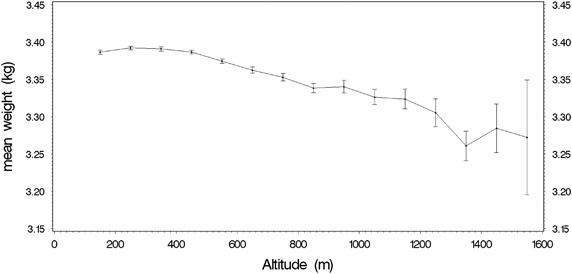
This seems to be generallysupported by studies which are unusuallyrigorous for the field of fetal development. Even better, it’s supported in both South America (where higher altitudes correlate with lower income and lower density, and I suspect very different child-rearing practices) and Colorado (where the income relationship reverses and while I’m sure childhoods still differ somewhat, I suspect less so). The relationship also holds in Austria, which I know less about culturally but did produce the nicest graph.
This is a big deal because until you reach truly ridiculous numbers, higher birth weight is correlated with every good thing, although there’s reason to believe a loss due to high altitude is less bad than a loss caused by most other causes, which I’ll discuss later.
[Also for any of you wondering if this is caused by a decrease in gestation time: good question, the answer appears to be no.]
Children raised at higher altitudes do worse on developmental tests
There is a fairamount of data supporting this, and some even attempt to control for things like familiar wealth, prematurity, etc. I’m not convinced. The effects are modest, I expect families living at very high altitudes (typically rural) to be different in many ways from lower altitudes (typically urban) in ways that cause their children to score differently on tests without it making a meaningful impact on their life (and unlike birth weight, I didn’t find studies based in CO, where some trends reverse). Additionally, none of the studies looked specifically at children who were born at a lower altitude and moved, so some of the effects may be left over from the gestational effects discussed earlier.
Hypoxia may not be your only problem
I went into this primed to believe reduced oxygen consumption was the problem. However, there’s additional evidence that UV radiation, which rises with altitude, may also be a concern. UV radiation is higher in some areas for other reasons, which indeed seems to correlate with reductions in cognition.
How much does this matter? (not much)
Based on a very cursory look at graphs on GIS (to be clear: I didn’t even check the papers, and their axes were shoddily labeled), 100 grams of birth weight corresponds to 0.2 IQ points for full term babies.
The studies consistently showed ~0.09 to 0.1 grams lower birth weight per meter of altitude. Studies showed this to be surprisingly linear; I’m skeptical and expect the reality to be more exponential or S shaped, but let’s use that rule of thumb for now. 0.1g/m means gestating in Denver rather than at sea level would shrink your baby by 170 grams (where 2500g-4500g is considered normal and healthy). If this was identical to other forms of fetal weight loss, which I don’t think it is, it would very roughly correspond to 0.35 IQ points lost.
However, there’s reason to believe high-altitude fetal weight loss is less concerning than other forms. High altitude babies tend to have a higher brain mass percentage and are tall for their weight, suggesting they’ve prioritized growth amidst scarce resources rather than being straight out poisoned. So that small effect is even smaller than it first appears.
There was also evidence out of Austria that higher altitude increased risk of SIDS, but that disappeared when babies slept on their backs, which is standard practice now.
So gestating in Denver is definitely bad then? (No)
There are a billion things influencing gestation and childhood outcomes, and this is looking at exactly one of them, for not very long. If you are making a decision please look at all the relevant factors, and then factor in the streetlight effect that there may be harder to measure things pointing in the other direction. Do not overweight the last thing I happened to read.
In particular, Slime Mold Time Mold has some interesting data (which I haven’t verified but am hoping to at least ESC the series) that suggests higher altitudes within the US have fewer environmental contaminants, which you would expect to have all sorts of good effects.