
In Defense Of The Sunk Cost Fallacy

Dutch disease is the economic concept that if a country is too rich in one thing, especially a natural resource, every other sector of the economy will rot because all available money and talent will flow towards that sector.  Moreover, that sector dominates the exchange rate, making all other exports uncompetitive.*  It comes up in foreign development a lot because charitable aid can cause dutch disease: by paying what the funders would consider a “fair wage”, charities position themselves as by far the best employers in the area.  The best and the brightest African citizens end up chauffering foreigners rather than starting their own businesses, which keeps the society dependent on outside help.  Nothing good comes from having poverty as your chief export.

I posit that a similar process takes place in corporations.  Once they are making too much money off a few major things (Windows, Office, AdWords, SUVs), even an exceptionally profitable project in a small market is too small to notice.  Add in the risk of reputation damage and the fact that all projects have a certain amount of overhead regardless of size, and it makes perfect sense for large companies to discard projects a start up would kill for (RIP Reader).**

That’s a fine policy in moderation, but there are problems with applying it too early.  Namely, you never know what something is going to grow into.  Google search originally arose as a way to calculate impact for academic papers. The market for SUVs (and for that matter, cars) was 0 until someone created it.  If you insist on only going after projects that directly address an existing large market, the best you’ll ever be is a fast follower.***

Simultaneously, going from zero to an enormous, productive project is really, really hard (see: Fire Phone, Google+, Facebook’s not-an-operating-system).  Even if you have an end goal in mind, it often makes sense to start small and iterate.  Little Bets covers this in great detail.  And if you don’t have a signed card from G-d confirming your end goal is correct, progressing in small iterative steps gives you more information and more room to pivot.

More than one keynote at EA Global talked about the importance of picking the most important thing, and of being willing to switch if you find something better.  That’s obviously great in in some cases, but I worry that this hyperfocusing will cause the same problems for us that it does at large companies: a lack of room to surprise ourselves.  For example, take the post I did on interpretive labor.  I was really proud of that post.  I worked hard on it.  I had visions of it helping many people in their relationships.  But if you’d asked at the time, I would have predicted that the Most Effective use of my time was learning programming skills to increase my wage or increase my value in direct work, and that that post was an indulgence.   It never in my wildest dreams occurred to me it would be read by someone in a far better position than me to do something about existential risk and be useful to them in connecting two key groups that weren’t currently talking to each other, but apparently it did.  I’m not saying that I definitely saved us from papercliptopia, but it is technically possible that that post (along with millions of other flaps of butterfly wings) will make the marginal difference.  And I would never have even known it did so except the person in question reached out to me at EA Global.****

Intervention effectiveness may vary by several orders of magnitude, but if the confidence intervals are just as big it pays to add a little wiggle to your selection.  Moreover, constant project churn has its own cost: it’s better to finish the third best thing than have to two half finished attempts at different best things.  And you never know what a 3rd best project will teach you that will help an upcoming best project- most new technological innovations come from combining things from two different spheres (source), so hyperfocus will eventually cripple you.

In light of all that, I think we need to stop being quite so hard on the sunk cost fallacy.  No, you should not throw good money after bad, but constantly re-evaluating your choices is costly and (jujitsu flip) will not always be most efficient use of your resources.  In the absence of a signed piece of paper from G-d, biasing some of your effort towards things you enjoy and have comparative advantage in may in fact be the optimal strategy

Using your own efficiency against you

My hesitation is that I don’t know how far you can take this before it stops being effective altruism and starts being “feel smug and virtuous about doing whatever it is you already wanted to do”- a thing we’re already accused of doing.  Could someone please solve this and report back?  Thanks.

* The term comes from the Dutch economic crash following the discovery of natural gas in The Netherlands.  Current thought is that was not actually Dutch disease, but that renaming the phenomenon after some third world country currently being devastated by it would be mean.

*Simultaneously, developers have become worse predictors of the market in general. Used to be that nerds were the early adopters and if they loved it everyone would be using it in a year (e.g. gmail, smart phones).  As technology and particularly mobile advances, this is no longer true.  Nerds aren’t powerusers for tablets because we need laptops, but tablet poweruser is a powerful and predictive market.  Companies now force devs to experience the world like users (Facebook’s order to use Android) or just outright tell them what to do (Google+).  This makes their ideas inherently less valuable than they were.  I don’t blame companies for shifting to a more user-driven decision making process, but it does make things less fun.

**Which, to be fair, is Microsoft’s actual strategy

***It’s also possible it accomplished nothing, or makes it worse.  But the ceiling of effectiveness is higher than I ever imaged and the uncertainty only makes my point stronger.

Links 8/14/15

gamessavedmylife.tumblr.com – a collection of stories from people whose lives were significantly improved by video games.  Interestingly, at least some of these fit the cultural archetype of “addict”, but their stories make it clear that like most addicts, they were self-medicating something worse.

When doctors don’t monitor you and don’t give you the tools to monitor yourself.

Lazy Programmer Excuses

My friend Beth made a fashion blog for women in STEM and called it fibonacci sequins.

Microscopic corkscrews swim through your blood vessels to root out plaque.  Good job science.

I’ve written before about the terror of antibiotic resistance.  Resistance spreads fast because a lone resistant individual will find themselves with a wide open field after antibiotics are used.  But what if we could avoid that?  (Some?) Bacteria absorb iron by releasing tiny molecules to bind to it (siderophores), and then absorbing the larger molecule.  There’s no homing device: the siderophores they absorb are not necessarily the siderophores they released.  You’d think this would lead to free riders (bacteria that produce no siderophores, but it doesn’t, possibly because the bacteria are so closely related.

What if you disabled the siderophores?  The bacteria could mutate new ones, but they won’t necessarily reap the benefits of that because they have no claim on their own siderophores.  The selection pressure for new siderophores won’t be zero, but it will be greatly reduced.  As it turns out, there’s an existing drug used to treat certain cancers that does exactly that, and in a short trial bacteria failed to develop resistance to it (while they did to two common antibiotics).  And this mechanism has nothing to do with existing antibiotics, so resistances won’t develop together (i.e. if a colony ever did develop resistance you could probably take them out with penicillin).   High five science, you’re doing great this week.

Employee of Four Hour Work Week takes modafinil to work 60 hours straight.  No one seems to think this has any bearing on the feasibility of the four hour work week.

“The problem with allowing absolutely no abuse in activist circles, of course, is that this cuts people off from the ability to advocate for themselves, based on the “crime” of surviving abuse without proper follow-up care. I don’t think that’s really what we want to do unless we have no other choice. The people who haven’t been damaged by abuse can’t be the only people with the access to advocate.” –Almost Diamonds.

Things I wish I had written: Reason vs. Evidence in Effective Altruism.  Some people believe cash transfers are better than microcredit because of evidence (RCTs examining the effects of both on identifiable metrics).  Some people believe existential risk is more important than global poverty because of reasoningThey believe that by the time we have concrete evidence, it will be too late.  That’s not necessarily wrong, but it is very different than the proof that cash transfers outperform microcredit.  I guess I lean more to the evidences side but am super glad there are people on the reasoning side.

In that vein, I want us to start distinguishing risky from uncertain.  RIsky implies a low chance of success, but if the potential return is high enough the expected value may still be high.  Uncertain means “we don’t know what success buys us” or “we don’t know what success is.”  Going into a hospital is risky because of the high rate of medical errors and hospital-originating infections.  Investing in unfriendly AI risk is uncertain because who knows how that’s going to work out.

Food Choices at EA Global

[EAGlobal was a wonderful experience that I haven’t written much about because my brain was too stuffed full of wonderfulness to produce anything useful.  I dislike that the first thing I’m writing about it is a controversy/complaint]

There’s a utilitarian thought experiment: would you rather have one person tortured for their entire life, or a googolplex of people experience a single dust mote in their eye?  I always viewed it as too theoretical to be anything but an ideological purity test, but I think I’m seeing a version of it in action right now, in the debate around serving animal products at EA Global.

You have a small number of animal rights activists saying “this is torturing and consuming a sentient being and that’s morally abhorent”, and a much larger number of omnivores going “but seriously, they’re delicious”.  The ARAs don’t understand why aesthetic preferences are overriding morality (and either don’t believe that animal products are ever medically necessary or don’t believe that outweighs the cost to the animal), and the omnivores don’t see why such a small group is getting to override their preferences because of a principle they don’t believe in.

I think the moral weight of the ARA’s concerns may actually be working against them here.  I don’t think many people would object if the organizers said “the local cuisine is vegan and shipping in meat is just too expensive, bring some in your luggage if you must.”  But the fact that the morality arguments exist and tend to resonate with people even if they don’t agree makes people defensive, and then aggressive.  Allowing the organizers to drop meat for morality reasons is an implicit endorsement of the idea that meat is indeed immoral, which has unpleasant implications for omnivore’s moral standing the rest of the week.  By the Copenhagen interpretation of ethics, better to deny that there is a problem than participate in an incomplete solution.

My original position, based mostly on the fact that I am simultaneously really bothered by and completely immune to ARA’s disgust-based arguments, was that EA Global had made the right call: vegan or at least vegetarian options in the main line, a small amount of meat hidden off to the side.  But now that I think the insistence on meat is strongly Copenhagen-driven, I’ve changed my mind.  Admitting unpleasant things about ourselves and making incremental progress is supposed to be one of our things.

[By that same token I think ARA’s should be a little happier about how much meat consumption was reduced that weekend, even if it didn’t go to zero.  But then, I’m an incrementalist]

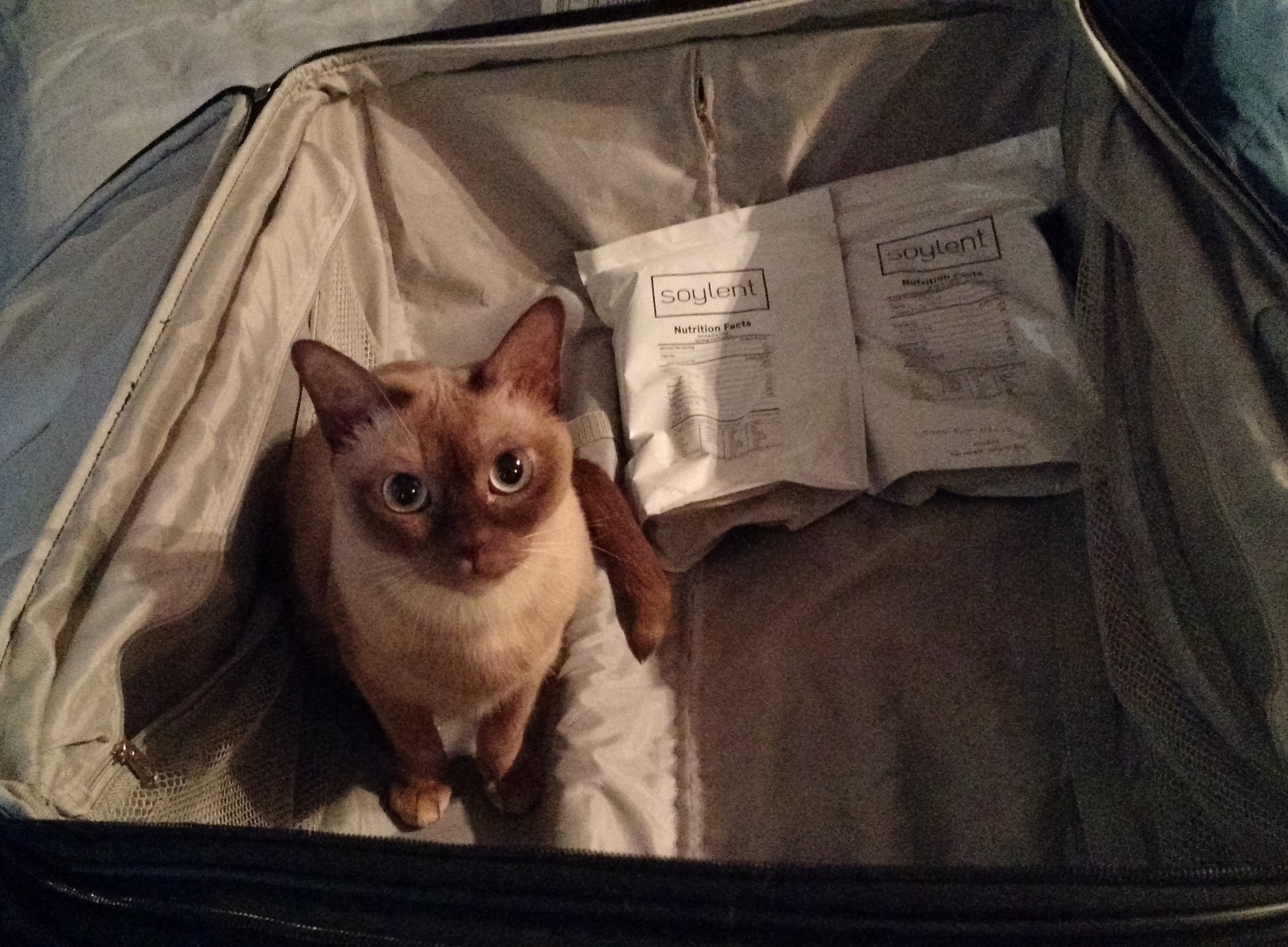
At the same time, some people need animal products.  The definition of need is tricky here- my doctor has told me to eat small amounts of meat, but going three days without any will be fine, but in practice what was served at EA Global was too hard on my stomach and I wouldn’t have been able to eat enough calories from that alone.  Some people are on paleo and even if that wasn’t the healthiest choice, a sudden drop off in meat will be physically hard on them.  Some people have a lot of things they can’t eat such that meat is the easiest way to get them a nutritionally complete meal- especially when you have a lot of different people with a lot of different exclusions.  But even if meat were served, it’s impossible to fulfill 600 people’s dietary requirements with a reasonable amount of effort and money. The best solution may have been to announce the menu ahead of time so people could plan, and then let the chips fall where they may.

But I think we can do one better.  My new favorite solution is to offer both meat and whatever vegans nominate as the best fake meat and offer both without a way to distinguish between the two at the time.  Omnivores would be given one at random with a code that they could later use to register 1.  how much they liked what they were served and 2.  whether they think it was real meat or not.  If they really don’t like what they got they could go to a back room somewhere with their code and ask for the other one (still not telling them which they got).  The same back room could serve people who medically need meat and people who want the definitively vegan option.

This gives people who want but don’t need meat (and are able to eat !meat) a way to get it, and vegans a way to advance the cause of veganism, possibly further than they would get by banning it (by showing people how good !meat tastes).  In most circles neither side would find this adequate, but Experimenting and Using Data are What Effective Altruists  Do, and I think that could convince/pressure enough people (on both sides) into it that it would be worth trying.

Links 8/7/15

SourceForge (a website that lets you host software for download) moved from giving people the option to bundle adware with their software to forcing people to include adware.  Internet erupts exactly the way you would expect, except on Slashdot, where despite many submissions the story didn’t get traction until a week later.  Slashdot is owned by the same company as SourceForge but explains they weren’t burying it, it’s just that that seven day period contained a weekend and it slowed them down.

A good round up of the research on discrimination against women in the tech industry, including the fact that women are often punished for doing the things that lead to career advancement in men.  The suggested solutions strike me as good, but I wish the framing were different.  It’s not a problem if some companies are hypercompetitive, it’s a problem that all the low-competition jobs are dead ends.  That ends up hurting more women because women are on average less competitive (in part because they’re punished for being competitive where men would be rewarded)- but in some ways it hurts non-competitive men more than similar women, because it’s more culturally acceptable for a woman to leave a job for being too cutthroat.  Ditto for work/life balance- everyone should have the option to trade money for time and predictability, not just women with young children.

[I spent a whole paragraph explaining why a gawker media article was wrong and mean but ultimately this sentence seemed just as valuable]

Dogs appear to have separate spaces in their brain for humans and other dogs, and human smells are rewarding in a way nothing else is.  Huey concurs.

Scientists grow miniature organs by accident.

Video games for physical therapy:

Beautiful theory killed by ugly gang of facts: socially anxious people become less so when they can attribute their nerves to caffeine (PDF), even if they have not had caffeine.  This is simultaneously counter-intuitive and unthreatening to my world view and suggests that a major problem can be removed with some framing.  Unfortunately, while the results are technically statistically significant, the sample size, sample population (100% college students), and small effect size (hidden by a misleading graph) all scream “this will never be replicated”.

Product Endorsement: Baby Watermelon

I am going to have so much to share from EA Global once I recover but until then please enjoy this fun fact:  personal watermelons are really good.  You would think they would be terrible because flavor is positively correlated with distance from rind, but personal watermelons get good almost right away.  It’s like it’s the same amount of flavor as a normal watermelon in a much smaller size.  Genetic engineering is finally pulling its weight.

Links 7/31/15

Things I learned from TED: there was a frog that incubated its eggs in its stomach and drop crocs are real. And we’re trying to bring them back

My favorite comment from the Hacker News thread on my open office post:

…[S]omeone mentioned that because they happened to overhear a conversation between two engineers they were able to save weeks of them working on the wrong thing.

Anecdotes like that aren’t signs that open offices are successful or result in “having good communication” – it means you have horrible communication and you got lucky.

I think one’s response to “I overheard a thing and it saved us weeks” stories might be a really good test of attitude towards open offices in general.  Do you see the serendipitous successes, or the implied failures?  The work you didn’t have to do because you learned something, or the work you had to do to process all of the information that wasn’t useful to you?

Speaking of things in the office that are great for some and horrible for others: Ask a Manager talks about dogs in the office.  One woman has deathly allergies and the ADA on her side, but nothing can shield her from the social consequences of being The Lady That Made Them Ban Dogs From the Office.  I’m actually pretty sympathetic to the dog owners on this; they made plans based on promises from the company and losing them could be really disruptive.  Not as disruptive as dying of course, but it’s not necessarily a small thing.  The real problem is an office set up that makes the choices “abandon your dogs” or “kill co-worker”, which is an esoteric example of the general problem of open offices making environmental settings communal.

The obvious side effect is that everyone is operating farther from their optimum on things like light and temperature, but it also reduces maneuverability.  Even if everyone in the room would like dimmer lights it’s a whole thing to poll them and talk to facilities and then repoll to see if you should adjust more.  G-d forbid anyone have different preferences over time.  Where a person with migraines and their own office could just turn the bloody light off when they feel one coming on, they now have to go through some entire thing with HR to set up a response ahead of time and then invoke it, or leave work and get a migraine on the way home anyway.  The company could give them their own office, but that will cause resentment, and they’ll miss information because everything is still built around the idea that information is distributed via the ether.  People talk about how open offices are so dynamic but there’s a lot of ways they make things less flexible.

Some number of hydrocephalics (people with fluid replacing up to 95% of their brain) are completely unaffected and in fact undetected until they get head scanned for other reasons.  Leading explanations include “isolation makes remaining area strong” and “souls”.

Filtering Labor

This is either a subset of interpretive labor or a closely related concept: Filtering Labor.  Suppose one person is generating information, and another person needs a small subset of it, or needs the information in aggregate but not specific pieces.  Who does the labor to filter it down?

Let’s talk about this in a work context.  Recently I was on a thread with four other people.  Everyone needed to get the original few letters, and everyone needed to know the final decision.  But in between those two were 5 or 10 e-mails nailing down some specifics between me and one other person.  The others needed to know the decisions we made, but reading the back and forth was of no value to them.  Nonetheless, they stayed on the thread.  This wouldn’t be such a big deal if they only checked their e-mail once a day because they could skim through the thread, but that’s not how much people check e-mail, and I know it’s not how these particular people were handling this thread, because there were other messages in the same thread that required and received a near-instant response from them.

We could have saved them effort by taking them off the thread, and re-adding them when they were needed, with a summary of the decision.  But that requires looking at every message and thinking “who needs to see this?” What if a message is mostly unrelated to them but not entirely?  How do I know if a decision is finalized enough to be worth summarizing it to them?  It didn’t apply in this particular case, but my general experience at work is that the best moment to send out the summary- when everything has been more or less settled- does not draw attention to itself.  You just go two days without having to make a decision.  Not to mention that knowing what is relevant to others requires information about them- who filters that?

This only gets worse as companies grow.  My job is clearly terrified there will be something somewhere in the company that would be useful to me and I won’t know about it.  One solution would be to make things easy to find when I wanted to look for them (a pull-based system).  You can do some of this with good archiving and search tools, but to make it really work it requires effort from the information producers or some sort of archivist.  Things like tagging, summaries, updating the wiki.  Information producers rarely want to put in this effort (in part because of a justified belief it’s just going to change again next week.  But by the time that’s identifiably not true, the relevant information has faded from memory).  You can attempt to force them but it hurts morale and it really is going to be obsolete in a week.

So my job, and I believe a lot of other large software companies, uses a push system.  I’m on dozens of email lists giving me a stream of updates on what people are doing, sometimes very far away in the org.  I tried to make a list to convey to you all the lists I am on, but it is impossible.  Making the collected output of these lists useful often requires a lot of interpretive labor (e.g. translating a changelist into what a tool actually does and how it might relevant to me).  That takes time, and the farther away from me something in the org is, the more time it takes.  At this point there is no way I could thoughtfully process all of my mail and get anything else done.  It looks like information is being spread more widely, but the signal to noise ratio is so low I’m learning less.

The open office is an attempt to do the same with in person interactions- if people won’t seek out others to give them information they need (in part because they don’t know who needs it or who has it), make it impossible to not overhear.  We know what I think about that.

Some of this comes from a failure to adapt to circumstances.  When you start a company everything anyone does is relevant to you and you will always know about it without any effort on anyone’s part.  As you add people everything is still pretty relevant to them, but it takes more effort to find out about it.  Start-ups start using stand-ups or mailing lists.   The bigger they get, the more effort goes into sharing information.  For a while this doesn’t cost a lot in processing.  People have a certain amount of slack in their day (compiling, between meetings) and everything is close enough to what they work on that it’s easy to interpret.  But peoples projects grow more and more distant, and eventually you run out of slack.  After that every additional piece of information you give them beyond that comes at the cost of them producing actual work.

Which doesn’t mean you should stop: maybe it saves more work than it creates.  But I wish companies recognized the effort this required and started thinking more strategically about what was truly useful. There are already specialists that do parts of this under various names (Project/program manager, technical writer, manager, tech lead), if this was made explicit I think we could save people a lot of effort.

Mission Statement

As you may have guessed from the previous two posts I’m not happy at my current job and looking for a better one.  Some of that is figuring out what kind of environment I work best in and some of it is developing skills, but I also needed to figure out what problems I wanted to solve.  This was where So Good They can’t Ignore You was so helpful- it helped me realize I needed to look at what would make me feel most impactful, rather than what I would find entertaining.

I know what things interest me: health, poverty, education, psychology, video games, mental health, nutrition, medicine… but no one else seems to think these things are as linked as I do.  I think I finally what they have in common, for me: they waste potential.  People who could have done great things die or don’t have the money to pursue them or are too sick or pained or no one will teach them the necessary skills.  That’s tragic.  That’s loss on an enormous scale.

I don’t find anti-poverty work as emotionally compelling as the intricacies of mental health or CFAR.  But if I bother to think it through, I realize there’s a lot of people who will never get to the level of calibrating their predictions because they’re starving, or because all of their mental energy is going to keeping them from starving.  In a very real sense, giving money to poor people is one of the most effective rationality-raising interventions possible.

So that’s my goal. Remove things that are keeping the most people from being all they can be.

Thoughts on So Good They Can’t Ignore You (Cal Newport)

Recently I read So Good They Can’t Ignore You.  I have well known trouble distinguishing “things the book said” from “thoughts I had while reading it”, so I’m just going to tell you what I thought and if you’re interested you can track down the book and see how original this was.

The book’s official tagline is “Why Skills Trump Passion in the Quest for Work” and it frames itself as anti-passion, but Newport eventually admits that’s a marketing hook.  Mostly his thesis is that passion alone will not make you happy, and skill can be used to extract concessions from your employer that make life more pleasant, so you should focus on skill.  Passion is a great driver for developing skills so that seems like a weak criticism of passion (he puts all the positive aspects of passion under “mission”), but he also suggests that it’s impossible to find something you’re really passionate about until you have a certain amount of skill, so still focus on that.  Given the essentially infinite number of skills available it seems like there’s room for your interests to have input earlier in the process.  I think what he’s really attacking is the idea that your job should be a source of entertainment.  That has given me severe clarity in what I’m looking for job-wise.

The epitome of the jobs-as-entertainment model is “Choose a job you love, and you will never have to work a day in your life”.  That is neither true nor desirable, unless you use a very specific definition of work.  Let’s take this blog.  No one is forcing me to write it.  For the first year I had something like five readers, most of whom I regularly talked to in person.  Obviously it was motivated entirely internally, which is another way of saying “powered by love.”  And yet, it was still work.  Even if you discount all the reading I did as “things I would have read for fun anyway”*, and the thought I put into it as “a thing I can’t stop my brain from doing”, I have to organize my thoughts and translate them to things other people can understand.  I had to configure the page layout so it was neither hideous nor generic.  I had to proofread and correct mistakes.  I had to retype entries from scratch after WordPress broke again.  I had to correct all the typos Beth pointed out to me after I published.  Nothing past writing the first draft could be considered entertaining the way playing Twenty is entertaining, and even the reading, thinking, and first drafts took considerable time and effort.  That sounds like work to me.  And yet obviously I was doing something I loved because there was no other reason to do it. **

Love doesn’t erase the fact that something is work.  It can motivate the work, it can cushion the annoyances of work, it can give you the incentive to continue when you would otherwise give up, but it can’t erase it.  And I kind of resent attempts to try.  I am a grown up human, I do not need swings or field trips to chocolate factories to trick me into swallowing a pill showing up.

How I feel about office scavenger hunts
The canine equivalent of the company picnic

What I do need is a good working environment, clarity around my goals, and the tools to achieve them.   Those are what let me accomplish things, which is the reward I want from work.  An occasional morale event when I we’re all producing really good work together can be really rewarding, but frequent events (like my job has) when I’m unhappy with my productivity feels like… like eating too much dessert when what I really need is a nutritious meal.  My taste buds notice the sugar but I don’t get any of the associated psychological rewards, and it turns into queasiness.  Speaking of which: office candy counts as entertainment but the nutritious-organic-local-cuddled meals at work are productivity aids.  Let’s not throw the baby out with the bathwater.

Like 80,000 hours, So Good They Can’t Ignore You has a large emphasis on building career capital.  This section isn’t perfect. A lot of the case studies are opportunistic (in the positive sense of the word), and serendipity is not repeatable.   I feel like it’s skipping a critical step without acknowledging it.  It’s also a little too “be a good worker bee until you’re called up to the the big leagues” for me; traditional corporate or academic paths work for a lot of people and the whole “the only thing holding you back is fear” narrative is stupid, but there’s a lot of other paths to success that get a lot less publicity.  But this was still useful.

I have some topics I find both interesting and skills that would be useful in an associated career.  But as you may have noticed, I have a lot of interests, many of which require expensive, brittle credentials to pursue.  It would suck to spend years in school only to get bored with the field. I highly suspect interests are a better predictor of what will be entertaining than what will be rewarding.  What SGTCIY suggests in this situation (actually all situations, but I think it applies to me more than most) is to build capital in things that will be useful in service to lots of interests/goals.  Like, say, programming, a skill and job I already have but really always skated through on raw intelligence and a willingness to do low status work.  Between this book and not getting a job I really wanted I’ve started make deliberate choices and investing.

It’s also really nice to read a career guide by someone with a career that is not writing career guides (Newport wrote the book in between finishing a computer science PhD and starting a professorship), and one with writing skills to boot.  I finished the book in two days because it was just that readable.

*I used to read things with the explicit goal of blogging about them; they were worth blogging about so rarely I stopped.

**I was planning on using the blog as a portfolio for job purposes, but one of the reasons blogging works as a signal of interest and skill is that it’s so costly and low-reward no one would do it unless they loved it.