An Apple a Day Does Surprisingly Little?

How did apples get to be the standard bearer for all that is good and healthy? In terms of nutrient per calorie, they’re not that good. 1 cup has 65 calories, 3 grams of fiber (12% RDA), and 5.7 mg vitamin C (10% RDA), and very small amounts of a wide range of other nutrients. Pears are just slightly better: 1 cup has 81 calories, 4g fiber, 5.7 mg vitamin C, and enough potassium to be noticeable.  Meanwhile the same volume of grapes, so long derided as nature’s candy, have 104 calories, 1.4g fiber, 16.3 mg vitamin C, 22 mcg potassium.  Almost everything apples or pears have trace amounts of, grapes have slightly more of.

Wasting their lives
Wasting their lives?

I wonder how much of this is because of the skin:pulp ratio.  Produce skin tends to have a lot the bulk of the vitamins*.  Plus grapes are more colorful, and color intensity is a shockingly good proxy for nutritional value in produce.

I also wonder how apples got such a sterling reputation without the benefit of a good marketing firm.   My best guess is that they grow further north than most fruit and keep for much longer, and established cultural supremacy back when produce was scarce and fruit did not regularly fly.

Full disclosure: I was originally going to compare apples to iceberg lettuce, which I had previously seen described as nutritionally vacuous but easy to ship.  But when I looked it up I discovered iceberg lettuce actually has a pretty good nutritional profile.  1 cup has 10 calories, 1 g fiber, 2.0 mg vitamin C, and 22.0 mcg potassium (22% RDA), and trace amounts of other stuff, which makes it strictly better than apples on a per calorie basis.

While we are at it: spinach does not have that much iron.  It has a number of other vitamins and is very good for you, but the original reputation for iron-richness came from some guy putting the decimal point in the wrong place (source: some guy at a party 6 years ago).  In fact the oxalates in spinach bind iron, making it harder to absorb.

Apples aren’t bad for you.  If you want an apple, eat an apple.  But if don’t want an apple and are trying to cajole yourself into it to make doctors keep their distance, consider grapes instead.

*Also the pesticides.

HAES post-check

A chief contention of Health At Every Size (Linda Bacon) is that human beings can’t lose weight, so even if it would optimal for them to weigh less, there’s nothing to be done about it.  Is this true?  It’s hard to answer, because the question isn’t very well defined.  Bacon admits there are things human beings can do to gain weight, and when they stop doing them, they sometimes lose weight.  So if you’re doing those things, you probably can lose weight.  And that people have a set range they can move around in healthily, based on diet and exercise, so if you’re at the top of your range now you could lose 20 pounds and still be okay.

On page 143, Bacon very strongly implies that twins maintain the same body weight even when they have very different activity levels, so weight is controlled by genetics.  The studies she cites do show that when activity and diet is held constant, two unrelated people will have different health metrics.  They also show that when two identical twins have different activity levels or diets, they will have different health metrics (including weight).  Oh, and the combined sample size of both studies together is 35 sets of twins.  This is where I started to get angry.  I get using weak studies that strongly support your hypothesis.  I get misleading people about what a study stays to support your hypothesis.  But doing both is just…argh.  I supported HAES.  The actual prescriptions for food are basically the Michael Pollan diet (eat food, mostly plants), and motivation to retrain yourself to like real food rather than hyperprocessed crap.  Those goals are good.  Those goals are good even if they lead to weight gain, because under most circumstances produce is good for you and cheetos are not (although not all- this Captain Awkward post is full of people for whom carrots trigger intense digestive distress but hamburgers are safe and nurturing.  I used to live off of pasta because anything else felt like eating death.)

I did check Bacon’s sources on the claim that people who lose dramatic amounts of weight tend to gain it back within 5 years.  That appears to be true, at least in the studies she cited.  And yet, she also cited studies showing that activity level affects weight.  My explanation is that losing weight is not a thing you do.  Your diet and activity level translate to a weight or body fat percentage*.  If your current weight is different than that, it will move towards it.  If you change your behavior, you will move towards the new translated weight.  The translation appears to be a combination of genetics and perhaps past experience (she claims loss-and-regain cycles increase the set point.  I’ve read that a lot of places, but at this point I neither trust her nor have the heart to investigate).

So how do my current views compare to those I held before reading HAES?

Exercise- still good for you.

Human diversity- still vast.

Impervious of weight to diet and exercise- depends a lot on what you mean.  I will never look like Keira Knightley, but I will probably lose fat if I exercise more.  Which I have just started to do after ceasing for a very long time because I was recovering from surgery, and will pause again when I have my next surgery, because the health harms outweighed the benefits.  Fat is a proxy for health, but not the only measure of it.

Large amounts of fat are quite bad for you, but it’s unclear where that effect kicks in.  The American aesthetic ideal is much lower that the healthy weight cut off, and may be actively unhealthy. In the normal range, diet and exercise have bigger health impacts than fat.

Our food supply is definitely fucked.

Fat people still don’t deserve to be shamed, especially under the guise of for their health.  First because no one deserves to be shamed, but especially because shame is super bad for your health.  It is intrinsically bad and it keeps people from seeking medical care, for both things related and unrelated to their fat.  Stop doing it.  People owe you neither their health nor their attractiveness.

*Weirdly, in my case it appears to be weight.  I’ve had a shockingly consistent weight despite large changes in activity level and muscle mass.

Today in Bad Infographs

The Washington Post has a cool infograph showing the results of a racial Implicit Association Test by state.  I have a couple of problems with it.

First, the population sample is composed of people who went out of their way to take the test on the website, which is a long way of spelling “the population sample is invalid”.  Second, the volume of use of implicit association in psychology seems to be driven more by a compelling story of what it means and psychologists’ sheer joy at having a thing they can measure, in a short lab test, with numbers and everything, than any actual evidence that the story is true.

But those are objections I would bring up to any presentation of this data.  What is bothering me about this infograph in particular is a new and exciting variant on misleading axis choice.  The Post chose blue to represent a lower IAT score (which, if implicit association’s claims are correct, means being less racist) and red to be a higher one. The lowest values are a darker blue, the higher a darker red, with a neutral value being white.  At this point, blue and red are so tightly associated with Democrat/liberal and Republican/conservative that I think using them for anything else is manipulative.    But having white as a middle color also strikes me as weird.  Wouldn’t an even mix of the two be purple?

Worse, the “neutral” color does not rest on a score of 0, because that is the lowest score on the IAT.  Instead white represents a score of 0.402, which is almost but not quite the middle of the range of state averages (0.341-0.456) It was chosen because it was the IAT score of the median state, Michigan.  The overall effect is that a casual reading of the infograph would lead to conclude southeast and eastern states are racist and New England and northwest states are anti-racist.  In fact, if you treat IAT score as a quantity, the most racist state is about 33% and 10 percentage points more racist than the least racist one.    We don’t know what that corresponds to in actual behavior- does 10pp translate to a 1% difference in likelihood of hiring a black person, or 50%?- but that makes the color choices more misleading, not less.

The Limits of Metrics

For a long time now I’ve been trying to describe a hesitation I’ve had around EA.  Outcome metrics are great.  Outcome metrics are a huge improvement over “but look how much money we spent.” and “have you seen how sad this child is?“.  And yet.  My original stated concern was that over-reliance on metrics would drive us to focus on easy-to-measure outcomes over equally more* important hard-to-measure outcomes, or on known outcomes over more important unknown outcomes.*

Now I have a better analogy.  Metrics are like nutritional labeling.  Nutritional labeling is great when you want to decide between cheetos and soylent, or between soylent, mealsquares, and any one of their homebrew competitors.**  But suppose I set a fiber quota for myself.  The ideal way to do that would be to eat a variety of fruit, vegetables, beans, and nuts throughout the day, but that is super hard to keep track of.   I either have to eat in exact serving sizes (forcing the continuous variable of hunger to the granular treatment of serving size) or calculate exactly how much I ate after the fact (a pain in the ass and/or impossible), and then look up how much fiber is in the food (ignoring any natural variation), write it down, total it up… and if it’s midnight and I’m short, eat a ton more food I may not want.  Or I can pour a bunch of psyllium husks in a glass in the morning, check “eat fiber” off my todo list, and eat HoHos for the rest of the day.

Obviously the first choice is better overall, even if I ultimately end up with less fiber. But it is much harder to measure, in part because the benefits accrue over a wide variety of nutrients, whereas the psyllium and HoHos diet produces one big shiny number to trumpet in brochures.  I think this is a problem in charity too.  The Ugandan girls-club study I looked at last week had some outcomes that were both easy to measure and to value (spending), easy to measure but hard to estimate the value of (delayed marriage and childbirth), and kind of fuzzy to measure and of unclear value (age at which they do marry, as measured by proxy “when would you like to get married”).  Luckily for that project the increase in girls’ income per unit NGO spending was almost as high as it was for pure vocational training, plus it had these social benefits, but suppose it had been 75% as good?  Half as good?  10% as good?  What is the cut off for being better than pure vocational training.

I’m solving this problem in my nutritional life by drinking a full serving of vitaminized protein powder*** mixed with chia seeds every day, plus whatever the hell I feel like eating.   The almost-food frees up my stomach and brain to figure out what I especially need and seek that out, without fear I’m letting some other deficiency fester.  This is startlingly similar to Holden Karnofsky’s (co-founder of GiveWell) suggestion that westerners focus on the problems of the 3rd world they are in a good position to fix (e.g. malaria), and let the locals do the rest.   So I guess Effective Altruism has addressed this problem, it’s just that it addressed it by limiting itself, which is not the most emotionally satisfying answer but is something the world could do with more of.

BONUS FACT: EA and soylent have both found their home primarily with the rationalist community, and my rationalist friends (all of whom I met through EA) are simultaneously the most likely of anyone I know to drink soylent and to host communal dinners with secular grace.

*E.g. Food aid to the third world looks great measured by “people who stop starving in the short term.”  We know now that this destroyed the local farming economy and left entire regions either starving or in ongoing dependence on 1st world aid.

**Of these, mealsquares have been the clear winner among my friends.

***Not quite the same as soylent because it lacks the fat, carbs, and fiber to be a meal replacement.  This presents two slightly different problems.  The lack of fat and sugar I feel fully prepared to make up for in the rest of my diet.  But nutrients are digested differently depending on what other nutrients they are in proximity to.  The chia seeds are attempt to get the benefits of protein x fiber.

Controls and Confounds

I’ve talked a lot about controlling for confounding variables (also known as backing them out of your analysis), by which I mean, I’ve insulted several researchers for not doing it. And sometimes it is as obvious as I make it sound (controlling for smoking when studying coronary events). But sometimes it’s not. Eztra Klein has a great post about what it means to control for something.  If black and white people receive equal sentences for using crack and powder cocaine the system is, in one sense, not-racist.  But the fact that crack cocaine gets penalties so much higher than powder cocaine, and crack is more associated with black people, means that black people end up with much more jail time.  If the sentencing discrepancy is based on good reasons (e.g. yes, murder should get more jail time than jay walking), it’s not racist.  If the sentencing discrepancy exists entirely because crack is associated with black people, then it’s extremely racist, and the people who receive higher sentences for crack use are victims of racism against black people regardless of their race.  Klein takes on racism in the context of crime.  It’s true that you can almost close the criminal justice gap by controlling for things like income and type of offense, but those things are not necessarily independent of race.  It’s an excellent piece and you should read it both for it’s excellent explanation of how statistical modeling works, and its commentary on race in America.

This comes up with obesity too.  Someone went through and calculated life expectancy for each BMI* category (*moment of side eye for categorical analysis*), and found that while obesity (BMI >= 30) and being underweight (BMI < 18.5) were associated with excess deaths relative to normal weight, being overweight ( 25 <= BMI < 30), was not.  First, I find it extremely telling that their description was “not associated with excess deaths”, when the more accurate description would be “associated with noticeably fewer deaths.”  BMI-overweight people actually lived longer than BMI-normal people.  Allow me to summarize the conversation that followed.

Fat advocacy groups: see, fat isn’t unhealthy.  In fact, it’s the healthiest.
Pro-weight-loss groups: Bullshit.  The study doesn’t account for things that make you thin and then kill you, like cancer, or anorexia.
FAs: Okay, so when a confound causes death and skinniness, it’s legitimate, but if it causes death and fatness** it’s an excuse to let ourselves go?
Team skinny: What’s the alternative, let you be fat? Let you feel good about being fat? I can’t talk about this with you until you’re ready to take it seriously.

What’s the lesson here?  First, it’s to define your question very well.  Do you care if literally changing someone’s skin color improves their life, or if there is an overall system in which one color consistently comes up as the loser?  Is weight a good predictor of health outcomes, or is it a determinant of them?  Designing experiments to tease out these variables is incredibly hard.  Almost everything we know that affects weight also affects health.  The exception is liposuction, and my understanding is it is not associated with any health gains, but then, it’s barely associated with weight loss.  The situation with race, crime, and justice is even worse.

The second is that BMI is not only bullshit because it tosses a bunch of data away, but because the category boundaries are, at best, based on absolutely no data at all.

*Normally we would side eye use of BMI, but massive population studies are the one time it’s kind of okay.

**E.g. Type 2 Diabetes, sedentary lifestyle, poor diet\

Obesity, Blood Pressure, and Study Design

This entry had better save someone’s life because WordPress ate the entirety of the first draft and half the second draft and it was not easy to recreate.

Health at Every Size claim: high blood pressure (hypertension) is not caused by fat, but by dieting (which, because fat people diet more, creates the illusion that fat causes high blood pressure.  This is that confound thing we talked about last week).
My reading: The first source it cites does not quite say this: they say that current diet affects blood pressure, regardless of weight (which is actually even better news).*  This study (PDF)  purely retrospective and found both weight cycling and waist:hip ratio (a measure of fat gain around the waist, and due to the design of the study, a measure of fat itself**) to be significant (also, sample size was very small).  The next 2 studies were in obese spontaneously hypertensive rats.  Using animal models bred to have the disease you are studying is very common  because it reduces the number of subjects needed to generate a statistically significant result, but if the model is suffering from a different root illness that merely causes identical symptoms (e.g. rats bred for leptin deficiency lose fat when given leptin, but leptin-sufficient humans do not).  The last source is a book with a name like a perfume store.
Verdict: claim not proven.

HAES claim:  hypertension is only associated with bad outcomes in thin people.  Fat people with hypertension actually live longer.
My reading: This appears to be true, but all the studies were retrospective, none studies backed out smoking as a confound, and half were in men only.  None looked for a dose-dependent effect, but dumped people in two or three buckets and compared outcomes within them.  The technical term for this is categorical analysis (the alternative is numeric analysis), and it is almost always a bad choice. Here’s why:


START STATISTICS  FIELD TRIP

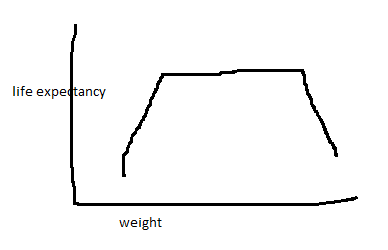
Let’s imagine that weight affects, and is the only thing to affect, longevity, and that it does so in an exceedingly simple way

Statistical analysis by MS Paint


Any idiot can draw the correct inference from this graph: being extremely overweight or underweight is bad, being anywhere in the middle range is equally good.  Let’s imagine three naive scientists attempting to study the relationship between weight and longevity.

Scientist A gathers an equal number of people at every weight and sorts them into “low” or “high” weight, with the divider being the exact center of that trapezoid.    They conclude weight has no impact on lifespan.

Scientist B draws the low/high line in the same place, but has slightly more extremely overweight people than extremely underweight people (which is what will likely happen in the real world, because 100 pounds overweight is a struggle, but 100 pounds underweight is dead).  They conclude being overweight increases chance of death.

Scientist C gets and even distribution of weights, but draws the line to the left of the exact center.  Their low-weight group now has a higher percentage of extremely underweight people than the high-weight group has of extremely overweight people.  They conclude being underweight increases your chance of death.

And those were good intentioned scientists.  A bad intentioned one can gather their data first and set cut off points after to prove almost whatever they want.

END STATISTICS FIELD TRIP

Verdict: After all the crap I’ve given HAES for misrepresenting studies, you might think I’m about to do that again.  But actually I find it perfectly plausible that all the studies on weight and blood pressure use categorical analysis, because it’s incredibly common in medical studies.  I really hope there’s a good justification for that, but the only one I’ve heard is that the math is easier, which might have made sense when everyone was doing statistics by candle light with a slide rule, but is hard to swallow now given the abundance of software packages that will do it for you.  So I will tentatively accept HAES claim as true, but I don’t see how you can turn the claim into actionable suggestions, except to worry less, which is actually an extremely valuable suggestion in this context. So let’s go with “supported, but of limited usefulness.”


*This is your once-per-post reminder that someone who talks about weight or BMI and opposed to body fat percentage is already wrong.

**I spent several very confused minutes googling what “android” meant in context.  I assumed the “android” referred to “women”, but android (when it doesn’t mean “obviously superior phone”) means “man-like”, which would make this an extremely unrepresentative study.  Turns out that “android” modifies “obesity”, and it means fat growth around the waist and upper body (more often seen in men) as opposed to around the thighs, hips, and breasts (more often seen in women).

Fiber: the Mr. Rogers of nutrition

I have consciously decided to let the arguments for high protein diets pass me by, despite how convincing some of the research and underlying mechanistic claims sound.  Humans have been cycling through high -protien, -fat, and -carb diets since we developed enough of a surplus to choose, and I’m pretty sure if any of them were that superior to the others it wouldn’t have been supplanted.  I would say “everything in moderation”, but that is just a zen way of saying “Eat the correct amount.  Idiot.” which I don’t think is very helpful.

HAES brings up a more constructive suggestion: eat fiber.  Fiber* is usually left out of the macronutrient triumvirate, but so is water, and water is extremely useful.  Off the top of my head: Fiber has the advantage of being natural**, because our ancestral foods had much more fiber than our current ones, yet its lack of calories is well suited to our current, couch-based, lifestyle.  It evens out digestion of other nutrients, reducing the destructive sugar/insulin boom and bust cycle.  It simultaneously treats diarrhea and constipation (if you drink enough water, which you should anyway).  Have you ever wished you could eat a good thing and have it cancel out a bad thing?

mitch-hedberg-onion-ring

Well, that might actually be true if the good thing is fiber, and the bad thing is not cocaine.

Here is where I meant to track down all the good things HAES says about fiber, but when I read it more carefully.  I realized most of what it was praising was fruit, with the implication that fiber was the reason fruit is beneficial.  The one actual fiber claim is that high-glyemic diets increase the risk of type 2 diabetes unless the diet is also high in fiber (five sources, all of which say nice things about fiber, one of which is actually about type 2 diabetes.  The paper did conclude that fiber fights type 2 diabetes, but it was a post-hoc survey, which is a weak methodology).  However, those other four sources also say pretty good things about fiber, just not the one the book claims they did.  I think we are all on board with “fruit and whole grains” > “potato chips and soda”, although I’m severely disappointed that this of all books is backing that up with data on weight loss, rather than actual health outcomes.

But Dr. Wikipedia has many very specific nice things to say about fiber, and it cites much more relevant sources.  Fiber increases micronutrient absorption (a little).  Fiber increases nutrient absorption (more).  Fiber fights inflammation.  Basically, it does everything good and nothing bad.  So while HAES didn’t lay out its case properly, fiber is definitely good, and I look forward to finding out who takes this too far and what the negative effects are.

*Definition of fiber varies a little from institution to institution, so for clarity: I am defining fiber as carbohydrates that are not broken down for energy in the human body.  It’s worth noting that there are two contributors to whether an organism can digest food: its own enzymes, and the bacteria in its digestive track.  Termites can’t naturally digest wood, but they house a bacteria that can.

**It’s easy to oversell “naturalness”, but when you have a mission critical system made of complex legacy code no one understands, sticking close to its original environment is a good default strategy.

Bariatric Surgery

I had a pretty poor opinion of weight loss surgery already, but Health At Every Size all but says any doctor recommending it should lose their license for malpractice.  That claim seems worth investigating.  Luckily, she cites her sources.

First, I feel it’s important to note that bariatric is medical Greek for “obesity related medicine.”  I’m already not thrilled with that because I think excess fat is a symptom of health problems, but rarely a health problem in and of itself.  “Bariatric surgery” is often sold as something that is fixing a problem, the way an appendectomy fixes appendicitis, but it is at best undoing the damage of something else that is making you fat.

That said, let’s start with the immediate death rate.  HAES quotes a study as reporting a 4.6% death rate within the year: what it doesn’t say is that that study was done on Medicare recipients, meaning they were older than 65 or disabled.    Moreover, the 4.6% number is based on death from any cause, not what would be expected above and beyond what is normal for patients’ age and health.  Controlling for age, sex, and likelihood they would have died anyway* the researchers found that surgery increased your risk of death in the 90 days after surgery by somewhere between 90% and 200% (=3 times as likely to die), depending on which demographic you were in.  Inexperienced surgeons make this worse (which they do not back out of their model).  This is not just the stress of surgery: that’s twice the death rate following coronary revascularization or hip replacement, neither of which are minor.

HAES cites another study, published in JAMA as reporting a 6.4% four-year death rate.  This study has a number of problems.  Its only control was matched for age- and sex- but not health status.  A lot of the deaths stem from heart disease, which could plausibly be caused by being fat or having been fat, which is not a case against weight loss surgery.  Worse, that was the death rate only among people considered “at risk” enough to justify four years of follow ups.  The article doesn’t explain what qualified someone as “at risk”, but rarely does that risk mean “at risk of living too long”.  HAES cites a blogger who cites the study as demonstrating a 250%-360% increase in mortality over four years, relative to age- and BMI- matched controls, but I don’t see that anywhere in the original paper.

Meanwhile, the American Society for Metabolic and Bariatric Surgery aka “the people doing the surgeries” is happy to report a mere 0.2%-0.5% mortality rate after the first month of gastric bypass surgery.

That’s everything the book cites on mortality, which I found unsatisfying, so I turned to Dr. Google.  This Swedish study actually bothered to match controls (although surgery was not assigned at random, introducing the possibility that the surgical patients varied on a factor they didn’t think of) and found a 30% reduction in death over 10 years.

But I hate it when people act like death is the only bad thing that could ever happen to you.  What about people who don’t die, but do suffer for the surgery?  HAES cites six studies showing long term nutritional deficiency.  Of the five I was able to find online, all showed serious deficencies and none had a control.  Interestingly they all found a vitamin D deficiency, when vitamin D is primarily produced by your skin in response to sunlight, unless you live in Seattle, in which case you mostly get it through supplements.  Either way, food is not a major source of it, and if bariatric surgery effects vitamin D levels (which these studies have not demonstrated) I am extremely curious as to why.  Given the current controversy as to the efficacy of vitamins even in people with normal stomachs, it’s not clear how much this issue could be fixed with supplementation.

Every study I’ve read agrees that people lose substantial weight after surgery and then gain some of it back, I’m not even bothering looking for citations for this.

CONCLUSION: bariatric surgery has severe risks.  These may be partially compensated for by a skilled surgeon and good nutritional technique.  For extremely obese patients the benefits may outweigh the risks.  We don’t know where the cut off is for “fat enough to benefit.”  The strongest piece of evidence against bariatric surgery is that no one has done the fairly obvious studies that would conclusively demonstrate their effectiveness.

Some of the benefits probably stem from societal approval rather than genuine health issues, and the long term fix for that is for society to stop shaming people for their weight.  Another part of the benefit may be a forcing function, i.e. if patients ate like they’d had the surgery they’d lose weight whether or not they actually had it.  For an individual living in the society they live in and who has already tried dietary changes, this is sad but irrelevant to the decision.

I’m really uncomfortable with this conclusion.  It doesn’t fit my prior model, and I prefer the tribal affiliation of strong weight loss surgery opponents to strong weight loss surgery advocates.  I consider the evidence I’m basing this on somewhat iffy,  but in all honesty if it had come out the way I expected I would be fine with it.  I’m also pretty disappointed in HAES for so blatantly misrepresenting the evidence.

*Risk of death was calculated using the  Charlson Comorbidity Index.   I have no idea if that is a good model, but it appears to be standard.  This doesn’t prevent the researchers from being wrong but it does mean they’re probably not being deliberately manipulative.

Nature tricks us again

Nature, the pinnacle of prestige in biology, is going free access, meaning anyone can read their articles for free.  This is definitely an improvement over me not being able to read their articles  (mostly produced and paid for with tax dollars) for free, but it’s not the victory it might look like.  Michael Eisen details how they’re still protecting their subscription model, but the more insidious problem is that they still charge for “reprints”, in which they print out the article and mail it to you like some sort of medieval peasant.

“Why would that matter?”, you say quietly to yourself “I mean, I could see how that was an issue back when articles had to be chiseled onto dinosaur skins, but doesn’t everyone just read them online now?”  First, reprint costs were an issue slightly more recently than that.  When I started college in 2002 a professor loaded me up on articles, and then asked me to please bring back the ones I wasn’t interested in because they were expensive to produce.  These were for articles he wrote, but he still had to pay the publishing journal to hand out copies to freshmen.

Admittedly, that particular problem had already been solved by the time I graduated.  Anyone on campus could read almost anything they wanted, for free.  But the more insidious issue is the people who want to pay for reprints.  Specifically, companies wishing to demonstrate how awesome their product (often but not exclusively a new pharmaceutical drug) is will buy reprints of articles supporting their case.  I admire their uprightness in paying for each copy, rather than buying one and giving an intern some alone time with the copier, but what I don’t understand is why they buy so many copies.  More than they could possibly distribute unless they started throwing them out of helicopters.  It’s like they enjoy giving the publishers money for some reason.

What this means is that people with money don’t just influence science by funding the studies they want done and then writing the articles about them, or by buying advertising in scientific journals (which we can at least detect is happening).  They reward journals for publishing articles favorable to them by buying reprints.  [Source: Bad Pharma, by Ben Goldacre].  And Nature has left that revenue stream wide open.

Insulin and Glucagon: Mockingsugar

There’s one more big food hormone everyone talks about: insulin. The visiting doctor on local news explanation of insulin is that it is produced by your pancreas in response to sugar in order to signal all your other cells that sugar is available in the blood stream and they should eat it.  The truth is, of course, more complicated.

First, your pancreas is producing insulin all the time*.  It then stores in the insulin until triggered.  This makes sense: demand for insulin is very spikey, and producing it all on demand would require an enormous number of cells that would be idle much of the time.  The sugar thing is a simplification as well.  Chemicals other than sugar stimulate insulin release, and not all types of sugar stimulate release.  Insulin is released by glucose in the blood (and by mannose, a sugar that looks very similar to insulin), but not fructose (which has fewer carbon atoms), but also amino acids**.  How much each amino acid stimulates production appears to be an open question.   This paper suggests all essential amino acids stimulate production greatly , this one says leucine, phenylalanine, and arginine (not considered essential in health adults) are the strongest, this one says arginine, lysine, alanine, proline, leucine and glutamine.  We’ll cover why this may matter in a minute.

Just like ghrelin and leptin act as semi-antagonists, insulin has its own nemesis: glucagon.  Where insulin stimulates your cells to take in sugar (and protein), glucagon stimulates your liver to release stored sugar.  This is necessary for keeping energy levels up when there is no immediate dietary source of sugar.  Glucagon also stimulates your body to break down protein (dietary or, in a pinch, your own muscles) for energy.  Remember how we said fasting could lead to muscle growth by stimulating growth hormone production?  Well it also leads to breaking down your muscles for energy, via glucagon.

Insulin and glucagon are in a very delicate balance.  When you eat a high-protein meal and have adequate energy levels, your body would like to use that protein to build enzymes and muscles and things.  To do this it must release insulin, which triggers your cells to take in amino acids from the blood.  But insulin also triggers them to take in sugar.  If the meal did not contain enough sugar***, this will send your blood sugar level dangerously low.  So your body preemptively releases glucagon, which triggers the release of stored sugar, thus maintaining blood sugar levels at optimal.  But! what if you’re on a chronically protein-rich, sugar-deficient diet?  This pattern could cause you to starve to death.  So glucagon also causes your liver to take in amino acids and use them for energy (which it can then distribute throughout the body).

What I’m wondering is if glucagon and insulin respond to differently to different amino acids. Specifically, if essential amino acids cause a larger [insulin – glucagon] than non-essential ones.  That would allow your cells to preferentially take in the most necessary amino acids, while leaving the less necessary ones for glucogenesis, which would certainly be handy.  Alas, I cannot find any studies on individual amino acids and glucagon.  This may be moot, since my impression is that the modern amino acid mix is pretty much closer to the paleolithic amino acid than sugar or fat are, so our system probably handles it better.

Your pancreas is a real go getter that wants to be prepared for extra sugar, because excess blood sugar is actually pretty damaging.  To do this it looks releases not just enough insulin to cover current blood sugar levels, but what it anticipates those levels will be in the future.  The problem is that it’s prediction algorithm is woefully out of date.  It may not even have caught up to farming (whoohoo, wheat and rice!), much less modern hyperprocessed snack foods.  If you eat a small piece of candy, your body doesn’t release enough insulin to handle the candy.  It looks at the sugar level and assumes you just ate something enormous and releases an appropriate level of insulin.

allthe nutrients

When the rest of the sugar and protein fail to appear, your blood sugar level drops precipitously. I don’t even know what it does to your blood or cellular protein levels, but it can’t be good.  Over time, your muscle cells may get tired of your pancreas’s false promises and stop listening to its pleas.  But the fat cells never stop listening.  This means that when you do eat protein or sugar, your fat cells take in a disproportionate amount of both.  If this progresses too far you get type II diabetes.****  Meanwhile, your glucagon production is completely unchanged, so your liver is happily taking in protein for energy synthesis (which frees up sugar to make fat).  This means it is perfectly possible to get fat as the rest of your body starves.

Oh, and one more thing affects insulin and glucagon production: stimulation of the vagus nerve.  Saying “vagus nerve” is only slightly more helpful than just saying “the body”, because the vagus nerve goes everywhere.  This article suggests that it’s carrying a signal from the liver to reduce insulin production.  This study stimulated the vagus nerve below the heart and found it raised both glucagon and insuline levels.  This study found removing the (hepatic?) vagus nerve in rats reversed type 2 diabetes.  I’m going to put this down as “the digestive system is actually much smarter and more communicative than we realize.”  I’m also curious about the fact that the vagus nerve also extends into the face, where it can detect chewing, but can’t find any studies on it.

Insulin probably doesn’t make you feel or full in the classic sense, but it can drop your blood sugar, which will make you slow and sleepy until you eat more food (“hey, a candy bar would wake me up…”), but it can stimulate leptin production and release which will make you feel full (and is another strike against leptin as The Ultimate Fat Barometer).  Glucagon probably is an appetite suppressant, which I find counterintuitive, and probably means it plays a bigger role in protein digestion than weathering long term calorie deficits.

What I find most amazing is that I have a biology degree, and didn’t realize insulin had anything to do with protein until just now.  We talk about insulin/sugar/diabetes/fat so much, we miss the protein/strength/cellular activity level.  I do not like what this implies at all

*And the brain.  Like leptin, insulin appears to make your brain feel safe to expend energy.  But at least not in the lungs this time.

**Reminder: The human body builds proteins out of 21 different amino acids.  Some of these it can produce itself, some must be taken in from the environment (essential amino acids).  Amino acids can also be used to generate energy, although this produces more ugly byproducts than sugar or fat, to the point it’s actively unsafe at higher levels.

***Admittedly less of a problem now than it was in the evolutionary relevant time period.

****Type 1 is a simple problem of insufficient insulin production.  Injecting insulin isn’t a perfect cure because you can’t perfectly replicate the sensitivity of the pancreas, but it is pretty close.