Poverty, Medicine, and Research

John: http://gap.hks.harvard.edu/women%E2%80%99s-empowerment-action-evidence-randomized-control-trial-africa
[Women’s Empowerment in Action: Evidence from a Randomized Control Trial in Africa]
Me: That’s awesome. Wait, why are they jumping between percentage points and absolute percentages? And they don’t give the absolute numbers at all.*
John: http://www.ucl.ac.uk/~uctpimr/research/ELA.pdf
Me: Sweet. Wait, so they plopped some afterschool clubs down and then measured outcomes for girls that attended them? That’s a hell of a confound.**
Paper: Nope, this is an RCT, and we compared both attendees and non-attendees (will overestimate impact due to confounds, but miss any spillover affects on non-attendees) and treatment communities with control communities (will underestimate impact because only 20% of girls attended the club, will catch spillover effects).
Me: But mobility is high, what if girls leave the area?
Paper: we track them. Plus attendees, members of treatment communities, and members of control communities had similar attrition rates.
Me: I’m still distraught you’re only giving rates of change, not absolute numbers.
Paper: Jesus Christ, not everyone loves numbers as much as you. The numbers are in the appendix.
Me: This looks like you made it worse.
Paper: Maybe it would help if you read the part that explains how to read the numbers.
Me: Your sexual health knowledge test includes questions like “A woman cannot catch HIV while on her period. T/F”. That’s the opposite of true.
Paper: You see why we’re concerned.
Me: HA! You said you calculated based on living in a treatment area, not participation, but table 2 is contingent on participation.
Paper: Table 2 describes duration and intensity of club attendance.
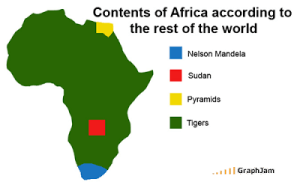
Me: Fine. Your study was perfect and its results are amazing. But you said Africa and the study takes place entirely in Uganda and treating Africa as a uniform mass is racist.  Why don’t you just talk about your tiger prevention efficacy?

africa

The paper graciously conceded my last point, but it knew my heart wasn’t in it. There is no end to the number of follow up studies one can suggest, but this is as good as a single study can be, and I accepted their conclusions. Founding afterschool clubs for girls in Uganda, with a mix of social activities and vocational, and health education, has pretty amazing results. $17.90 US (I know the exact number because the paper specifies it, which I love) spent on a girl translates to an additional $1.70 in monthly spending, almost a 50% increase (they tracked spending rather than earnings because self-employment earnings tend to be feast or famine. Employment also went up significantly), and a decrease in rape and child bearing. That means the program pays for itself in less than a year, and they get some additional benefits on the side. And to the researchers’ credit, the abstract trumpeted the less impressive community-wide numbers, when they could just as easily have used the confounded but shiny attendee numbers.

I mention this for two reasons. One: someone found a way to improve the bodily autonomy and earnings of African young women, basically for free. That’s neat. Two, I read this paper the morning after spending hours on a HAES post (which you may or may not ever read because wordpress ate it, thank you very much. WordPress ate this one halfway through too, so what you read is a cliff’s notes version of my original Socratic dialogue). The HAES post was enormously frustrating, because of the two claims I investigated, I found one (that cyclic dieting, rather than current weight, increases blood pressure) to be pretty misprepresentative of the data, and the other (high blood pressure hurts thin people more than fat people) pretty well supported…for a medical claim. By which I meant the evidence came from either retrospective studies (too many confounds to contemplate) or rats specifically bred to have the physical fitness of an aging Tony Soprano. That is genuinely good for medical research, and that fact is really frightening given how much is riding on getting the correct answer.

So when I read this paper, and see the study is well designed, they explain their modeling in a way an educated non-expert can understand, and they refuted every one of my criticisms, I felt a kind of relief. I’m not quite ready to say “trust the experts”, but at least I didn’t spend two hours tracking down reasons to not trust them

*If something goes from 10% to 20%, that’s an increase of 100% but only 10 percentage points. Switching between the two and failing to give the absolute percentages is a common trick for making data look more impressive than it is.

**Confounding variable, i.e. something that varies between your control and treatment group that is not the thing you are studying, and affects outcomes. The most popular confounding variable is time, e.g.

Pirate_Global_Warming_Graph
But here I’m worried about motivation: girls who show up to a club to learn entrepreneurial and life skills are probably more likely to start businesses and delay marriage than those that don’t attend,

Leptin: Catching Chemicals

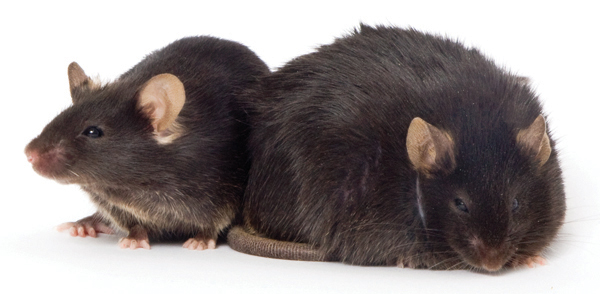
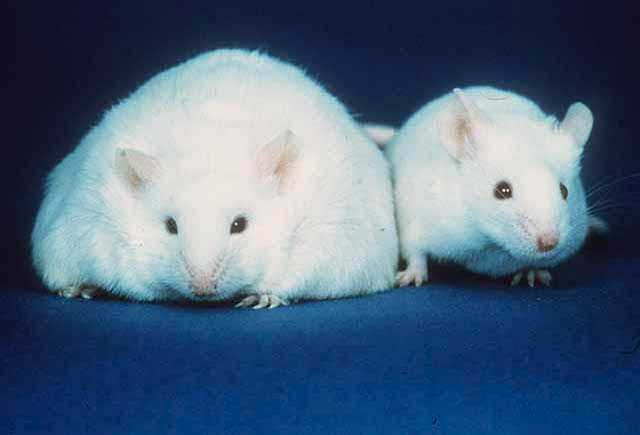
Leptn is often considered the anti-ghrelin.    It is produced by fat cells to say “I exist and am full, you do not need to feed me.”  Animals with their leptin gene knocked out grow enormously fat.  This is a perfectly lovely story that can be conclusively proven by a picture of a fat rat.

Figure2diabetes
Bring me Solo and the wookie

If you do not find this story compelling, please consider that I also have a photo of a fat mouse.

Well, if it isn't Lone Star. And his sidekick, Puke
Well, if it isn’t Lone Star. And his sidekick, Puke

Are you convinced yet?  Look, I know last week I said all hormones are almost fractally complicated and anyone who says they completely understand one is lying, but that entry forever to write (thanks for publishing that a week early, wordpress), and this entry has pictures of obese rodents.  Surely you believe the rodents?

Original source: http://commons.wikimedia.org/wiki/File:Big_Fat_Red_Cat.jpg
If no, would a cat be sufficient?

*sigh* I’ve created a monster.

Like ghrelin, leptin is important to fetal lung development because, and I quote, “I don’t know stop asking me.”  Leptin is also produced by the ovaries, skeletal muscle, stomach (some cells produce both ghrelin and leptin), mammary epithelial cells, bone marrow, pituitary, liver, and of course adipose tissue.

Leptin stimulates ovulation and sperm production, which makes some evolutionary sense: getting pregnant when you don’t have the resources to carry it to term in a healthy way is extremely costly (men have to be nearly dying before they stop producing sperm entirely, but levels can drop incompletely before then).  This doesn’t explain why the ovaries (but not testicles) produce leptin, since they don’t have any independent information about fat stores.  This may be an example of an override (in which the ovaries decide they want a baby even though the rest of the body doesn’t believe it has enough fat), but the fact that I can come up with a clever anthropomorphization does not make an explanation legitimate.  You can sort of see why leptin facilitates the onset of puberty, since puberty takes a lot of energy.

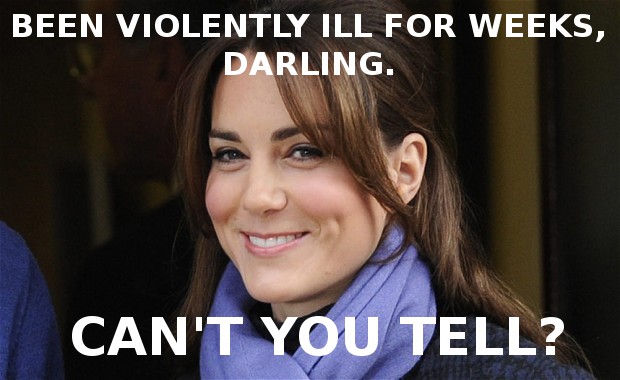
What you can’t see is why, despite everything we know about pregnancy and eating, the placenta produces leptin. Excess amounts appear to cause hyperemesis gravidarum (extreme morning sickness aka Kate Middleton’s one weakness).

katemiddleton

High amounts of leptin appear to be good for your brain.  Just so story: brains are extraordinarily expensive, so if you don’t have sufficient savings your body turns on the dimmer switch.  They also have a long term protective effect against Alzheimers.  On the other hand, high levels of leptin alter the immune system in a way that encourages artery hardening.  I am way more afraid of living with Alzheimers than I am of dying of a heart attack, so I will count this as one point for fat.

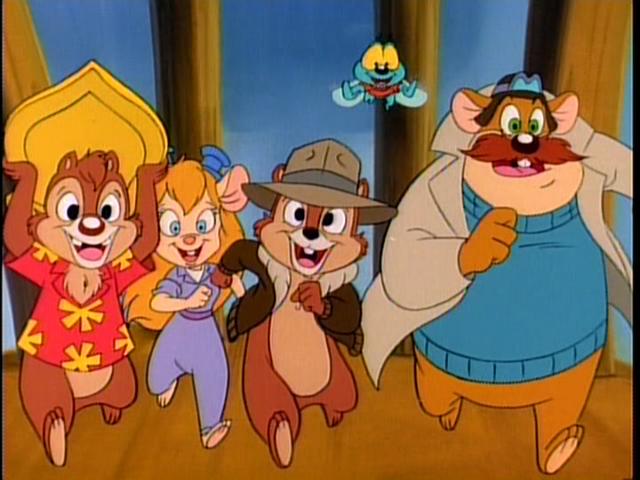
Leptin’s overall effect on the immune system is complicated.  Leptin is an inflammatory agent, possibly to prevent damage from overreating as your body suddenly tries to shove extra calories that won’t fit in the white adipose tissue under the bed and in the coat closet (the organs).  Which may explain why ghrelin is an anti-inflammatory.  Leptin and ghrelin chose opposite powers and color schemes, like an early 90s superhero cartoon.

Or an early 90s cartoon
The safe represents the hypothalamus

Fatness in humans does not appear to be a problem of inadequate leptin production, and more leptin does not make people thinner.  Instead, it appears that the brains of obese individuals are less sensitive to leptin.  No one knows exactly why, but “crash dieting” is high on the list of suspects.  Two people with identical body compositions but different genes or life history may produce very different amounts of leptin, which means they may require very different behavior to stay the same weight, in ways we do not understand at all.  Which I could have told you before we went on this magical photographic tour of my childhood.  But now we know for sure, plus I learned that fetal lung development is creepily intertwined with food in a way no other organ is.  Let us go forth and use this new knowledge

The Rescue Rangers also want me to play video games.

Contempt and Complacency

My current surgical dentist recommended some things fairly far outside the mainstream.  I went to my old dentist for a second opinion, and she very solemnly informed me that his recommendations were outside the mainstream.  I explained that mainstream medicine had had nine years with this problem and only made it worse, whereas his one operation had made things better.*  She repeated that conventional treatment for my symptoms was to do something else.  I explained his specific hypothesis about the root cause of my symptoms, which had a coherent narrative and made specific testable predictions.  We had tested it once and the predictions were upheld.  She repeated that conventional treatment for my symptoms was to do something else.  I asked her what her explanation was for the problem, accounting for  the symptoms, imaging, failed treatments and the one successful one.  I asked her if she would have recommended the surgery I already had, which had been conclusively proven necessary.  I would have eventually died without it.  She repeated that conventional treatment for my symptoms was to do something else.

This woman wasn’t evil, or trying to profit.  She didn’t even charge me for the visit.  She followed up with other practitioners and with some additional data I sent her afterwords.  When her words failed to convince me, she was was genuinely sad and worried that I was going to hurt myself.  But she was simultaneously completely unable to wrap her head around the actual evidence in front of her.  And while her concern for me is touching, the fact that it centered on a treatment that was helping and not any of the treatments that made it worse is pretty damning.

This is one of many examples of why it pisses me off when people deride medicine outside the mainstream (including but not limited to eastern and “natural” medicine) and mock those stupid enough to believe or even try it.  Conventional medicine does some things very well.  If I get in a car crash, take me to the hospital.  But if something is consistently failing, the smartest, most scientific, most rational thing to do is look at other options.  And if those other options succeed based on the scientific method (ideally with large studies, but scaled down to n =1 if necessary), that is evidence in their favor.

I used to express this as “Yeah, and you said Mesmer was a danger because his patients stopped blood letting” or “You don’t get an opinion until you start washing your hands“, but now I have an even better example.  The American Academy of Pediatric Dentistry’s position on soda used to be “Are you kidding me?  Of course kids shouldn’t have soda.”**  But when Coca-Cola gave them a million dollars, the president defended it by saying “Scientific evidence is certainly not clear on the exact role that soft drinks play in terms of children’s oral disease.”***  I’m not saying alternative practitioners are all brilliant bastions of moral purity.  Some are idiots, some hurt people for money.  I’m just saying that “hypothesis that passed many tests” is a better proxy for correctness than “recommended by large medical association” is.

This is highly related to Scott Alexander’s cowpox of doubt.  If you spend too much time on easy problems you start to believe all solutions are obvious, and anything new must be not only wrong, but dumb.  It breeds a contempt for uncertainty that is inimical to discovery.  And this is why I’m considering a broad anti-contempt stance, even though contempt is really fun and a fantastic group bonding exercise.

*Of course it’s too soon to know if this will last forever, but none of the conventional treatments had worked even briefly.

**Exact words: “…frequent consumption of sugars in any beverage can be a significant factor in the child and adolescent diet that contributes to the initiation and progression of dental caries.”

***Original source: Health at Every Size, which I am side eyeing for implying that this was an official change in policy.  The position paper on the AAPD’s website still condemns soda, juice, and even formula.

Cannibidiol for pain: a partial retraction

Earlier I described CBD as having absolutely no effect on cognition.  This turns out to be wrong.  I’ve subsequently found that CBD does impair cognition somewhat relative to optimal, it just does so less than pain.  And at least for me, it doesn’t wear off quickly: if I take it at night I’m in less pain the next day, but I also have trouble focusing for long periods and doing truly complex work.  It feels like I can’t get far enough away from problems to see the whole of a thing.  If my choices are “in pain and dumb” or “not in pain and dumb”, I choose door 2, but this does make me more forgiving of NSAIDs.

In other news, they finally took my bone spur out and wow, I’m in a lot less pain.

Why Jezebel is Wrong that Cats Don’t Care About You.

Jezebel has a post titled “Why House Cats Generally Don’t Care (About You)“, in which they assert that cats don’t care about humans because they’re so close to wild cats.  Where do I start with this?

  1. The claim that domestic cats are closely related to wild cats is not backed up by numbers.  Jezebel claims ” house cats may not be that genetically different from wild cats”, citing sister site io9, which in turn cites a summary (warning: PDF) of the base article for its claim that the feline genome is “highly conserved.”  (Jezebel eventually links to the full article, but only the abstract is accessible)
    1. I’m not sure it’s actually wrong to describe an entire genome as highly conserved, but the term is usually applied to specific genes or even gene sequences, not entire genomes.
    2. You know what is a good system for measuring how different two things are?  Numbers.  For example: humans and common chimpanzees share 97% of their DNA.  Eyeballing it, it would not surprise me at all if domestic cats were more related to their ancestral wildcat than humans to chimpanzees.  I don’t see any numbers in either blog post or any of the article summaries I have access to.
  2. Despite numbers being excellent at measuring things, genetic similarity does not correlate very strongly with behavioral similarity.  For a fascinating example of see the fox domestication experiment, in researchers attempted to breed fur-farm foxes for tolerance of humans.  They succeeded in less than 40 years.  


    1. Domesticated foxes vary from undomesticated fur-farm foxes by only 40 genes.  They tragically don’t give a total gene count, but farm + domesticated foxes different from wild foxes by 2,700  genes, so 40 is almost 0%.  Nonetheless, undomesticated adult farm foxes will either bite your face off or cower from you, and domesticated ones want tummy rubs.

      .  We’ve had thousands of years with cats, we could make them want tummy rubs if we wanted.

  3. Which we have done.  Jezebel seems to be ignoring variation between breeds and individuals.  Certain breeds, like burmese, scottish fold, and Maine coon, really love and orient towards humans.  They don’t have dogs ability to read human facial expressions, but they do seek out their owners for attention, even when no food is on offer.  My cat loves tummy rubs and will fetch his favorite toy, although he has yet to realize people other than me can throw them.
  4. Meanwhile chow chows, one of the earliest dog breeds, possibly originally intended as food, are described as “cat like” because they’re so independent, and need extensive socialization to even tolerate strangers.
  5. Jezebel also comments on cats’ hunting behavior.  What they say is true, but it’s equally true of dogs: domestic and wild, feline or canine, animals have hunting behavior built in but need to be taught to eat what they kill.

And thus concludes your daily dose of Someone Is Wrong on the Internet

And now for a completely different kind of sexism

Last week there were a bunch of very angry articles about some douchebags who want to make vaginas smell like peaches, implicitly because the current smell is gross, which is why they grouped it with their product to make pet shit smell like bananas.  Aside from all the body shaming, I heard “vagina” and “peaches” as “yeast infection” and my legs immediately slammed shut.  Vast swaths of people immediately jumped on the company as misogynistic.

It turns out that Sweet Peach is actually a pretty cool company.  It was founded by a “ultrafeminist” woman who wants to facilitate vaginal health by giving users individually-tailored probiotic supplements, based on a microbiome census.  I love everything about this idea.  She doesn’t want to make vaginas smell like peaches because that would be stupid, she named the company Sweet Peach because it’s hard to get a business checking account for Sweet Vagina.

The article didn’t misquote the speakers though.  One was an investor in Sweet Peach, the other was the owner of a different company he invested in (whose end goal really does seem to be making pet shit smell like bananas).  They definitely referred to Sweet Peach as their company, without even mentioning its actual founder Audrey Hutchinson.  “Not mentioning Hutchinson as the founder or including a photo of her among his slides was a mistake”

This story may be the perfect microcosm of everything I think about Silicon Valley.  You have this really cool idea pursued for altruistic reasons, and some douchebags trying to take credit for something that sounds awful.  All you need is a mention of the cloud and it’s the total package.

Your Annual Reminder: Tryptophan Does Not Make You Sleepy

Turkey isn’t even that rich in tryptophan  If you get sleepy tomorrow, it’s because you ate 4000 calories.  An insulin spike may be involved (more about this next week).

But! I did learn some interesting things researching this.  Wikipedia’s entry on food comas says that tryptophan bypasses the blood brain barrier and is converted to seretonin and then melatonin, which makes you sleepy.  It’s two sources refer only to plasma concentration, nothing suggesting tryptophan leads to an acute spike in melatonin (caveat: I only have access to the abstracts).

Meanwhile, webmd believes that protein is the only nutrient Americans get too much of, which suggests to me they don’t understand that sugar, fat, and salt are nutrients, or are idiots.

Different things for the same name

I’ve picked up enough scientific/medical Latin and Greek that I can often guess what a new term refers to without looking it up. Of course 50% of that comes from knowing “itis” means “inflammation”, but I’ve picked up other terms too.

The problem is that even English -> Science translations are ambiguous. In psychology, “displacement” means redirecting an emotion from the cause to a new target (e.g. you’re mad at your boss so you punch a wall). In the closely related field of animal behavior, displacement means taking the energy of a negative emotion it can’t act on and investing it in something positive (e.g. your cat licking itself after it hears thunder).  Over in physics, it means physically moving something out of the way, which is probably the closest to the conversational definition.

Latin -> Science -> English is even worse. Take parabiosis. It literally translates to “living next to”, which could mean the perfectly reasonable “two species living in very close association with each other, without noticeable benefit or cost to either”. Or it could mean “sewing the circulatory systems of two different animals together so they can share blood forever.” This is useful when you want to test if blood borne chemicals are relevant to a system but have no idea which chemical might be relevant, e.g. testing how aging affects recovery from trauma. AKA Elizabeth Bathory was on the right track.

If you read that and are wondering if you can maintain eternal youth by sewing yourself to a college student, the answer is probably no. The mice must be heavily immunocompromised to avoid mutual destruction via the immune system (although I wonder if this could be combated with cloning.  Hypothetically.). But having discovered that pigeon-rats are a very real possibility, I am excited/afraid to discover what other Simpson’s Halloween episodes we can make real.

On a more serious vocabulary note note, I’ve been using Iodine’s in-browser medical translator, and I’m shocked at how helpful it is.  You wouldn’t think Highlight-rclick-google search is that taxing, but compared to seeing the definition instantaneously and in context, it feels like an enormous waste of working memory.    My only complaints are that it doesn’t autotranslate words in links, which are often exactly the words I want to know the meaning of, and that it’s strictly medical rather than biological, so it skips a lot of basic science words.

On Racial Injustice in America

This blog is a testimony to my willingness to talk about things I’m not an expert in. But when it comes to Ferguson, I can’t think of anything to say. It’s desperately important, and I want to add my voice to the chorus saying This Is Wrong, because it is, and because so many white Americans’ response to Ferguson was to support the cops. But as a white American I have no first hand experience with the kind of systemic racism that killed Michael Brown, and everthing I try to write feels like I’m pretending I do.

I went to a protest today, but it didn’t give me any insights. I can’t even claim to be a good source of referrals, because I haven’t read that much about Ferguson. I’ve been reading about these kinds of murders for years, and it took me a long time to realize this one had gone mainstream. My Facebook feed is filled with great articles on many aspects of the case, but none seem like the right intro for people who aren’t already convinced, and if you are convinced you can find them on your own.

The best long term source I know on racism in America is Ta-Nehisi Coates, and while he hasn’t talked extensively Ferguson, he’s talked well.  I also encourage you to give money to support the residents of Ferguson or the legal rights of the protestors, and to be physically present for protesters in your town.  No one has any math on how effective protests are, but this is not something you can buy your way out of.

Book review: Why Does He Do That, by Lundy Bancroft

The best part of Why Does He Do That? was the description/definition of abuse, which he doesn’t give formally until very late in the book.  Abuse arises from a miscalculated sense of entitlement.  Anger and substance abuse issues may influence how someone expresses those entitlement issues, but are completely orthogonal to its existence.  This is, according to the author, why conventional therapy is useless as a tool against abuse.  Modern therapy is explicitly aimed at helping patients meet their own goals.  Anti-abuse treatment is aimed at teaching someone their values are wrong and changing them.

The difficulty with this definition is it requires knowing *everything* about a situation before you can decide if abuse took place.  Someone telling a partner “Don’t go on that hike with your friends, your knee will hurt for days” could be an abuser isolating their victim, or an abuse victim trying to prevent pain their partner will take out of them, or a genuinely concerned partner in a healthy relationship.   You just don’t know until you know the state of the person’s knee, how they usually act after long hikes, whether there’s a pattern of isolation attempts, support of other endeavors…So you can’t help but come out of this book seeing abuse everywhere.

Given how wonderful the book was in understanding the psychology of abuse, I was extra disappointed to see the author so dismissive of female-on-male abuse.  He acknowledges that men can be abused (by other men), he acknowledges that women can abuse (other women), he acknowledges that men and women can be abused by people physically smaller and weaker than them (because no one tolerates physical abuse until emotional abuse has broken their defenses), he acknowledges the role of various privileges (money, citizenship, education, etc) in same -sex abuse, but he insists that there is no way a man can ever be abused by a woman.  In fact, he says a man accusing a female partner of abuse is a sign that he is abusive. I don’t doubt that most accusations of female-on-male abuse that this guy hears are false, because he’s hearing them in a program for male abusers.  And I suspect that the kind of entitlement he’s describing is more prevalent.  But categorically denying the possibility of the reverse is dangerous and damaging to male abuse victims and ultimately, because it constrains our conception of what abuse can be, female victims.

I am also really uncomfortable with the book’s title and associated goals.  It doesn’t actually matter why a person is abusive (which Bancroft agrees with).  And in many ways, it doesn’t matter if it’s entitlement leading to official Abuse or a sick system, because either way you have to leave.  But I acknowledge that the descriptions of abuser-types could be helpful to victims who think it can’t be abuse because he’s not throwing a lamp at you.

Overall, I think this book has some really good points and brings a lot to the table.  It also propagates some really toxic ideas.  I would absolutely listen to this author if I wanted to treat abusers.  And if I had a friend in a bone fida abusive relationship, I think this book could be helpful.  But it is the last thing I would use as abuse prevention, and especially the last thing I’d give to a young person starting to date. For them, I want a model of healthy relationships,  teaching in how to maintain them, and the self esteem to leave when they can’t.