To take a straw yet real example, consider the phrase “mindfulness for sales”. This is so against the purpose of mindfulness it hurts me. On an object level you can’t do mindfulness for any particular thing. Mindfulness gets you in touch with what is already there. It could help your sales or it could make you realize you hate sales and need to quit today. Your higher brain can choose when to engage in mindfulness when it predicts particular benefits, but if you go into it gunning for a particular outcome you won’t get anything at all.
“Mindfulness for relaxation” is not nearly as bad, but it still bugs me. You can’t choose what emotion predominates at any given time. If you have a lot of negative emotions running around (because, say, your nerve damage is acting up and your job pulled you off a useful project where you were learning a lot and pushed you onto a project no one asked for requiring skills you don’t have and aren’t given time to properly learn), mindfulness will be painful. If you continue through it you may well get that relaxation, but if you’ve been told meditation will be a spa experience you may well give up because apparently you can’t even breathe right.
Just to pick an example.
Being told that strong negative emotions weren’t a sign of failure was really game changing for me. One, it let me do mindfulness work and get mindfulness benefits out of it, even if they weren’t relaxation. Two, it enabled me to see why mindfulness wasn’t relaxing for me and look for something that was, which I eventually found. I’ll talk about that tomorrow, but in case there’s anyone like me that really wants what meditation promises and hasn’t gotten it, I wanted to spread the word.
Recently I read Poor Economics, which is excellent at doing what it promises: explaining the experimental data we have for what works and does not work in alleviating third world poverty, with some theorizing as to why. If that sounds interesting to you, I heartily recommend it. I don’t have much to add to most of it, but one thing that caught my eye was their section on education and IQ tests.
In Africa and India, adults believe that the return to education is S-shaped (meaning each additional unit of education is more valuable than the one before, at least up to a point). This leads them to concentrate their efforts on the children that are already doing the best. This happens at multiple levels- poor parents pick one child to receive an education and put the rest to work much earlier, teachers put more of their energy into their best students. Due to a combination of confirmation bias and active maneuvering, the children of rich parents are much more likely to be picked as The Best, regardless of their actual ability. Not only does this get them more education, but education is viewed as proof one is smart, so they’re double winners. This leaves some very smart children of poor parents operating well below their potential.
One solution to this is IQ tests. Infosys, an Indian IT contractor, managed to get excellent workers very cheaply by giving IQ tests to adults and hiring those who scored well, regardless of education. The authors describe experiments in Africa giving IQ tests to young children so that teachers will invest more in the smart but poor children. This was one of the original uses of the SATs in America- identifying children who were very bright but didn’t have the money or connections to go to Ivy League feeder high schools.
This is more or less the opposite of how critics view standardized testing the US. They believe the tests are culturally biased such that a small sliver of Americans will always do better, and that basing resource distribution on those tests disenfranchises the poor and people outside the white suburban subculture. What’s going on here?
One possible explanation is that one group or the other is wrong, but both sides actually have pretty good evidence. The IQ tests are obviously being used for the benefit of very smart poor children in the 3rd world. And even tests without language can’t get around the fact that being poor takes up brainspace, and so any test will systematically underestimate poor children. So let’s assume both groups are right at least some of the time.
Maybe it’s the difference in educational style that matters? In the 3rd world, teachers are evaluated based on their best student. In the US, No Child Left Behind codified the existing emphasis on getting everyone to a minimum bench mark. Kids evaluated as having lower potential than they actually do may receive less education than they should, but they still get some, and in many districts gifted kids get the least resources of any point on the bell curve.
Or it could be because the tests are trying to do very different things. The African and Indian tests are trying to pick out the extremely intelligent who would otherwise be overlooked. The modern US tests are trying to evaluate every single student and track them accordingly. When the SATs were invented they had a job much like the African tests; as more and more people go to college its job is increasingly to evaluate the middle of the curve. It may be that these are fundamentally different problems.
This has to say something interesting about the meaning of intelligence or usefulness of education, but I’m not sure what.
The bouba/kiki effect: cross-cultural agreement in what certain shapes “sound” like.
US Military released bacteria they thought to be harmless onto an American city. 239 times. Spoiler alert: was not harmless. Other people have covered the whole “jesus christ the military proved America was vulnerable to biological warfare by committing biological warfare” part, so I’m going to focus on the harmless part. The US government, and humans in general, have a nasty tendency to say “harmless” when they mean “you can take it.” Most humans could shake off the bacteria they were using; it was only a problem in a small portion of the population that couldn’t fight it. I’ve heard the same thing about the pesticides they used to kill mosquitoes to prevent West Nile: totally harmless because the human liver is amazing, hard on those without that super power.
Opportunistic bacteria aren’t all bad though. Glow in the dark bacteria saved civil war soldiers from septicemia.
UK government spies on children for thought crime, ends up leaving them vulnerable to hackers. And by hackers, I mean anyone who attempts the password “password.”
Sydney, my co-organizer for Seattle EA, talks about money, class, and effective altruists. I was part of the problem here: when people talked about discomfort with the emphasis on money in EA, I assumed they meant donations. The idea that the money spent during meetings would be an issue literally never occurred to me. Also, with God as my witness, I thought going around saying “la la la everyone’s a programmer la la la is anyone here not a programmer? because that would be notable” was helping. I think I was trying to avoid the problem of claiming there’s more diversity than there is and overcorrected. I also think this is a specific instance of the general difficult of owning your advantages without rubbing it in, which is made much more difficult by the fact that one of our goals is giving people a place to brag about giving.
I find most meat gross, but bacon is an exception. Unfortunately pigs are really smart, to the point I mostly avoid pork even though I eat other animals. Science is helping me out by investing kelpt that tastes like bacon with a better nutritional profile than kale. I’m skeptical, because nutrition is part of what generates taste so having that many vitamins should make it taste different, and seaweed usually isn’t 50% fat. But I’m hoping the collective wishing of everyone reading this will make it so.
80,000 hours says few effective altruists should earn to give as their permanent plan. I’m a little annoyed that it’s framed as “your beliefs about us are inaccurate” when the truth is more like “we changed our minds”, but if you ignore that it’s good context. My own take on it is that if the idea of EtG sounds like permission, you should do that. If it sounds like an obligation keeping you from direct work, EtG is a strong default to occupy you until you have the skills and opportunity to do direct work.
This week’s beautiful gang of theory killed by an ugly gang of facts: You know that woman who was committed for saying Obama followed her on twitter when he actually did follow her? The truth is more complicated. I’m embarrassed to admit this didn’t occur to me.
Apparently real life is not like Trauma Center and tumors don’t come with fun perforated lines showing you where to cut.
I was shocked too
Real cancer looks almost identical to the tissue that spawned it, which makes it easy to cut too much or too little. Luckily, science is on it. Here is a TED talk by Tal Danino about releasing bacteria that can only live in tumors, and fluoresce when they reach a certain density:
This is meant as a diagnostic tool. But once you know cancer is there, separating it from the tissue is still an issue. For that I direct you to Quyen Nguyen’s work with florescent stains. Her lab produces a variety of stains in different colors which stain different tissues (she demos on cancer and nerves) to show surgeons what to and not to cut
Hey everyone- I’m travelling a lot this week and while I have produced an impressive number of half posts, nothing is quite ready to go. But! If you are in the SF/Berkeley area, I will be near you for the next few days and we should hang out. You can email me at elizabeth@ this domain name.
PS. Please don’t rob my house, it would make things weird with my house sitter.
Reading The Remedy, or really anything about the time after formalized western medicine but before the germ theory of disease, is an exercise in terror or frustration. How could anyone think attending a childbirth with autopsy gunk on your hands was a good idea? Or leaches. Who looked at those and said “I’ll bet those will make people healthier”?
My first reaction reading The Colony, about a Hawaiian leper colony founded shortly after the germ theory became entrenched, was “oh no doctors, you overapplied the lesson.” Leprosy has an epidemiology a lot like tuberuclosis: long periods between infection and symptoms, and an ease of spreading that means everyone is constantly exposed to it. This makes it look like an inborn condition, not a contagion. Leprosy and TB are actually pretty closely related too. I assumed that doctors looked at their failure with TB and overcorrected. It didn’t work because only a small fraction of people are suspectible, and (it’s implied although never stated outright) they will be exposed to it whether symptomatic patients are quarantined or not.
Then I remembered that shunning lepers* predates germ theory by a couple of thousand years. Ancient and medieval people were completely capable of identifying disease as contagious and instituting a separation. So why didn’t industrial-age doctors?
Then I remembered that while the peasantry considered it obvious that disease was contagious and should be shunned, they considered it equally obvious that leprosy was punishment from God for sin and the black plague could be avoided by killing Satan’s minions, the cats. Nobody talks about all the things everyone knew that doctors correctly disbelieved in.
Without a lot of proof, I strongly suspect that doctors signaled intellectual rigor and membership in the medical class by disbelieving things the peasantry believed. Believing things the peasantry does believe doesn’t signal either of those things even if the belief is correct. No one gets credit for believing eating food is good and eating Belladonna is bad. If you’re not very careful in that environment, it’s easy for peasants’ belief in something to become evidence against it.
This is similar to the process of the toxoplasma of rage, in which people signal membership in an ingroup by loudly believing its most dubious claims. I also highly suspect it’s what’s going on with dietary constraint and toxins. It is obviously true that what you eat matters, some things you put in your body will damage your cells, getting rid of them is good, and there are things you can take to get rid of them. It’s called heavy metal poisoning and chelation. Or if you’re Huey the dopamine dog, chocolate and activated charcoal. But dietary constraints and belief that specific things were bad for you got associated with special snowflakenes, so you can signal intellectual rigor by dismissing them. This despite the fact that nutrition obviously makes a difference in your health, that humans vary across many dimensions and there’s no reason to assume they wouldn’t vary across digestion and nutritional needs. Likewise things we put in our mouth obvious have the capacity to hurt us and there’s no reason to assume we have an exhaustive list of those, or that they’re identical across all humans.
In D&D terms: people are advertising their will save bonus by how credible an idea they can disbelieve. No one wants to be this guy:
[Thor rushes Loki, only to run through the illusion and trap himself in the cage]
Disbelieving everything is an easy way to be right most the vast majority of the time. For every correct idea that’s an almost infinite number of wrong ones, and even those that are true are incomplete (see: physics, Newtonian). But if everyone disbelieves everything, we will never discover anything new.
I’m not in a position to criticize anyone for being frustrated at people for being wrong. I lived that life for a long time. But I try to counter it now by remembering that humans aren’t really capable of distinguishing “laughably wrong” from “correct, and world changing” without investing a lot of energy. If there aren’t negative externalities and they’re not asking anything from me, their investment in their crackpot idea is something like an insurance policy for me, or a lottery ticket. Most won’t pay off, but when they do I’ll be glad they were there.
“Minimal negative externalities” and “at no cost to me” are important caveats. Children need vaccinations, and I don’t want the government paying for medicinal prayer. But if a functional, taxpaying citizen wants to spend their own money to get their chakras realigned every six months? Yelling at them seems like a waste of energy. Hell, they may have a genetic variation that enhances the placebo effect to the point it is medically significant. The human brain is weird and we don’t even know what all the pieces are, much less how they work. If someone investigates something that’s a positive for me, even if all they do is conclusively prove it doesn’t work.
You can believe people are wrong, you don’t have to accept all ideas as equally valid. But what I would suggest, and what I’m attempting to do myself, is to make the amount of energy you put into your disbelief proportional to the harm the idea causes, not its wrongness. To have wrong ideas drop out of sight, resurfacing only if they cause problems or turn out to be a winning lottery ticket. I think that on net this leads to a better world, and in the meantime I’m calmer and less annoyed.
*Which really means shunning anyone with skin discoloration, ancient people not being entirely up on their bacteriology.
So you’re saying yelling at myself for an unwanted emotion is…not…helpful? But then how will my brain know it was wrong?
Speaking of which: they discovered a new organ in the brain. It’s always been there, we just didn’t notice till now. Like the biological equivalent of the faceless old woman who secretly lives in your home. The new organ is lymph tubes that drain lymph fluid from the brain to your lymph nodes, which means the brain is more connected to the immune system than we thought.
Science also discovered a tiny lobster that eats bacteria and lives on deep sea thermal vents.
4500 words on energy work and neurology. I love this because it’s so respectful of people’s experiences and the long tail of what the work can accomplish, while being really rigorous with the explanation. Caveat: does not actually cite any science for explanation. But I still found it useful and interesting. Also it taught me the word psychoneuroimmunology, which is even better than neuroendodontics.
One argument against earning to give is that people won’t follow through: the culture will corrupt them and they won’t give. Will Macaskill points out that people dedicating their lives to charity don’t have a 100% follow through rate either. The miserable conditions we expect people to tolerate because “it’s for a good cause” (read: you’re selfish for asking for more) are a recipe for burnout. Half of all teachers quit in their first five years, and high poverty schools have a turnover rate of 20%. That’s not actually that much higher than other professions- but 40% of people who pursue an undergrad teaching degree never teach at all (source for all). The best number I can find for nonprofits as a whole is that 45% of young workers expect their next job will be at a for-profit. Would love to see comparable numbers on earning to give.
As a follow up to yesterday, I just want to say that having a thing I look forward to that I can only do on the bus is working out brilliantly as a device for making commuting less miserable and it was totally worth buying the Kindle Fire to make it happen. If you want to try for yourself, I recommend getting the 16gb, the 8gb could barely hold three HD episodes. I also recommend an anti-glare screen, because its glare is awful and the screen picks up fingerprints like woah.
The next recommendation is a little weirder. I bike to the bus, which means I’m in biking clothes and have to maneuver my bike onto the cow catcher. This makes waiting for the bus a little tricky- anything I have in my hands will have to be put away really quickly so I can rack my bike and get on, but I have no pockets. And for reasons that may not be entirely rational, the time it takes to unsling my backpack and put a toy away makes me really stressed out. But if I don’t use a toy the time at the bus stop is wasted, and that’s stressful too. What I wanted was a way to make the whole of commuting feel either productive or like an indulgence.
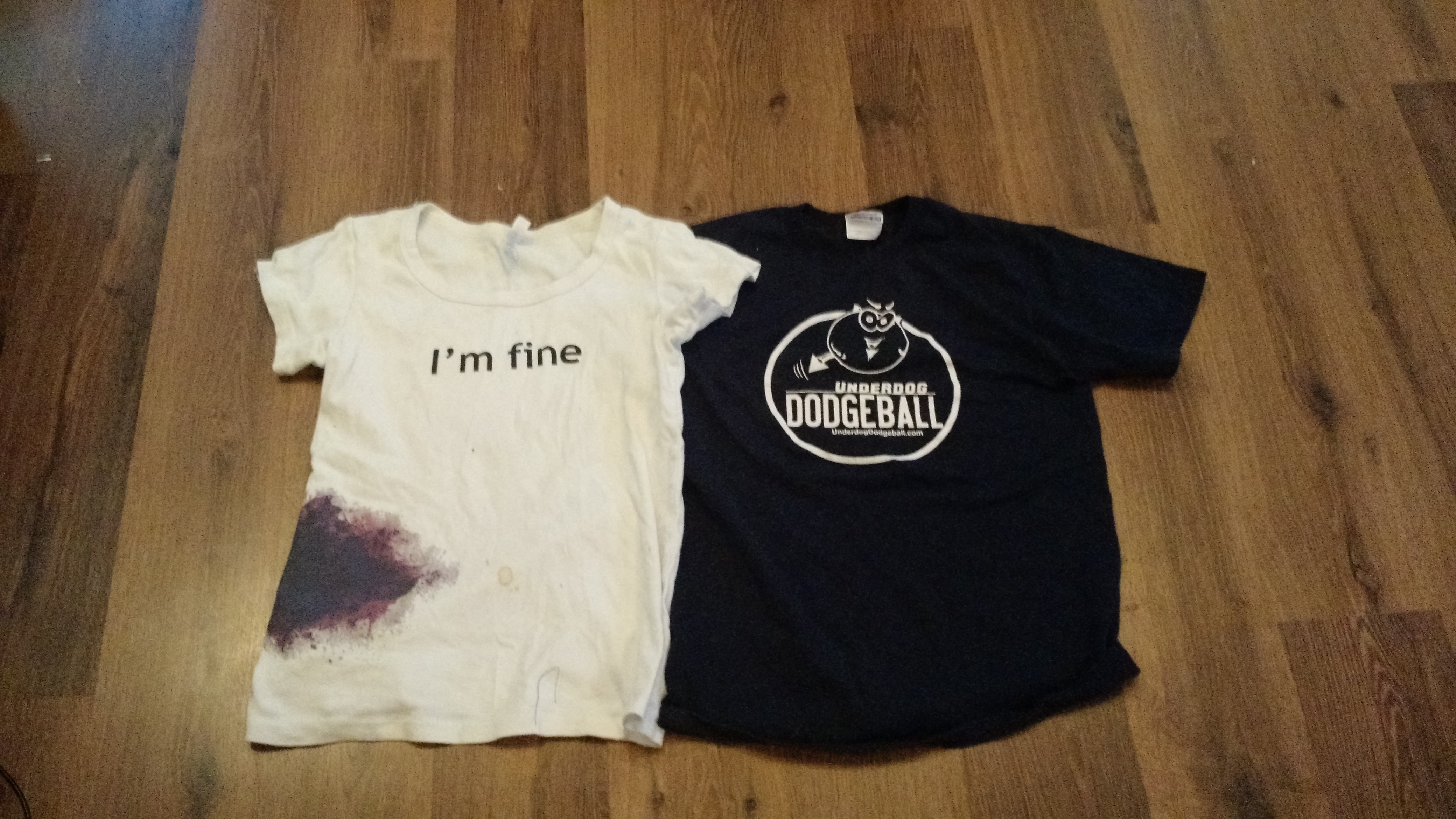
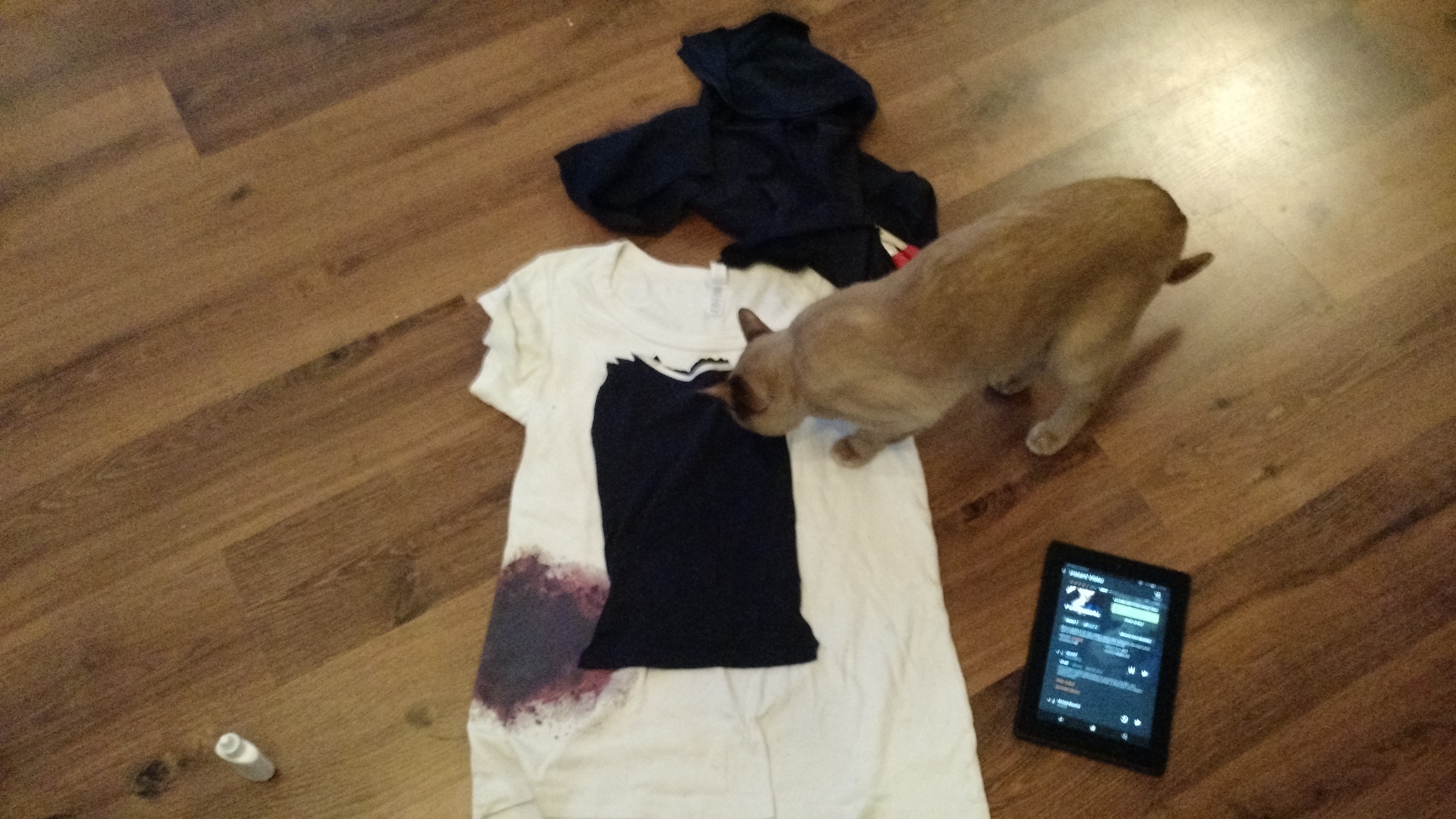
So I made myself a shirt, out of two shirts and some fabric glue.
Two shirts enter, one shirt leavesI believe my cat may have been getting high off the fabric glue.
Steps:
Place desired toy on shirt, cut patch around it. Leave space for depth.
Put fabric glue on single edge of patch and apply to surviving shirt.
Lock cat in other room.
Reapply patch to surviving shirt. Once you have it aligned, apply glue to other two edges and apply (you leave the top open so it’s a pocket). Remember to apply it less than completely flat, so the pocket will have depth.
I don’t know if this is a property of the fabric glue, my shirt, or this project in general, but some of the glue filtered down such that the base shirt was glued to itself and the patch ran free. If you catch this early enough you can separate and try again.
This shirt is not aesthetically pleasing and is weirdly stiff where I overapplied fabric glue, but it gets the job done.
[explicit spoilers for episode 1 of Hannibal, implied spoilers for 2 and 3. I haven’t seen past that but I am making predictions about what will happen]
My need to make movies make sense is most obvious when it comes to animal behavior*, but that’s not its only manifestation. Take police procedurals. I made Bones tolerable by saying la la la science fiction. I’m now watching Hannibal because it’s one of the best shows available on Amazon Prime Streaming, which is the only streaming service that allows offline viewing, which is important because I have a bus commute again.**
Hannibal… does not make a ton of sense. The premise is that an ex homicide detective is a brilliant criminal profiler but unable to get into the FBI because he couldn’t pass the psych screening, so they just hire him as a “special agent” that does everything a normal agent does, including field work. You would think that was Hannibal Lecter, but it is not. Lecter is the psychiatrist the FBI hires to babysit the unstable profiler (who I can only imagine will one day regret copying Lecter’s answers off a psych test). Lecter also accompanies the agent on field work, which I don’t think even regular FBI agent’s counselors are normally allowed to do. The actual profiler (Will Graham) comes up with theories more or less out of thin air and they always turn out to be correct. He insists the evidence makes it obvious.
On the face of it, this makes no sense. But what if Hannibal is set in a just slightly alternate universe, where psychic powers exist but are considered shameful because they make people mentally unstable? The FBI can’t officially hire them, and they in fact test for powers before hiring to make sure they don’t hire any psychics. But if there just happens to be a profiler who makes totally evidence based leaps, enabling them to catch really gruesome serial killers they otherwise couldn’t, well surely you can hire them on a contract basis.***
Why doesn’t the psychic Graham notice Hannibal is murdering and eating people? I’m glad you asked. Hiring a babysitter for a psychic is tricky business. You wouldn’t want someone they could manipulate or even read, that would defeat the purpose. So you hire someone who’s a null field to psychics, or at least your psychic. As a bonus, this person can lie to them when need be. Note that Graham says he hates going to psychiatrists- presumably every one he’s been to has been unreadable to him, and he hates that.
And that’s how I learned to enjoy Hannibal.
*Ask my brother about watching the King Kong with me.
**”So you’re coping with your motion sickness by watching a show about food and gore?” “Yes”
***The same way my team at Microsoft rehired the same contractor for our Apple version over and over again.
First, it’s great, and totally reverses Pixar’s downward slide. Second, they did an amazing job of making everything work as a character/story and a metaphor for how the brain works and an Aesop. A good chunk of the time kids’ shows teach lessons I consider abhorrent (looking at you, My Little Friendship Means Never Having Boundaries) , and at the beginning it looked like they were setting up one of those, but in the end in became clear they considered it exactly as problematic as I did.
Also I need to see it at home so I can cry harder. That is all.