I said I wanted to get this done while the game was still in a Humble Bundle, and technically I succeeded, but it turns out it doesn’t matter because I’m not going to recommend it.
SOMA was sold as “Like Amnesia but sci-fi and underwater” and I love all of those things, so I had very high hopes. Hopes that were dashed. I don’t know if my tastes have changed since I played Amnesia or SOMA just wasn’t as good, but I stopped playing two hours in.
If we’re assuming the former, the problem is I’ve played a lot of puzzle games since Amnesia and my standards have gone up. Both Amnesia and Portal have puzzles so you have something to do while running from monsters and…eh. I thought I was cheating myself by looking up solutions so often, but then I solved a few myself and there was still no sense of satisfaction. It’s more just testing what the environment will let you do until the problem somehow goes away.
I was intrigued enough by the story to look up the ending. If you’re looking for something with similar themes, less terror, and better puzzles, I strongly recommend The Swapper, which remains one of my favorite games of all time.
In summary: Manganese is an essential nutrient and too much will kill you.
On one hand we have people exposed to manganese is the air from industrial processes. These people definitely get Parkinson’s like symptoms, and in the aggregate score lower on various intellectual tasks. Monkey infants on soy formula (which has more manganese than milk based formulas) had mild neurological effects, so you can take in enough from food alone to be dangerous.
On the other hand, manganese superoxide dismutase is the only thing keeping your mitochondria from melting, and it does several other things besides. So we can’t just throw up our hands and say “no more manganese”, we have to actually figure out a safe level.
The World Health Organization has set the No Observed Adverse Effects Level at 11mg/day, based on the observation that some humans naturally get that much through their diet. As mentioned previously, we know you can get manganese poisoning through food alone, so this is not very reassuring to me.
The most comprehensive source I found on this was this thread on the soylent message boards (they cite several of the same things I did above, all correctly, so I trust their work ). According to their sources, most adults already eat enough Manganese to meet the RDA. I don’t want to put too much stock in the RDA, because neither I nor they could find out how the FDA (or the Linus Pauling Institute) set it. However even if you accept the number, if people are already getting it through diet, and too much is toxic, it doesn’t belong in a multivitamin.
This is worrisome enough to me that I’m tossing my multivitamin and focusing on getting individual missing nutrients through specific supplements (if anyone knows of a balanced B supplement, please let me know). It’s not so bad I’m tossing my protein/vitamin powder, because it has a lower volume of manganese and I don’t eat much at a time- however when it’s gone, I’ll probably switch to a straight protein powder.
When you hear “supply chain”, your first thought is probably not “let’s base a leisure activity around that.” But the world is so big and game development is so cheap now that that this does not stop there being more video games than I can play that cater to my taste in complicated supply chains. If you happen to share those tastes, here are some games to try:
Colonization: Built off the Civilization 4 engine. You build cities near resources on the map, which you can harvest using units of various skill levels, which can then be processed into various goods, again by units of various skill levels. Theoretically you need to build liberty so you can declare war against your colonial power, but I always quit before that stage, because why would I spent time on war when there are supply chains to build. You have to move goods between cities (for processing and selling to the mainland) manually, which makes this my low-thought comfort game.
Anno (1404): This is a whole series based on both trading and supply chains. I would say they made it just for me but there is a combat section :(. I’ve only played Anno 1404, supposedly the best of the series. Anno 2070 is set in post-apocolyptic water world, which seems like it’s even more for me, but it has annoying Ubisoft DRM so I’ve never actually played it. Anyway, the mechanics. James Recommends does a better job explaining than I will, but it is a video, so I will try anyway.
You start on an island that has all the resources you need to keep your peons alive, which you provide by building resource extractors (apple farms) and processing plants (cider mills). As you make them happy they evolve into better people, enabling you to tax them more and build new buildings. Which is good, because these better people have more demands for making them happy. Complicated demands.
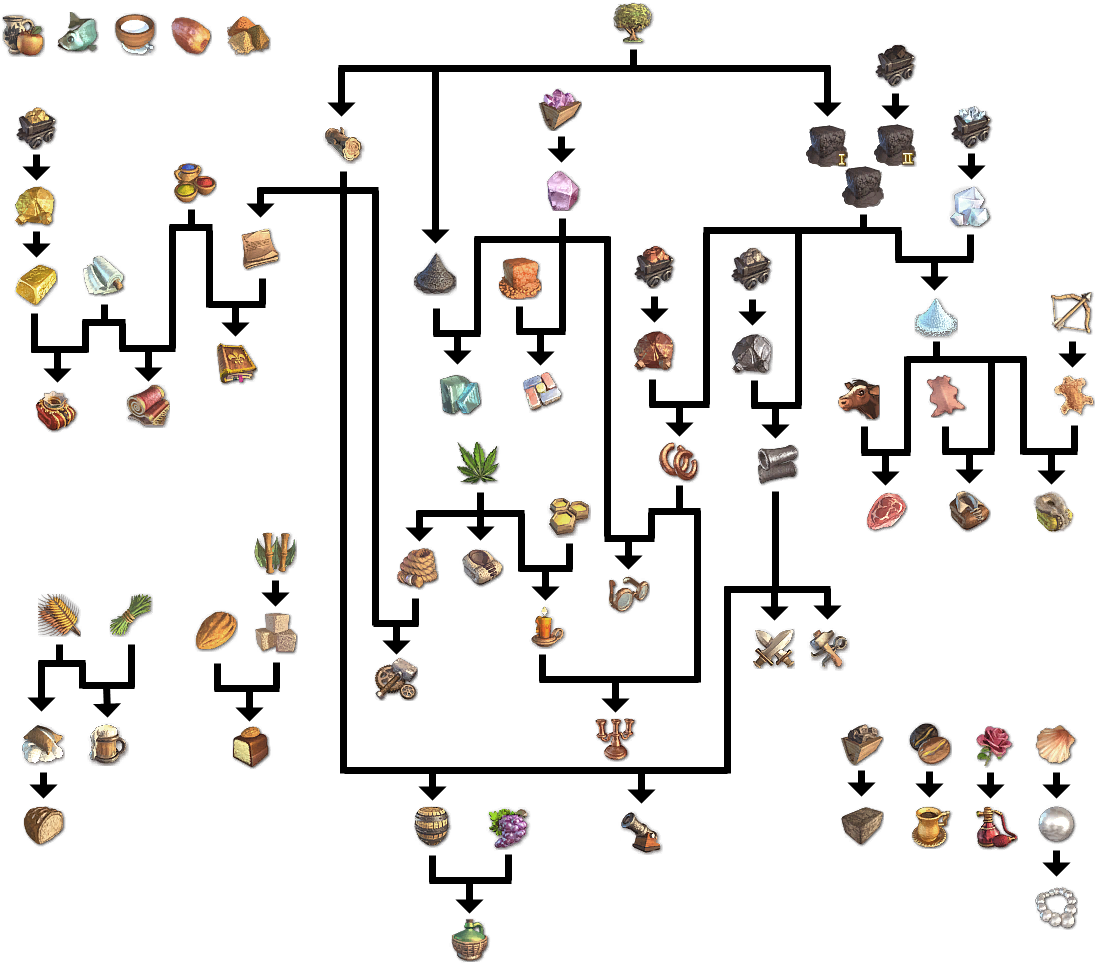
For example, Patricians want books, which requires a printing house. Books need indigo (which requires a sufficiently large Oriental settlement on an island fertile for indigo) and paper, which requires a paper mill, which requires lumber input, which comes from a lumberjack hut. Oh and paper mills can only be built on rivers, so you might have to find an island just for that. That’s not too bad. But you also have to build the printing house, which requires glass. Glass comes from a glass smelter, which needs quartz (which requires a higher level Oriental settlement and a quartz quarry) and potash, which comes from a glassworks building that runs on trees.
Put more graphically
What is most unique about Anno is that your resources are limited to the island they were farmed/created on, and if you want them on a different island you have to move them with ships.
Unlike every other game I can think of, Anno lacks a staffing mechanic. All buildings come fully staffed, even if there’s no housing on their island (and there are reasons you generally concentrate your housing on two islands). Housing is essentially a tax farm, with which you get money to build more buildings. I think the purpose of combat here is to create something for you to spend money on that is not more buildings, which is fine, but it involves more strategery and uncertainty than I feel like dealing with in my leisure time. Luckily, Anno lets you turn off pirates and rivals completely so I can build my little anthill uninterrupted.
Tropico: I think I’ve played Tropico 1, 3, and 4, which is enough to say they’re all the same and it doesn’t really matter which one you get.* In Tropico you are the Presidente of a banana republic, and have goals like “build a kickass diversified economy” and… I didn’t commit the others to memory. I think one involves a Swiss bank account?
Tropico’s production supply chains are much simpler than Anno’s, barely more complicated than Civilization’s. Raw material -> processed good -> ship off the island for money. But it does have a nifty education mechanic. Different buildings require employees of different genders and education levels. You can’t simply overeducate your workforce, because being underemployed makes people dissatisfied and inclines them towards regime change. You could rig the election or kill them, but that has other consequences. You can give them makework, but that gets expensive, especially if you give them makework as teachers and professors and create more education.
Tropico has no combat mechanic, unless you count peasant revolt, which I don’t because it can be averted with good enough supply chains.
*I picked up Tropico 5 in the latest Humble Jumbo Bundle, which is around until 4/3, but I’m trying to finish Soma in time to review it while the latest Humble Indie Bundle is up, so I haven’t actually tried it. I assume it’s like the last 4 but with more DLC.
When it comes to history, I lean towards “trends and forces” over the “great man” theory. I’d like to test this. Do you have recommendations for people or especially specific media that would challenge my view?
Some clarifying examples:
– Neither Sabin nor Salk get credit for curing polio, because if one of them hadn’t the other one would have, and if neither had someone else would have. Obviously developing the vaccine faster was a big deal for the kids who would otherwise have caught polio in 1956, but it’s not changing the trajectory of the world.
– Robert Moses may count as a Great Man because he locked NYC into a car-based equilibrium that people are unable to break to this day. In general I think “moved world to a different equilibrium” is going to be a common pattern among people who change the world.
– Dictators killing a bunch of their own people doesn’t count, the effect is too local.
– There’s a reasonable argument John Wilkes Booth counts because Lincoln would plausibly have handled Reconstruction much better than Johnson. But if I learned there were many planned attempts on Lincoln’s life and estimate at least one would have succeeded, Booth would no longer count.
– To the best of my knowledge, whoever started the American civil war doesn’t count, because that was pretty clearly going to happen. But both Grant and Lee do count, because who won the war mattered and there weren’t equally skilled replacement generals. We know this because the north tried 400 people before Grant.
I read part of the book The Polyvagal Theoryand went to a two day seminar by the author, Stephen Porges. I went because I thought there was a strong possibility EFT worked by affected the vagal nerve, and thought maybe polyvagal theory could explain how. I ended up pretty disappointed.
Once I was at the seminar I was very interested in a protocol Porges developed called Safe and Sound, which purports to cure a number of things including many symptoms of autism, plus misophonia (which I have), by playing songs with certain frequencies filtered. Porges showed very impressive videos of autistic children going from non-functional to neurotypical-passing. He bragged about a 50% improvement rate. He played a sound sample and even on hotel sound system speakers, it had a very definite affect on me, relaxing many muscles. So of course I ordered it.
In a failure of order of operations I didn’t look up the results until after I’d ordered it (I really wanted my misophonia fixed, plus the demo had been so impressive). The paper tries very hard to hide this, but what actually happened was not an average 50% improvement in some patient metric, but that 50% of patients showed any improvement. Given that autism is a high variance disease and children are often receiving multiple interventions, this basically means “didn’t make anything worse, probably”.
But I’d already ordered the thing, so I decided to try it. This was kind of an ordeal, btw. Safe and Sound is available only through “trained professionals”, even though the protocol consists in its entirety of listening to some songs on an MP3 player. And I checked, there’s nothing magic about the MP3 player or headphones they send you, you could do it with any reasonably good pair you had lying around. Based on this, I have to assume the 3-digit price tag and gatekeeping are entirely about prestige, because they’re certainly not about helping people or making money (I’m sure he could make more selling the CDs without the gatekeeping).
The protocol did have an effect, in that it consistently made me very sad. It didn’t have any effect on my misophonia, even though I tried it twice. The occupational therapist tried to insist it had worked because I was blunter and more confident in my last conversation with her, but no, sweety, that was because I was more sure your system was bullshit. Then she recommended I give them more money to do other protocols, which I inexplicably declined.
I am fighting the urge to get into the science of polyvagal theory, because it is really really interesting and has a lot of explanatory power. I put off writing this for five months because I wanted to do a more scientific review. But the empirical results are not just bad, they’re bad while proponents are claiming they are good. I can’t trust someone who does that.
For bonus points, when I asked some pointed questions during the seminar, Porges blew me off. So I’m not going to give polyvagal theory any more brain space, even though it would be so cool if it was true.
Recently I accompanied my housemate to the doctor for what was eventually diagnosed as “Fuck if I know but your lymph nodes are huge.” The treatment for FIIKBYLNAH is steroids to bring down the swelling and, if you are my housemate, a sedative so the steroids don’t keep you up for 36 hours straight. The doctor was a little bit reluctant to prescribe sedatives to someone who was waking up choking on their own spit (housemate didn’t help this any by asking for benzos when she meant Benadryl). Yes, the steroids should help that problem, but it would be a real shame if the doctor triangulated wrong and she ended up sleeping through her own death. But 36 hours without sleep is bad for you too, so the doctor compromised by asking me to “check on” her.
Let’s be clear: it takes four minutes of oxygen deprivation to incur permanent brain damage. Nothing that could be called “checking on” was going to happen at a frequency of four minutes. I could sit there and watch my housemate sleep, at least while she was napping, but the doctor wasn’t telling us to do that. So basically she was asking for a lot of work from both of us that would, in the event of an actual problem, lead to discovering the body faster.
This is a reasonably simple example of a problem I see in the medical field a lot, where they make gestures towards problems but aren’t really weighing costs and benefits. It makes me feel really unsafe.
Hmmm, if I’ve pledged to donate 10% of my income to charity, and I select an effective charity (eg. Against Malaria Foundation) as the 100% recipient on my humble bundle, should I morally count that as part of my charitable donations?
It doesn’t count for taxes or company matching. And on a practical level, I think that if $12 is a high enough percentage of your donation budget it’s worth the accounting overhead, you are probably not in a donation season of your life. Focus on savings and investing in yourself.
But maybe the overhead is cheap for you, plus Someone specifically asked about morality. And that depends on what kind of morals you’re working with.
If you’re strictly utilitarian, I think you can count the sale price of the bundle as equivalent to a donation . The fact that you got something out of it is irrelevant to the good it does.
If you’re a virtue ethicist I think it doesn’t count, because you got something out of it besides bed nets.
I’m not a strict utilitarian or virtue ethicist. I think I have an obligation to give ~10% of my income because my ability to earn that income is in part based on things I didn’t earn, like being born in America with a high IQ to parents with money and a love of education. The “luck tax” framing is why I get to deduct the costs of being unlucky (e.g. medical bills) from the income used to calculate required donations. Under this framework I also don’t count Humble Bundle purchases as donations, because I’m getting something out of it.
But I only buy bundles I would happily buy without the charitable inducement. You could argue that the difference between what I’m willing to pay commercially and what I actually pay is a donation. This is relevant right now as the current bundle is attractive to me for the Crusader Kings 2 expansion, Stellaris, and maybe Cities in Motion 2* but not quite $12 attractive, especially because missing expansions for a game I own distresses me far out of proportion to the actual expected value of the expansion. However, “I totally wouldn’t have bought this except it goes to charity” seems like an easy rule to game.
There’s another moral issue though, which is paying the developers and Humble Bundle for their work. Paying the developers feels least pressing for cases where they’re using HB as a lure in an attempt to get you to buy more, but I think it’s important when people put complete games in a bundle. Humble Bundle itself has costs, and I think it’s only fair to cover those. You might think saving babies from malaria is obviously so much more important it doesn’t matter, but that’s an overfeeding from the commons that prevents us from having nice things if it spreads. I like having nice things.
I’d feel differently if HB or the developer chose the charity themselves; that’s paying them via an indirect route. But when you’re picking the charity, it doesn’t count towards paying the devs.
So I think on a moral level you get to count the difference between what the games are worth to you and what you actually pay (but don’t inflate your price to donate, that’s just dumb), unless you’re a utilitarian, in which case you can count the whole thing. But if it’s actually worth the mental overhead to you, probably focus on building a savings cushion and improving yourself rather than donating at all.
*I love the concept but found Cities in Motion 1 disappointing
Humble Bundle is a website that sells very cheap bundles of (mostly older) video games. And by cheap I mean “pay what you want”, although paying more does get you more games. You choose how much of the purchase price to distribute to a charity, the game developers, and Humble Bundle itself.
Paradox is a games publisher and developer that I am super glad exists. Their games are genuinely different. For example, Majesty is kind of an RTS, except you don’t control your units. All you can do is build buildings and set rewards, and then watch your idiot fragile wizards walk into a den of monsters over and over while your high level warriors sit around because no reward is high enough to interest them. I have lost hours to this game.
Humble Bundle is currently hosting a Paradox Bundle (sponsored link). It includes the sequel to Majesty, which plays basically the same except dwarves are amazing. It also includes Crusader Kings 2, aka “the real Game of Thrones game.” It is kind of like an RTS, except you build power mainly through marriage alliances and politicking. I sunk about 20 hours into this game before losing my tiny Irish Kingdom to a hard drive failure, and could never build up the heart to play again.
Paradox Games frequently make Extra Credit’s Games You Might Not Have Tried series, which by the way is an excellent series you should follow if you’re interested in seeing games evolve as an art form. My excitement after watching a game appear on GYMNHT is a very good predictor of how much I eventually enjoy a game, so I’m just going to link to the relevant episodes here.
A word of warning- Paradox games tend to have a *lot* of DLC, some real and some cosmetic. Some of these games are either old enough that that’s not an issue (Majesty 2) or are being sold with DLC (Europa Universalis III Complete, although if that turns out to mean “complete in 2014 but we’ve added 4 DLCs since then” I will not be surprised). You can be perfectly happy playing the main games without the DLC, but this bundle is obviously a loss leader trying to induce you to spend more. For example, the complete Crusader Kings 2 is $160 on HB right now ($100 cheaper than Steam, so I guess the humble store isn’t useless after all). I find this a little out of keeping with the spirit of Humble Bundles (me getting cheap games price discrimination). Simultaneously, it strikes me as quite reasonable; I already joke that HB isn’t me buying games, it’s me buying the chance to try games, and if I happen to enjoy it I get the game for free. Monetizing that second part is totally fair. $200 feels like it’s pushing it through.
While I’m shilling, Humble Bundle has a monthly bundle for which only one game is announced ahead of time. The game for February is Civilization 6, which is itself worth the $12 if you’re into that sort of thing.
Status: I thought this was a common economics term, but when I google it I get either unrelated or references using it the way I expect but not defining it. It’s a really useful term, so I’m going to attempt to make it a thing.
“Tallest Pygmy Effect” is when you benefit not from absolute skill or value at a thing, but by being better at it than anyone else. For example, the US dollar is not that great a currency and the US economy is not that great an economy. However, the dollar is more stable than other currencies, so it becomes the currency of choice when you want stability. This high volume makes USD more stable and is in general good for the US economy (because e.g. US companies don’t have to take on currency risk when they borrow money).
Tallest pygmy effects are fragile, especially when they are reliant on self-fulfilling prophecies or network effects. If everyone suddenly thought the Euro was the most stable currency, the resulting switch would destabilize the dollar and hurt both its value and the US economy as a whole.
This is part of a series called epistemic spot checks, in which I investigate claims a book makes to see if it’s worth paying attention to, without attempting to be comprehensive about it.
Introduction
This is a weird review to write. I went into reading The Tapping Solution with two beliefs:
The scientific claims would be far less supported than the author implies. The best case scenario was “as terrible as your average therapy research.”
The book’s prescriptions work for me anyway, in the sense that they make me calmer and happier and enable me to take better actions.
This book is about EFT, which stands for emotional freedom technique. I write that in a very small font in the hopes you won’t notice how stupid it sounds. EFT is also known as tapping, because the primary action is tapping your fingers against your face.
I originally learned about EFT in a book that went full blown magic about it: you tap your fingers on your face, it changes energy currents in your body, and the universe magically gives you what you want. There’s no point evaluating the science in books like that; they are what they are. The Tapping Solution markets itself as the more studious cousin of that book. It keeps the energy channels but backs off the magic gifts claim, offering the much more defensible explanation that tapping changes something in you that lets you create better outcomes.
The basic idea of EFT is you tap out a pattern on your body, mostly your face, while repeating a statement about something with a lot of negative emotional affect for you, especially ones that activate the sympathetic nervous system (fight/flight/freeze). Repeat until you feel better.
[There’s a lot of different techniques claiming to be The Best EFT Script and, while I suspect there are individual variations in what works best for each person, I can’t possibly care about the intra-EFT wars. Any script you use should just be a starting point for making your own anyway.]
Why would tapping improve your mood? I have some guesses:
It makes anxiety et al. boring. There are a lot of activities where people deliberately activate their SNS (sky diving, horror movies, drugs), so there must be something fun rewarding about being activated. Plus, lots of the things that happen to you in response to anxiety are quite pleasant. People cuddle you and bring you ice cream. You put off doing the stressful thing. I don’t think many people deliberately push themselves into hysterics for the attention, but I do think these benefits bias how people handle their stress. Tapping does not offer those kinds of rewards; after two or three rounds of tapping, you are bored. There are times I have gone and done the stressful thing because I would rather deal with it than have to do another round of tapping. It’s nice to have my intolerance for boredom harnessed for good.
I suspect this is some of how cognitive behavioral therapy works as well. Having taught myself both, EFT is less work and yet harder to develop an immunity too, although hybrid systems do better still.
A sense of control lowers stress. Having A Thing You Can Do While Stressed that you think lowers your stress level is already lowering your stress level. You can dismiss this as a self-fulfilling prophecy, but that’s only the point if you’re actually evaluating the concept of energy meridians. If what you want is to calm down so you can respond to comments on your code review, it doesn’t matter if it’s a placebo.
Something something vagus nerve. The vagus nerve is this weird nerve that skips the spinal cord and runs all over your body, including most major organs and a lot of your face.
Its tasks include:
Parasympathetic (relaxing) stimulation of all major organs except the adrenal glands.
Parasympathetic stimulation of muscles around the mouth and larynx.
Possibly reduces systemic inflammation
Sympathetic (fight/flight/freeze) stimulation of blood vessels.
A bunch of sensory stuff around the face.
Activity on your face is already known to affect your body via the vagus nerve.
Cold water on the face slows down your heart, and this is attributed mainly to the vagus nerve.
Direct electrical stimulation of the nerve is touted as a cure for all kinds of stuff. My sense is the science on that is… optimistic, but there is a reason it is being done to the vagus nerve and not something else.
There’s an alternate EFT script that involves tapping only on the hands. I have fond this to be a calming distraction at best. Hands are also pretty innervated, so this points to the effects being due to something specifically in the face, as opposed to sensitivity in general.
So I don’t know what’s going on, but I suspect the effect of tapping is mediated via the vagus nerve.
It’s a framework for breaking your problem into bite sized chunks, which is the ideal size for problems to be. EFT practices vary in how much you work off a verbal script you’re given, vs introspect on your own issues and tap on what comes up. I predict script-style work to be at best competitive with relaxation exercises, and only introspective EFT leads to actual improvements.
Who knows, maybe energetic meridians are a real thing, or at least a workable metaphor for a real thing. Lots of things sound stupid until you know how they work.
In particular, if you mixed up the explanations for EFT and the much more legitimate EMDR (deliberate eye movements rewiring your brain), I’m not convinced anyone could tell which one was the Officially Sanctioned Therapy and which was the crackpot treatment.
Mark at meditationstuff.com argues that what gets sensed as energy flow is severe awareness of your own nervous system. He provides no compelling evidence for this, but it is interesting.
How I evaluated this book: usually when doing these checks I evaluate any statement I find interesting. In this case, I’m sticking to the ones for which the author explicitly claims scientific backing. For stuff that is essentially running on placebos and metaphors, I find a calm, confident, made up explanation is better than a hedged, hesitant, literally true one, so I’m not going to investigate the obviously exaggerated claims. But if you’re going to claim scientific validity, I am going to check.
Claim: “The amygdala is the source of emotions and long term memories, and it’s where negative experiences are encoded (p4)”.
True. Simplified, but obviously trying to explain how the amygdala was relevant to a particular concept, not give a comprehensive overview of our friend the amygdala. The amygdala is in fact so good at emotional memory that it can be invoked by visual cues even in people blinded by brain damage. This confused me at first, so let me note that the amygdala is not involved in fight/flight/freeze, but the longer, cortisol-driven chronic kind of stress.
Claim: Stimulating acupoints calms down the amygdala, and this is observable in fMRI and PET machines (p5).
Misleading, either bad faith or credulous. Bothstudies cited were done with acupuncture, not acupressure or tapping. I consider that relevant evidence for EFT, but dislike that he tried to make it even stronger evidence by hiding that both studies involved needles. The effectiveness of acupuncture appears to have large if weak support; I very quickly pulled up many more studies demonstrating the exact same thing, all of which were tiny (the largest was 18), and used fMRIs, which are suspect.
In general, studies of acupuncture have shown that it kind of works, but Official Legitimate Chinese Medicine Points don’t do any better than a random spot, so this adds more legitimacy to randomly stabbing yourself than it does to meridian points.
Claim: Other studies show that pressure works just as well for stabbing, maybe even better for anxiety (p5).
Seems legit. I didn’t find any citation for this but I’m willing to spot him that touching works better than stabbing for anxiety.
Claim: A study demonstrated that EFT reduces cortisol levels in the saliva (p5).
True, evidence weak but better than I guessed. The study cited is real, and with some effort I even found a full PDF. EFT did better than both a support group and no treatment on both a symptoms assessment and cortisol levels (24% decrease vs 14%). The differences in symptoms between EFT and the other groups are small, and some were not statistically significant. OTOH, every one of them goes in the same direction. I find this pretty compelling, assuming they published every trait they recorded. As usual, small study, vulnerable to p-hacking, etc.
Claim: This John Hopkins approved doctor agrees with us (p7).
Misleading, possibly very. The named person (David Friedman) does exist, but he’s a doctor of psychology, not psychiatry. The level that JHU approves of him is unclear. On his CV (PDF) he lists himself as “research associate”, “instructor”, and “faculty.” None of these words are “professor”, which makes me think he was an adjunct and certainly didn’t have tenure.
Claim: Competing systems telling you to never think about the negative are idiotic. True things are true (p8). In particular The Secret is bullshit.
Seems legit. “Make bad things approachable” just seems like a better tactic than wishing really hard. I also enjoy watching different alt modalities fight with each other.
Claim: Meridians have been scientifically validated, they’re called Bonghan channels (p10).
False. The official name of Bonghan channels is the primo-vascular system, and there’s minimal evidence it exists. Given that it’s pretty hard to prove that there’s a link between them and meridians in any scientific sense. But it’s established fact within the meridian community, so it’s at least well sourced bullshit.
A few more notes on The Tapping Solution.
As expected, Tapping Solution has failed the RCT test. What about the model test?
Well, it’s a fairly vague model, and energy meridians can be used to power anything. On the other hand it avoids my biggest complaint about heal-yourself-with-the-placebo-effect books, and also religion, certain parts of medicine, and psychology, which is that the solution to failure is often do the same thing harder. Tapping by and large avoids that trap. For actual physical problems you’re encouraged to see a doctor first, then tap, and if that doesn’t work see a doctor again. If a particular tap isn’t working you’re given alternate prompts to try. Additionally, tapping claims that often it will work so well you’ll forget you will ever upset about something, and the solution is not to hand over money to the nice man to keep the good vibes flowing, it’s to keep track of how upset you are at the beginning of the session. That level of empiricism shouldn’t make a book stand out, but it does. Tapping Solution, although not every book on EFT, is also pretty clear that you’re not imposing your will on the universe, you’re calming down so you can take better actions.
I don’t want to write out instructions for tapping because I believe the process of reading a book adds a lot of value over a quick run through (the same way doing yoga is better for you than waving a magic wand and becoming more flexible). But to help you decide if even starting the book is worth your time, here are some genres of problems I think tapping is most appropriate for:
Somaticizations, especially back pain.
Emotions you find too overwhelming to deal with, especially anxiety.
Legit life problems that are just too big to deal with all at once and need to be broken into bite size pieces.
Model
Simplicity: very low. “Magical energy currents” sounds simple in that you can explain it quickly, but it takes a very long time to explain what things it can’t do and why.
Explanation quality: poor. Merdians can power anything.
Explicit predictions: okay. You have to make your own explicit predictions, but the book very much encourages you to do so.
Acknowledging limitations: mixed.
Relative to other heal-yourself-with-the-placebo-effect systems, The Tapping Solution is modest in its claims about what your mind can do. It goes out of its way to establish that the mind-body connection is in fact a connection, it doesn’t mean your body is a hallucination you can will into whatever form you want.
Lesbian space rocks whose bodies are solid holograms are not representative study subjects.
And then on the next page there’s a story of how a woman cured her lung cancer with EFT. So it’s not amazing on this axis.
Measurability: extremely good. This is where EFT really shines. They claim it’s such a good technique you will forget you ever had a problem, and encourage you to keep track so you won’t forget.
Empirics
I’m deliberately not giving a lot of details on how to do it yourself, because I think there might be value to going through the book beyond the technique.
I taught this technique to five people, one of whom had a good response to it. Counting myself, that’s 1/3 successes, which is not great. But it’s cheap enough and has high enough potential I still recommend trying it.