There’s a fair number of horror movies and games where you can only see the ghost with special glasses or a camera. This game lets you live that with your phone camera. In your house. Good luck.
App to help Alzheimer’s patients remember their loved ones. The app is preloaded with descriptions of specific people- the users’ relationship to them, photos of memories, etc. When that person (with their phone, running their own version of the app) gets close enough, the patient’s app will flash that data. The article focuses on how this could delay memory loss, but I think it will also be helpful in alleviating some of the frustration and humiliation of Alzheimer’s.
Patients’ ratings of drugs are negative correlated with doctors’ ratings. There are some non-awful ways this could be true*, and we could resolve this conflict with trials directly comparing drugs. In the particular case of depression there’s one study directly comparing MAOIs to SSRIs. It was funded by the patent holder to one of the most popular SSRIs, and it found them to be equally effective, with SSRIs being safer (which depends a lot on how you weight different problems).
This isn’t the manufacturers’ fault. There’s no reason the manufacturer, who has put a lot of money into developing this drug and all the others that never made it to market, should spend money proving you shouldn’t buy their product. The problem is that drug company-funded research is almost all there is. In any sane world a public health agency would have run this trial long ago.
I’m extra frustrated by this because the FDA makes drug companies spend an enormous amount of money to get their drugs approved, and we still don’t get the data we really need. It’s security theater for medicine.
*e.g. a treatment needs to be rated at least so good by doctors or patients to be prescribed, or for something like depression where patients often need to try multiple drugs before finding one that works, the first line will show more failures even if it’s more effective on average because people who thrive on them never try the drugs that don’t work for them.
Iron Man saves 12 people under impossible circumstances as they fall from a plane: *crying*
Guardians of the Galaxy stall to evacuate the planet as doom flies in: *crying*
Captain America insists on endangering the entire world rather than let one civilian die in his sight: I’m uncomfortable with how angry this makes me.
Calvary shows up, allowing them to save everyone after all: Awwww….
Still not as bad as Green Arrow insisting they not kill the chief villain because Killing Is Wrong while splattered with the blood of henchmen he just killed.
Last week Sydney and I organized a meetup/presentations on accessible effective actions. Overall: it was a good idea, but the wrong audience for it. Signs of this include people saying “but if you’re giving up some meats why not just give up all of them?” in the talk on reducatarianism and “signing up to be a marrow donor is really easy” in the blood donation section. Meanwhile we totally forgot that not everyone spent five years reading academic research and wishing for a charity that did direct cash transfers, so we were not prepared to explain GiveDirectly as much as it needed to be. Which is not to say we didn’t try. When a new person asked “but isn’t giving cash directly to people bad?”, the room almost cracked with the energy of six people preparing to explain that no, it was actually the best idea ever. This turns out to be not nearly as good as one person preparing to explain it ahead of time.
There were also concerns it ran long, but we didn’t time it, so the lesson there is “time your presentations.”
The typical explanation for motion sickness is that your inner ear and your eyes disagree about whether or not you are moving, your body interprets it as food poisoning, and prepares to throw up. This does not quite make sense to me, because it fails to explain any of the following:
Why being a passenger is so much worse than being the driver.
Why playing video games (eyes say movement, ears say stationary), reading in a bus (eyes say stationary, ears say moving) and riding a roller coaster (eyes and ears both say moving very fast) produce the same feeling.
Why smooth rides (subways, no-turbulence airplanes) are so much easier than busses, or why highways are easier than stop and go traffic.
Apparently other people consider nausea a stomach issue, but for me it’s very much a head issue. Motion sickness also gives me headaches. What’s up with that? Why is it so tightly correlated with sinus pressure?
Why does low blood sugar feel so much like motion sickness?
I’ve never experienced this, but television assures me heavy drinking produces the same effect. Why?
Why does motion sickness give me temperature fluctuations.
I’ve heard a partial explanation for #3, which is that your inner ear actually senses acceleration, not movement, so a steady velocity doesn’t feel like movement. And we have a very compelling proximal explanation for #6: the difference in density between water and alcohol stimulates your inner ear both as you get drunk and as you sober up. So obviously the inner ear is very involved in this, but how?
Alternate hypothesis: motion sickness is designed to keep you from eating, because your body is not in a good state to digest. One way that can happen is if your sympathetic nervous system (responsible for fight-or-flight-or-stand-there-being-really-anxious) has kicked in, because it redirects blood flow and energy to things that are immediately useful in escaping from tigers (muscles, senses) and away from things that solve future you problems like digestion and the immune system (which are regulated by the parasympathetic nervous system).
Both the sympathetic and parasympathetic systems are regulated by the hypothalamus. For fun I googled “hypothalamus motion sickness” and the first result was this rat based study,* which put rats in a “animal centrifuge” to induce motion sickness. I couldn’t find video of a rat centrifuge, but NASA helpfully provided video of a dog centrifuge. It looks not quite as bad as a tilt a whirl, although the rats were exposed to double gravity so I should probably cut them some slack.
During their amusement park adventures, the rats experienced a spike in histamine production in the hypothalamus (how cool is it that we can continuously measure that?), and caused the rats to display characteristic motion sick rat behavior. Inhibiting histamine production or removing the inner ear (the part that detects motion) caused both of these to disappear. Histamines also help regulate body temperature, so that’s #7. This suggests that anti-histamines would be useful at fighting motion sickness. The good news is that this is correct, the bad news is that they make you sleepy and possibly give you Alzheimer’s. That’s fine for any one time but I don’t want to make a lifestyle out of taking them.
A website my laptop unfortunately ate the link to has a subtly different explanation: your brain tracks motor movement via an efference copy, creates a prediction of what sensory changes that should create, and they compares that to the actual sensory input. Motion sickness might be your brain saying “these are too different, abort, abort”, or buckling from the intensity of calculation needed to reconcile the input.
I have always wondered why I/people hold my (our) breath during times of stress. Unless you’re being hunted by a xenomorph right that second, oxygen deprivation is not helpful.
An artist’s rendering of when holding your breath might be useful
The most convincing hypothesis I’ve found is that your brain can only do so many calculations per second, compensating for breathing takes calculation, so you stop breathing. That this rapidly starves your brain of oxygen, lowering the number of calculations you can do, is exactly the kind of long term thinking I expect from the human body which, lest we forget, takes in air and food through the same hole. If both breath-holding and nausea can be caused calculation overload, we would expect the same things to cause them both. I can think of two things that do exactly this off the top of my head- sparring (but not drills) in martial arts, and playing Katamari, both of which involve complex spatial reasoning. These are not great examples because there’s a lot of confounding variables, like extreme physical exertion while being hit in the stomach.
To summarize my speculation: sensory input requiring too high a rate of calculation points you towards your sympathetic nervous system, which makes you nauseous so you won’t eat while you’re not capable of digesting.
This suggests that anything that kicks you towards the parasympathetic system should reduce motion sickness. Unfortunately the parasympathetic and sympathetic systems run on the same neurotransmitters, so looking at the relevant drugs does not provide useful information.
This also suggests that anything that lowers the number of calculations you need to do will be helpful. BCMC tested a heads up display that showed users their head position relative to the horizon.
Studies found it overwhelmingly helpful, although I haven’t dug into that paper in detail yet. Unfortunately there’s no way to purchase the technology, so I’m left hoping someone picks up the patent.
In conclusion: we don’t really know what causes motion sickness and that there’s no known really good treatmen. I am going to experiment with consciously tracking my head position relative to horizon and with rhythm games (which help integrate sensory data).
*The second result appears to be the exact same experiment, done 10 years earlier, with the exact same result. It’s nice to see something reproducible.
So if the current studies on leafleting effectiveness are unhelpful, what would be better?
First, we need a better way to determine what people are eating. People are notoriously terrible at remembering exactly how often they did a common thing over a prolonged time period, even if there’s no social pressure to answer a particular way. Possible solutions:
Ask people what they ate yesterday.
Monitor food consumption directly.
Bring people into the lab and observe what they eat.
Track dietary choices at individual level via dining cards (probably requires more detail than those cards currently provide)
Track dietary choices at population level by measuring total consumption in the cafeteria.
Give surveys asking people would like to eat, out of N specific options. Make all answers equally appetizing. Frame as cafeteria planning to avoid social pressure towards veg*n answers.
Another difficulty with the leafleting studies is that it is very difficult to asses who was in the treatment group 2-3 months later. Possible solutions:
Track individuals who received your pamphlet (and a control group).
At a college where you can track purchases by dining card: deliver pamphlets by mail to a randomly chosen half of your sample.
Use control and treatment colleges or dorms, rather than individuals. Will require finagling to avoid other confounds.
Hand out pamphlets in front of cafeteria or restaurant, see how consumption patterns change that night.
Have pamphlets be a call to action to something trackable, such as visiting a website, requesting a free veganism kit, or attending an on-campus event. Number who visit or call is an upper bound on number of people influenced by pamphlet.
Humane League is apparently trying this with facebook ads: I predict I will find that data much more compelling.
While we are at it, here are some interventions I think would work better than leafleting at reducing total meat consumption (although not necessarily the number of self-identified vegans or vegetarians):
Pay-per-click ads. To the extent “it’s super cheap and it has to convince someone” applies, it has to apply here too, and this way you’re not paying for pamphlets that go straight in the trash. Also I expect vegans to care a little more about paper waste.
Host discussion groups where brainstorm how to reduce meat consumption. In WW2 this worked much better than lectures on increasing consumption of organ meat. This could focus on vegan meals, or even Asian-style cooking where meat is a supplement rather than the focus.
Lobby colleges to provide attractive no-animal-product options. This reduces meat consumption even among people with no ideological commitment to doing so. It also helps college students build a palate for vegan options that may continue into adulthood.
Host low meat/veg*n meals yourself. College students love free food. At a minimum, that’s one meal’s worth of animal you’ve saved. Plus the palate building benefits of the cafeteria option.
Talk to the food science people and steal their secrets for making food appetizing.
Somehow the meme got established in Effective Altruism communities that convincing people to go vegetarian or vegan is cheap and easy, and the only question is whether doing so as a substitute for reducing consumption yourself was ethical. Me, John, Jai, and one shy friend dug deep into the research and discovered so many problems with the design of the studies showing this that we wrote them off entirely. I wrote up a whole blog post explaining how Animal Charity Evaluator’s analysis was wrong, and leafleting was not effective. In an act of thoroughness I would soon be very grateful for, I went to ACE’s website to make sure I was representing the studies exactly right. Turns out ACE made essentially the same criticisms we did, and also concluded the studies were insufficient to show any net effect from leafleting. If you go to the slate star codex link and follow the link to his sources, one has since renounced his math and the other says that his numbers are not meant so much to be “true” as to be “motivating in their concreteness”.
I did eventually find some organizations claiming leafleting was genuinely effective. Vegan Outreach cites Farm Sanctuary, which uses the exact study Animal Charity Evaluators criticized. ACE doesn’t go quite as far as I would: they note the 95% confidence interval of the effect and then the systemic biases of the study, whereas I would say “if you can’t get an effect size bigger than .001 in a study so egregiously biased towards your view, there is no effect.” But the criticisms have always been there.
It’s not like anyone’s default belief is “lots of humans can be convinced to make enormous permanent changes by one glossy 8.5×11 piece of paper,” so how this belief become established with so little data? How did I dig into ACE’s data deeply enough to understand the design flaws myself without noticing they saw the flaws too? (partial answer: their calculator still shows leafleting having an effect ). Unless there’s data I don’t know about, there doesn’t appear to be any support for the idea that leafleting reduces animal suffering. We really need to figure out how this spread in a movement dedicated to quantification so we can fix the systemic issue.
EDIT: I’ve had a couple of requests to include the specific criticisms. I originally didn’t because it felt mean to rehash ACE’s criticisms, but since the whole point is you can read their documentation without realizing them, that reasoning seems dumb now.
Everyone knows there’s a social desirability bias (reporting converting to veg*nism when you haven’t). This is especially an issue for the people who report reducing but not eliminating animal products- it’s easy to lie about that, to yourself or others. But the denominator (how many people received flyers total) is also unreliable, because there are a lot of reasons people who received a pamphlet will report they didn’t when asked two months later. Maybe they threw it out without looking at it. Maybe they read it and forgot. Maybe they totally remember it and realize that if they say yes to the surveyor there will be a long conversation that implies they torture animals, and they would like to not do that.
We don’t have to assume this is a problem: one of ACE’s studies attempted to use a control group, and flat out couldn’t, because no one reported receiving the control flyer. The lack of control group is a big problem, because it means you will give flyers credit for people that would have gone veg*n anyway.
Then you have to predict how long they stay veg*n. ACE’s numbers are outlined here, and there’s several problems. There’s social desirability bias again, and the samples are representative neither of the population at large or the population being leafleted. I have a strong prior that people who make changes based on a flyer are less likely to stick with them than the general population
This is minor, but ACE doesn’t count the value of the leafleters time when calculating effectiveness. Even if they’re volunteers, you need to consider the value of what else they could be doing with that time.
I never did do much with the kitten pain scale, because the pain meds’ effects were so striking there was no need for hour by hour monitoring. But I’ve found another good marker.
When I first started at crisis chat I really really loved it, and would frequently stay hours past my scheduled shift. I often left feeling energized*. At some point that changed. I put it down to a loss of novelty, or maybe nostalgia making me remember it as more fun than it was. I kept going because it wasn’t about me having fun, it was about me helping people, but I was more conservative about the latest time I would start a new chat.
Then I got those really awesome pain meds in January, and suddenly I was staying late again. But at some point it disappeared again.
One of the nice things about the meds is that they have a long lasting effecting. They push the pain-tension cycle back, so I’m in less pain for days or even weeks after they wear off. One of the bad things about one of them is that I hate being touched the next day. That’s suboptimum on its own, but it scares me to think of what else it’s doing that I’m not noticing, so I try to go as long as possible without taking it. I’m also very good at pushing away conscious knowledge of pain, even though it still effects me. So I ended up going really way too long without taking the topical pain medication.
Finally I took it again, and what do you know, I stayed more than two hours past the end of my next chat shift.
It doesn’t surprise me that I’m better at chatting when I’m in less pain, but I am surprised by the way I’m better. Ending chats is a tricky business. You don’t want people to feel shoved out the door, but a good chunk of our target audience is having anxious ruminations. The last two times I’ve been much better about recognizing when we’ve reached the end of the productive portion of the chat and wrapping it up. A few people even seemed to take the nudge out as permission to relax.
*although not always. Most days I had to call a child abuse report in were bad days
**Shift end times are a little fuzzy because of course you can’t leave in the middle of a chat. If it’s 5 minutes before your shift ends, of course you don’t take a new chat unless you’re prepared to stay late. But if it’s 30-45 minutes? You’ll probably be done only a little after your stated end, but you never know which call is going to be a two hour active rescue.
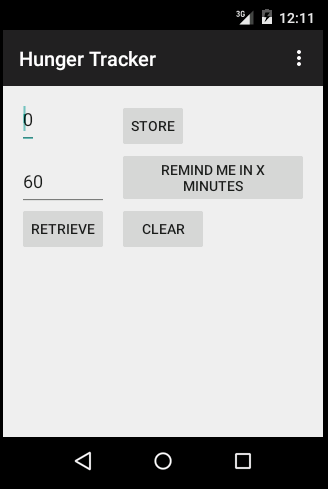
It’s out. I made some UI tweaks and got the release build working, so you’re not including a bunch of debug code. Here’s how I envision people using it:
1. Install manually. I’m working on getting it in the app store.
2. You should see something that looks like
3. To store your hunger: enter the number in the upper text box and hit “store”
4. Set an alarm for the next time you wish to track your hunger.
5. A notification with a quiet beep and short vibrate will remind you at that time.
6. When you want to retrieve your data, hit retrieve.
7. When you’re done, hit clear. This will erase all data, not just clear the screen.
I’m taking on sinus inflammation because it’s a major contributor to my motion sickness, which is a major contributor to making commuting suck, and commuting is one of very few things that can actually depress your hedonic set point (psychologist talk for “make you miserable”). My doctor has suggested xylitol nasal spray, which she claims inhibits irritation in the sinus cavities. Quick googleing reveals it’s also considered useful for bacterial plagues on the teeth and in the arteries. Let’s dig in.
Xylitol’s main claim to fame is as a calorie-less sweetener in humans. The claim is that it kills (many but not all strains of) bacteria via the same mechanism: it can’t be converted into energy, so the bacteria starve to death. This has to be to be missing a step. Bacteria are surrounded by billions of molecules they can’t digest all the time, and they survive that. If xylitol is to have an affect it must not only be indigestible, but inhibit digestion of actual sugar. Off the top of my head there’s two ways that could happen. In the human body, sugar is moved around by the blood. If xylitol takes a sucrose molecule’s ticket to a particular area, there will be less sugar there for bacteria to eat. The downside of this is that you might starve out your own cells. Another option is that bacteria cells themselves become confused by xylitol. The ideal would be if xylitol fit into a sugar receptor but couldn’t be taken into the cell, so the receptor was blocked indefinitely. Or if it was taken in it could trigger a “yup, we got a sugar” reaction that caused the cell to take in sugar later, but I’m not sure why a bacteria would ever turn down calories.
I found a lot of studies on xylitol and dental use. Most of what I learned is that dental abstracts are more like teasers than summaries, not cluttering up the space with numbers or sometimes even conclusions. Overall there seems to be a mild consensus for xylitol mildly inhibiting cavities, although it’s certainly not a substitute for fluoride. Also I totally should have been chewing xylitol while I was recovering from surgery, since is almost certainly disrupts oral plaques, although I worry about what it would do to the intestinal biome.
What about sinuses? I found a lot of very small studies, but 5 studies of size n are not equivalent to one study of size 5n. You don’t know how many more studies of size n were done but not published.
This study and this one found decreases in medical severity (as measured by the SNOT-20 score. Yes that’s it’s real name), but not self-reported pain (as measured by the less well named VAS score). This study in rabbits was well controlled (if small) and found significant decreases in bacteria.
Rabbits self-reported pain scores were ambiguous
This study found that a nasal decongestant spray worked better than xylitol or saline spray, which worked about equally as well. Nontheless it’s conclusion was that [name brand of xylitol spray] was an effective treatment for nasal congestion. It also spelled spray with an ‘e’ . Twice.
One interpretation of these results is xylitol helps impedes infection but irritates the sinuses such that there’s no change in pain levels. Another is that people are really good at suppressing conscious knowledge of pain. My experience has been I’m really good at suppressing moment-to-moment awareness of pain but I do notice when asked (which is how I went weeks without treating my dental neuralgia, and then suddenly noticed I was at 8 on the pain scale), and that the pain has a great deal of effect on my behavior and happiness whether I acknowledge it or not. And if I keep using xylitol I need to change my brand to one that, when it buys positive press in a supposedly objective forum, spells its own name correctly.
Seattle Effective Altruists just got a bunch of new potential members from the very different spheres of “Peter Singer’s talk” and “the Harry Potter and the Methods of Rationality wrap party”. I am planning an event targeted at these new people, with the dual goals of “make them slightly more effective even if they never come back” and “induce them to learn and do more about effective altruism”. The specific plan is to present actions one can do right now to make the world a better place. “Donating to GiveWell” will be there, but so will donating blood. I am looking for things that run the full spectrum of cheap/expensive, difficult/easy, time consuming/not, so that everyone has something that is doable for them. That especially means not having too many things that run on money, because not everyone has a lot of money to spare and we already spend a great deal of time on options for those that do. Any other suggestions for what to include? The list so far is:




 Aceso Under Glass