What doctors can learn from day care workers

So if being fat is bad for people, than doctors should tell them not to be fat, right?  Or at least tell them to eat vegetables and hit the elliptical, right?

Well, maybe.  But sometime around age two humans realize that they are independent beings who do not physically have to do everything an authority tells them to do.  Unfortunately, most doctors’ patients are over the age of two, and those that aren’t have their own issues.

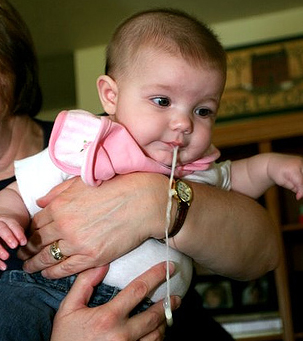
vomiting baby
They’re gross

Telling people to do things they already know they need to do has mixed results.  Scott Alexander suggests alcoholism could be decreased by as much as 13% if doctors would spend five minutes telling alcoholics it was bad for them.  What this doesn’t capture is how lectures change the doctor-patient relationship.  It is very difficult to give a non-judgmental lecture when your billing model gives you 10 minutes per patient.  Patients might avoid or delay visits for problems- alcohol related or not- in order to avoid the lecture.  This is a pretty big issue with overweight patients, and apparently without upside: patients lectured by their doctors are more likely to attempt weight loss but no more likely to achieve it.

In this TED talk, Thomas Goetz talks about a study of dental patients (no cite, unfortunately) that found that scaring them had no effect, but patients’ belief in their own ability to floss had a large one.  It’s impossible for me to separate my personal experience from this data.  Multiple dentists and hygienists told me my pain was my fault for terrible oral hygiene, and if I brushed and flossed it would go away.  This turned out to be untrue on a couple of levels.  The pain was caused by structural damage and internal infection, which may have been made incrementally worse by oral plaques but wasn’t caused by it.  And I was actually brushing pretty regularly, it just wasn’t do anything.  Then I started treating a completely unrelated digestive problem, and suddenly my teeth were cleaner.  I didn’t even tell my dentist anything had changed, she asked spontaneously.  So I guess, yeah, patients belief in their own ability to effect change matters, and if they don’t believe it, maybe consider that they’re correct and investigate why.

But let’s go one step farther.  Crum and Langer did an interesting experiment on two groups of hotel maids.  Both were told exercise is good for you.  One was given additional information about the intensity level of the work they did all day, and told just by going to work they were exceeding the surgeon general’s RDA of exercise.  Four weeks later, the informed group was slightly thinner (they even checked body fat %.  I am so pleased) and had lower blood pressure .  Not astoundingly lower(10 points on diastolic BP), but it was only four weeks, and a pamphlet is even less work than a doctor lecture.

This suggests that one of the more helpful things public health officials can do is reinforce the good things people are already doing.  You did a stretch?  Hurray for you.  Check parking lot twice before accepting a far out spot?  Still counts.  It would not shock me if part of the health improvements attributed to standing desks turned out to be simply a halo effect of feeling like you made a healthy choice.  Which coincidentally is how you turn a two year old into a civilized human being.

Multifactor analysis

Elodie Under Glass (no relation) has a guest post up at Captain Awkward about dealing with family members with disabilities/when you have a disability. You should read the whole thing and the comments, because it lives up to CA’s high standards, but here’s the thread I want to talk about: one LW owns a house that is unable to accommodate her disabled father comfortably. It’s three stories, no elevator, no bathroom on the ground floor, and she doesn’t have a good bed to offer him. He has MS. Some people viewed her choice of house as a failure to accommodate her father properly. Others pointed out that it’s quite possible she couldn’t afford a disability-friendly house, or the renovations necessary to make it so. One commenter went so far as to say:

The people replying to you rightfully take issue with your snide implication that the LW should have just bought a smaller house- which has no correlation to price of house.

Which is clearly bullshit.  It is true that size is not the only determinant of the price of a house.  It may even be true that in a particular set of houses (one that sampled over a wide geography, time, condition, and set of amenities), price and size are not particularly predictive of each other.  But if you hold those others factors constant, size is strongly positively correlated with price. So while I do believe people should get off the LW’s case about buying a house that couldn’t accommodate her father, for lots of reasons, I think saying there’s nothing she could have done to accommodate him is wrong.

This is actually a pretty good metaphor for weight, if houses actively fucked with you to maintain their price within a set range. Build an addition to your house?  Black mold. Hog rendering plant built upwind?  Enjoy your newly refinished basement.  Eat less fewer calories?  Enjoy catching twice as many colds this year.  Eat more calories?  Never stop fidgeting.  Weight is not beyond our influence, but neither is it completely in our control.

Back exercises

My back pain book recommended a stretch in which you lie on the floor, with your hips and knees at a 90 degree angle,  resting your hands on your quads, then lightly press your legs into your hands.  I didn’t even try it, because I knew my back wasn’t strong enough to hold the position.  But when I do the same stretch with my feet resting on an exercise ball, it feels awesome.  I can’t be sure I’m getting the same stretch because the book didn’t include a musculature chart, but it is definitely doing something good.

Review and Science: Thomas Was Alone

Humans have an amazing ability to ascribe intention and emotion when logic tells us there could not possibly be any, a fact demonstrated most succinctly by this clip from Community

but proven somewhat more rigorously by An experimental study of apparent behaviour (PDF), in which experimental subjects were asked to watch and describ a short film showing some shapes moving around.  If you would like to play along at home, I’ve embedded the video below.

The first subject group (n=34 undergraduate women) was given no instruction beyond “describe what happened in the movie.”  Exactly one subject described it in purely geometric terms.  Two others described the shapes as birds, and the rest described them as humans.  19 gave a full story.  The stories people told  (in this treatment and another where subjects were primed to view the shapes as people) had a shocking amount in common, suggesting there was something innate in the interpretation.*

My point is, humans will bond with anything.  In many ways it’s easier to bond with/project onto simple objects than actual humans or almost humans.  This can be used to great effect in art, to evoke desired emotions without all the messiness of using real people.  A simple example is an extremely short, simple game whose name I’m not going to tell you, because it would bias your experience of it.

Did you play it?  The game’s name is Loneliness.  Can you guess why?

I like to think the shunned little square from Loneliness grew up in to be Chris in Thomas Was Alone, a game about rectangles making friends.  Thomas Was Alone‘s premise sounds kinds of dumb: it’s a puzzle platformer with some narration ascribing emotions to the rectangles you solve puzzles with.  But it pulls this off so masterfully I actually bought branded merchandise of it, which is something I can’t say about a single other game.  The story is genuinely sweet, but the real skill is in how the puzzles reinforce it.  Each rectangle has slightly different skills, some more useful than others.  Chris is a shitty jumper whose initial story revolved around resenting the better jumper, and who is nothing but dead weight in the first puzzles (the other rectangles could get through without him, but he could not with them) suddenly becomes indispensable, I felt pride and relief.

TWA starts out a little slow.  If you want to play, finish the first world before deciding whether to continue or quit.  But I highly recommend it both as an interesting example of human psychology, and as a piece of happy art, which I don’t think we see enough of.

Okay, fine, I don’t see enough of because I’m a severe subscriber to the dark and edgy trend.  But that just makes Thomas Was Alone more impressive.

*Attenuated by the fact that women attending college during WW2 is a narrow subset of the population.

Wish me luck

Fourth dental surgery (this year) is today (not counting when they snapped that extra bone off).  I’ve buffered with some content but it’s going to be kind of grab bag for a bit, possibly even the rest of the year.  I have two different multi-book reviews in the pipeline but apparently other people use the library too, so neither is done.  I loved doing that HAES deep dive but it was seriously tiring and there was no way I was finishing another before this surgery.  So enjoy my forthcoming waffle mix review and have a happy solstice celebration of your choice.

Helping Ferguson, part 2

I talked before about the challenges in supporting causes like Ferguson, where the best work is being done spontaneously and you have very little information.  It turns out I do have a little bit of a connection- a good friend’s little brother goes to college in St. Louis, and he has a professor he considers a local expert on the subject of activism in St. Louis.  I realize that readers as smart and informed as my own will give “blogger’s friend’s little brother’s professor” very little weight as a source.  But sharing this information is better than not, so here it goes:

So after a bunch of back and forth with Bob Hansman, a professor here who is probably the person in St. Louis I trust the most to know how various charities affect people on the ground here, we decided that the best place to donate is the United Way of Greater St. Louis’s Ferguson Fund.

If you’re curious, I looked at various people on the ground and activist groups to see how to (or if we should) get them money. The problem was that many of these groups are not super active or transparent and that they advocate their own solutions to the complex issues at play here. For example, the most recent cause one of these groups organized for was a $15 minimum wage for fast food workers.

I wanted to send out a recommendation that was more broadly applicable. United Way seems to be pretty transparent and post a lot of updates on where this money is going. They also are supporting independent groups who are trying to figure out how to solve the problems in Ferguson, like the Ferguson Commission appointed by the governor. Hard not to get behind that.

I found this surprising.  United Way is often held up as everything that’s wrong with charity: a big, lumbering organization more concerned with their own status than the people they are helping.  And yet, they seem to be doing good work here, including supporting more nimble organizations.  I think I will be putting some money towards this.

r/fatlogic endorses creationism

Normally when I’m investigating something I like to read well regarded books on both sides, in the hopes that the ignorance will cancel out.  Finding a suitable counterpoint to Health At Every Size is hard, because its opposition is “everyone in the world”, and there has been no selective pressure to elevate the actual science away from the shame and aesthetic preferences.

For example, I spent a little bit of time on r/fatlogic which, as decisions go, was not my best ever.   r/fatlogic frames itself as a criticism of horrible “fat logic”- things like “700 pounds is no less healthy than 200 pounds.  Possibly healthier.”  This is not a great start.  I have a deep personal understanding of how frustrating it is when people are wrong, but I have found I am happier and a better person when I say “yup, wrong”, and then move on with my day.  For the truly awful I might e-mail a friend making fun of it (thanks, Rachel!).  Forming a whole club around criticizing people, especially people that are already having a pretty tough time in life, is bad for everyone.

r/fatlogic is even worse than that, because it has an extraordinary case of the cowpox of doubt.  Wrong people keep insisting body fat is independent of calories consumed and exercise?  Well then body fat must be solely dependent on calories consumed and exercise, and anyone who suggests it is affected by anything else is a fatty fat fathead making excuses for their fat.  They are literally denying  the possibility of individual variability in the translation of external environment into physical state.  For bonus points, they invoke “but thermodynamics”, which is the same argument creationists use against evolution itself.

Here I tried several ways to explain exactly how wrong they were and how that was terrible, but then I decided to take my own advice and stop before I endorsed the hollow Earth theory.  My current contender for an opposition book is Good Calories, Bad Calories, but I’m open to suggestions.

Health At Every Size Roundup

I read Health At Every Size and wrote a number of blog posts on it.  Some are follow ups on science it mentions but didn’t not examine in depth, some are spot checks of its scientific claims.  Neither set is comprehensive, but hopefully they are helpful.

HAES pre-check: What I thought about fat, food, and health before reading HAES.

Now I’m learning about hypothalamusing: The hypothalamus is the main coordinator of food consumption and use, and we have no idea how it works.

Ghrelin: The Hunger and Lung Development Games: the discovery that the hunger hormone also plays a crucial role in fetal lung development inspires a pun I will find increasingly difficult to maintain as the series progresses.

Leptin: Catching Chemicals: This one was a stretch.

Insulin and Glucagon: Mockingsugar: you try and come up with a food/health/fat based pun on the word Mockingjay.

Bariatric Surgery: HAES says it’s universally bad, my reading of the literature is that it’s awful, but sometimes the better choice.

Fiber: The Mr Rogers of Nutrition: Everyone likes fiber.

Obesity, Blood Pressure, and Study Design: partially an examination of the link between obesity and blood pressure, but mostly an explanation of why the studies we’ve done so far are so unhelpful.

Controls and Confounds: Why designing a study to determine causality is so hard.

HAES post-check: What I thought about fat, food, and health after reading HAES.

An Apple a Day Does Surprisingly Little?

How did apples get to be the standard bearer for all that is good and healthy? In terms of nutrient per calorie, they’re not that good. 1 cup has 65 calories, 3 grams of fiber (12% RDA), and 5.7 mg vitamin C (10% RDA), and very small amounts of a wide range of other nutrients. Pears are just slightly better: 1 cup has 81 calories, 4g fiber, 5.7 mg vitamin C, and enough potassium to be noticeable.  Meanwhile the same volume of grapes, so long derided as nature’s candy, have 104 calories, 1.4g fiber, 16.3 mg vitamin C, 22 mcg potassium.  Almost everything apples or pears have trace amounts of, grapes have slightly more of.

Wasting their lives
Wasting their lives?

I wonder how much of this is because of the skin:pulp ratio.  Produce skin tends to have a lot the bulk of the vitamins*.  Plus grapes are more colorful, and color intensity is a shockingly good proxy for nutritional value in produce.

I also wonder how apples got such a sterling reputation without the benefit of a good marketing firm.   My best guess is that they grow further north than most fruit and keep for much longer, and established cultural supremacy back when produce was scarce and fruit did not regularly fly.

Full disclosure: I was originally going to compare apples to iceberg lettuce, which I had previously seen described as nutritionally vacuous but easy to ship.  But when I looked it up I discovered iceberg lettuce actually has a pretty good nutritional profile.  1 cup has 10 calories, 1 g fiber, 2.0 mg vitamin C, and 22.0 mcg potassium (22% RDA), and trace amounts of other stuff, which makes it strictly better than apples on a per calorie basis.

While we are at it: spinach does not have that much iron.  It has a number of other vitamins and is very good for you, but the original reputation for iron-richness came from some guy putting the decimal point in the wrong place (source: some guy at a party 6 years ago).  In fact the oxalates in spinach bind iron, making it harder to absorb.

Apples aren’t bad for you.  If you want an apple, eat an apple.  But if don’t want an apple and are trying to cajole yourself into it to make doctors keep their distance, consider grapes instead.

*Also the pesticides.

HAES post-check

A chief contention of Health At Every Size (Linda Bacon) is that human beings can’t lose weight, so even if it would optimal for them to weigh less, there’s nothing to be done about it.  Is this true?  It’s hard to answer, because the question isn’t very well defined.  Bacon admits there are things human beings can do to gain weight, and when they stop doing them, they sometimes lose weight.  So if you’re doing those things, you probably can lose weight.  And that people have a set range they can move around in healthily, based on diet and exercise, so if you’re at the top of your range now you could lose 20 pounds and still be okay.

On page 143, Bacon very strongly implies that twins maintain the same body weight even when they have very different activity levels, so weight is controlled by genetics.  The studies she cites do show that when activity and diet is held constant, two unrelated people will have different health metrics.  They also show that when two identical twins have different activity levels or diets, they will have different health metrics (including weight).  Oh, and the combined sample size of both studies together is 35 sets of twins.  This is where I started to get angry.  I get using weak studies that strongly support your hypothesis.  I get misleading people about what a study stays to support your hypothesis.  But doing both is just…argh.  I supported HAES.  The actual prescriptions for food are basically the Michael Pollan diet (eat food, mostly plants), and motivation to retrain yourself to like real food rather than hyperprocessed crap.  Those goals are good.  Those goals are good even if they lead to weight gain, because under most circumstances produce is good for you and cheetos are not (although not all- this Captain Awkward post is full of people for whom carrots trigger intense digestive distress but hamburgers are safe and nurturing.  I used to live off of pasta because anything else felt like eating death.)

I did check Bacon’s sources on the claim that people who lose dramatic amounts of weight tend to gain it back within 5 years.  That appears to be true, at least in the studies she cited.  And yet, she also cited studies showing that activity level affects weight.  My explanation is that losing weight is not a thing you do.  Your diet and activity level translate to a weight or body fat percentage*.  If your current weight is different than that, it will move towards it.  If you change your behavior, you will move towards the new translated weight.  The translation appears to be a combination of genetics and perhaps past experience (she claims loss-and-regain cycles increase the set point.  I’ve read that a lot of places, but at this point I neither trust her nor have the heart to investigate).

So how do my current views compare to those I held before reading HAES?

Exercise- still good for you.

Human diversity- still vast.

Impervious of weight to diet and exercise- depends a lot on what you mean.  I will never look like Keira Knightley, but I will probably lose fat if I exercise more.  Which I have just started to do after ceasing for a very long time because I was recovering from surgery, and will pause again when I have my next surgery, because the health harms outweighed the benefits.  Fat is a proxy for health, but not the only measure of it.

Large amounts of fat are quite bad for you, but it’s unclear where that effect kicks in.  The American aesthetic ideal is much lower that the healthy weight cut off, and may be actively unhealthy. In the normal range, diet and exercise have bigger health impacts than fat.

Our food supply is definitely fucked.

Fat people still don’t deserve to be shamed, especially under the guise of for their health.  First because no one deserves to be shamed, but especially because shame is super bad for your health.  It is intrinsically bad and it keeps people from seeking medical care, for both things related and unrelated to their fat.  Stop doing it.  People owe you neither their health nor their attractiveness.

*Weirdly, in my case it appears to be weight.  I’ve had a shockingly consistent weight despite large changes in activity level and muscle mass.