Pain, ADHD, and happiness

I jokingly referred to pain-induced ADD on Monday, but I’m becoming more and more convinced that is actually what was happening.  After prior surgeries I was too exhausted to notice anything, but this time I was energetic enough to experience the pain.  I mean, unless I tried to go outside or something.  That led to a really entertaining systems crash in the supermarket.  But if I stayed inside I was able to do things like get food and put away dishes without strain.  Contrast with when my pain meds sabotaged my cortisol production.  Intellectually I was there and able to do things like read and blog, but physically it was a struggle to make myself a smoothie.

After surgery I could not read or write or even enjoy a movie.  It was more than pain making everything 70% less fun, it was that everything was annoying and frustrating and no fun at all.  I couldn’t enter a state of flow or concentration or even relaxing for any length of time.  Except when I played video games or the piano.  Neither were fun, exactly, and I was still in pain, but they were at least distracting and rewarding.  Looking back, this explains a lot of my behavior when I was in constant pain last year, it just took being out of pain and then very sharply in a lot of pain to make the pattern obvious.

At first I thought this was  Harrison Bergeron type thing, where pain was sending out interrupts too often for me to get into a groove on anything.  But then I read this blog post (blogs were just about in my power) by Sara Constantin on dopamine, explaining Peter Redgrave’s hypothesis that the spike (phasic increase) of dopamine is not itself a reward (which is how pop journalism usually describes it) but a timestamp that lets you know what actions should get credit for the actual reward chemicals you are about to receive.  That would explain why humans and animals with broken dopamine systems do feel pleasure when eating but will nonetheless starve to death unless you put the food directly in their mouth.

Many of the drugs used to treat ADHD inhibit dopamine reuptake, which raises your tonic (baseline) dopamine levels.  Constantin hypothesizes that if the baseline is too low than stimuli that should be ignored suddenly are interpreted as important, leading to a lot of SQUIRREL.

[ I was going to make this a gif but putting unpausable moving pictures in a post on ADHD just seemed cruel]

If this is correct, it offers an explanation for why ADHDers are so drawn to things like videogames and sex:  the time gap between doing the correct thing and getting the chemical reward is so short they can still determine causality, even against the a background of SQUIRRELs.  This needn’t be purely about hedonism- if it was, something consistently pleasant would work.  I think it’s about having an internal locus of control and self-efficancy.  Humans are happiest they feel like they have the power to change their own circumstances and have an impact on the world.  It’s hard to feel those things if your attention is constantly being torn away from what you choose and you can’t (on a neural level) determine what made you feel the emotion you are currently feeling.  This is one reason the toll of ADHD shouldn’t be measured in lost productivity alone; even people with very successful coping mechanisms are being denied that internal locus of control, and that’s miserable.

Here’s my contribution: my description of being in pain sounds a lot like other people’s description of ADHD, right down to video games being rewarding without strictly being fun.  And as it turns out the basal ganglion, the area Redgrave believes is using dopamine to timestamp causes so they can be matched with effects, also releases dopamine in response to pain.  It seems entirely possible to me that high baseline levels of dopamine could diminish the effect of a spike.  Instead of everything being timestamped “good job”, nothing is, with similar results

But let’s make it even more interesting.  Several anti-depressants are also useful in treating chronic pain, and NSAIDS (usually mild pain killers) treat depression.  I had previously put this down to “pain is depressing”, “depression appears to be connected to inflammation in ways we don’t understand” and plain old “brains are squishy and they don’t make sense”, but if there was a causal link?  The symptoms of depression include fatigue, feelings of helplessness and lost of interest or enjoyment of previously liked activities, which sure sounds related.  Quick googling found a very tiny study showing a connection between low dopamine and suicide, and this fascinating study suggesting that inflammation reduced the basal ganglia’s production of dopamine, which would tie all of this up in a very pretty bow.  Something causes pain and/or inflammation (the two often go together), which long term causes inflammation in the basal ganglia, which causes depression and reduces your body’s natural analgesics.

Look body, if you were worried about us getting high off of pain, maybe you could have releases fewer happy chemicals in response to pain, instead of making it just as fun but also cause depression some time later.

This would also explain why ADHD medicines are promising in treating depression (source, source, and a large showing among my friends), and why ADHD and depression so often go together.*

I cannot stress enough how unqualified I am to make this hypothesis.  Lots of people know lots more on all of these things than me.  But it comes together to be an extremely plausible explanation for both the literature I’ve read and my personal experiences.

*There’s a lot of evidence that depressed parents correlate with ADHD kids, but it’s probably environmental.

Simple Screening for Depression?

A  new study by Reid et al claims to demonstrate a biological marker for the presence of depression.  First we have the boring criticisms, like “32 is not a real sample size, “shotgunning 20 RNA markers and noticing which ones were increased in depressed patients and decreased after treatment is painting the target after you shot the gun” and “you’re comparing treatment group re-draws to control group baseline draws” but anyone could make those.  The authors make several of those points themselves.  And there are some statistical criticisms that pretty much invalidate the whole thing.*  What I find interesting is that even if the results are correct, they may not be useful.

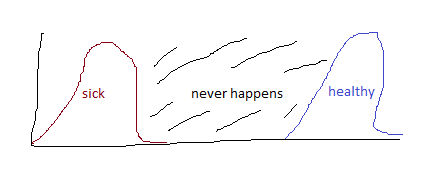
If you look at the table comparing the marker rates in depressed and non-depressed patients, there are 9 markers that differ in a statistically significant way. The problem is that they’re still not very far apart.  What you would ideally like to see in a diagnostic test is the following:

Two bell curves with no overlap

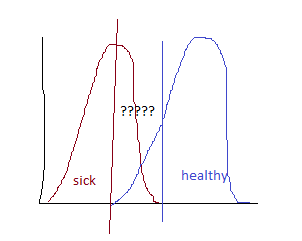
because then it easy to translate a test score into a health status.  But the markers in this study are more like

two overlapping bell curves

Which means that if you know someone is depressed you can generate a pretty good idea of their marker score, but there’s a wide range where knowing their marker score doesn’t give you a good idea if they’re depressed.   That makes it pretty useless for a screening test.

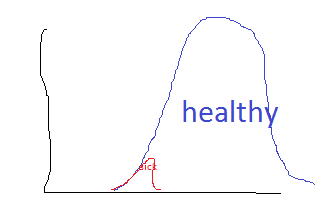
But it’s actually worse than that.  There are many more undepressed people than depressed people, so the curves could look more like

weighted

Under this graph, the sick mean could be four standard deviations out from the health mean, and yet a person with a low marker score is approximately equally likely to be depressed or not.  This is a bayesian reasoning problem and doctors are frighteningly bad at those, but then, they’re worse than chance at frequentist statistics too.

In summary, I’m not hopeful this proves to be a useful screening tool for depression.

*They don’t actually prove that the marker values of cured people converge with those of never-depressed people, they just fail to prove they’re statistically different.  Those are different things.  They also switch between two (equally valid) statistical tests (T-test and Fischer’s) without saying why, which means there is a high probability the answer is “we liked those answers more.”

Humans are complicated, children are even more complicated

[Had more dental surgery this week and am currently suffering from pain-induced ADD.  Expect less research and more wild speculation]

Consider pre-emptive testing for psychiatric or developmental issues in children.  If you’re too aggressive, you end up misdiagnosing a lot of perfectly normal deviations from the exact median as development issues in need of treatment.  Development is complicated, different systems come on line at different rates and in different orders in different kids, and they should be allowed to do that without being corralled into fitting a predetermined schedule .

But if you’re not aggressive enough, the kids develop coping mechanisms that hide the disability, making it harder to diagnose and treat.  Sometimes people treat this as solving the problem (especially for conditions that are often conflated with character flaws, like ADHD or some forms of depression), but they are wrong.  At best lack of treatment holds people back from their true potential, at worst it twists up their internal structure in ways that break at the worst possible time (usually grad school).  It’s a big problem with twice exceptional children, who have both brain-based deficiencies and a lot of raw intelligence, and I suspect for people with atypical presentations of their disabilities.  E.g. girls with ADHD or autism spectrum issues, boys with depression* or trauma from sexual abuse.**

Even perfectly accurate testing won’t fix this, because developmental asynchronies do not necessarily indicate a future problem, and treating them can prevent the issue from fixing itself.  The real issue is distinguishing natural, healthy leveling out from the development of costly compensation mechanisms, and we don’t know how to do that.

*Assuming the comomn adult male pattern of depression being expressed as anger holds true for boys as well.

**I think, couldn’t actually find data on this.

Locks of Love

I have mixed feelings on this criticism of Locks of Love.  They do appear to deliberately mislead people that the hair is going to pediatric chemo patients, when most of the wigs they make go to alopecia patients.  The cancer patients that do get wigs are those rendered permanently bald, not temporarily so.   I think it’s completely fair to criticize LoL for that mislead.

But the article also criticizes Locks of Love for throwing away hair that is grey, moldy, or too short for wigs (even though the guidelines on the website are pretty clear on what’s required), and for selling most of the hair that is donated.  The author derides this as getting a haircut for no purpose.  I think that criticism is not only unfair, but reveals a fundamental problem in the way the author views charity.  If your goal is to help bald children, you should want them to throw out unsuitable hair, and be agnostic as to whether your hair ends up in a child’s wig, or in a wig made by a commercial company that paid LoL for it.  You’re helping just as much.  Deriding this implies that having your hair on the head of a child is more important than a system that gets the most children.  If that’s true you’re welcome to pay for the privilege, but don’t pretend it’s the same as donating to help people.

Of course the chemo bait-and-switch is still dubious, and if you have a preference for helping that population it’s totally valid to go with one of the other orgs listed in the article

The Talent Code: Two Truths and a Lie

The Talent Code (Daniel Coyle) makes three claims: that myelination is instrumental in learning, that skill is built by by methodically breaking down actions into component parts and perfecting them, and that these two facts have anything to do with each other.

In TED talk form:http://tedxtalks.ted.com/video/Growing-A-Talent-Hotbed-Dan-Coy/player?layout=&read_more=1

Some background: your brain is made of nerve cells, which connect to each other and to other nerves outside the skull.  We have only the foggiest idea what brain cells do, but we’re pretty sure the external nerve cells are for controlling muscle movement and reporting sensory data.  Nerve cells communicate with each other by extending a long arm (called an axon) from their body to meet an axon from another nerve.  Signals travel down an axon electrically, and between axons chemically.  Like any electrical charge, nerve signals are subject to resistance and decay.  To prevent this they are wrapped in myelin, a mostly fatty substance that insulates the axon.

I had never heard of myelin being involved in learning, and in fact it’s not on the wiki page, but deeper googling reveals that there is some fairly compelling research to back this up.  Einstein had an unusually high number of glial cells (which, among other things, produce myelin).  White matter (made up mostly of myelin and glial cells) volume in fine-motor-control areas in the brains of pianists correlates with self-reported practice hours.  Most compellingly, mice prevented from producing new myelin are unable to learn a new task but maintain previous learning.  And it makes a certain amount of intuitive sense that a substance that protects and speeds up nerves would be involved in learning.   However, I don’t see anything here that tells us how a specific act of learning affects myelination of specific cells.  Coyle’s explanation of this is so dumbed down I immediately want to trounce it, but as far as I can tell it’s a reasonable summary of the data for his purposes.

His recommendation to practice by breaking down a skill into component parts and refining them to perfection seems entirely reasonable to me.  He cites a little bit of science for this, but mostly it’s just his observations of various talent hotbeds (The Spartak Tennis Club in Russia, KIPP schools, ).  He believes these hotbeds stem from a combination of this cultivated practice and “ignition”, the ability to make a kid believe they can be successful at something.  No doubt those are both helpful, but I don’t see any evidence that those factors and only those factors distinguish the talent hotbeds

This was originally going to be part of a longer series on several books with “talent” in the title, but there is only so much “intelligence is irrelevant, practice is everything” followed by absolutely no guidance on practice I can read.  So, here you go.

What a healthy child. And so full of organs!

Recently I decided to apply my unlikely super power “finding all sources of protein gross” to eating organ meats, on the theory that if I’m pushing myself to eat something it might as well be cheap and nutritious.  Organ meats have way more vitamins than muscle (compare chicken muscle with chicken liver).  Polar bear liver has so much vitamin A you can die from it.

death_by_polar_bear

But you can’t die from chicken liver, or at least I can’t, because I eat a few snips at a time.  Plus I had some chicken organs in my freezer from the time I went to a backyard farm and killed a chicken, which I expected to get a really great blog post out of but in the end my take away was “I am okay with this system but hope we develop a better one soon.”, which is not a great blog post.

I’m going to spare you my recipe because I really hope there are not that many people with my combination of digestive and chewing issues, but what I will tell you is that liver taste like crickets.   Maybe that is just what nutrition tastes like? Mostly this was an excuse to post my favorite Invader Zim clips.

Review: How to Be Sick (Toni Bernhard)

Everything this book says is absolutely true.  Mindfullness is awesome.  Spending energy being angry at reality for not living up to your expectations is not useful.  A calm acceptance of where you are now without attachment to the future is useful in almost any situation.  But my primary feeling reading the book was “This is fine for you, but I’m going to get better, so I’m just going to go wait for that.”  I told that to someone in the waiting room at the IV place who was probably suffering from something pretty serious*, thinking I was making a funny joke about how I had failed at zen, and she said “good for you, keep fighting.”

This captures a lot of the tension around health problems that are prolonged or chronic or ambiguous as to where they fall between the two.  If you “accept your limitations” too hard you end up putting yourself in smaller and smaller boxes until there’s nothing left.  If you don’t accept your limitations enough you push too hard and make yourself worse.  How to Be Sick isn’t falling into those traps.  It’s describing a third way, of zen acceptance that doesn’t overly narrow or widen your vision for the future because it’s not about the future.  The problem is that this is hard to teach.  The author had been practicing Buddhism for 10+ years when she fell ill, and most of the book feels more like describing the benefits or appearance of a mindfulness practice rather than how to achieve it.   I did get one really useful technique out of the book, enough to justify all of the time I spent reading it, and I suspect that will be true for a lot of people so I do recommend it.  It’s just not magic.

Although maybe it kind of is.  I ordered the book from the library when my doctor looked at me and said “maybe being pain free isn’t a realistic goal for you and you need to redirect your energy to learning to cope with it.”  But then I saw a specialist who told me that the damage was healing, would probably be finished in about a year, and in the meantime enjoy this pain medication that leaves you almost pain free.  So I can’t rule out that this book actually is magic, and if you are at the point where you’re considering books with subtitles like “A Buddhist-Inspired Guide for the Chronically Ill and Their Caregivers”, you probably are going to try weirder things in your attempt to heal yourself.  So give it a shot and please report back.

*I’m there to mainline protein because my teeth and stomach aren’t up to the task of eating enough to heal me, but a lot of people are there for debilitating but poorly understood collections of symptoms like fibromyalgia, or better understood but more terminal diagnoses like cancer.  Nothing makes me you feel grateful for your health after having dead bone scraped out of your jaw like seeing an eight year old get cancer treatment.

McDentistry

Sarrell Dental is a chain of dental clinics that serve children on public assistance almost exclusively.  Sarrell is a non-profit in that no one is an official owner collecting profits, but it is financed entirely be fees for its service; there are no donations.  Sarrell not only provides dental care to poor children for screamingly low reimbursement rates, but does outreach and education for free.

I have a few feelings on this.  First, the care could just be low quality, but that is not interesting, and providing care that is a pareto improvement over nothing (meaning it is doing some good and no harm) is not actually that hard.  Doing harm is not impossible, and humans are ingenious, but it is difficult.  So let’s assume for the sake of argument that they are maintaining an acceptable quality of care.  If that is true they are doing an amazing service: dental health is incredibly important for overall health.  Bad teeth are a class marker than often keeps adults who grew up poor down, regardless of their merits.  Getting poor children teeth cleanings is incredibly important and I am glad someone is finding a way to do it.

Second, I bristle at the comment that “This means that patients don’t always see the same dentist, and that can be a good thing on both sides of the drill. Dentists get a close look at their colleagues’ work and at the treatment plans they’ve suggested for their patients.”  If seeing a different dentist every time was so awesome, middle class people would do it.  They don’t because continuity of care is considered more valuable than a second pair of eyes.  But is that correct?  It seems entirely plausible to me that the ideal of continuity of care- a medic who knows you, who knows your history, who can spot subtle trends and probe for additional information- is absent for most people even if they are technically saying the same person repeatedly.  I saw the same orthopedist twice when I hurt my knee and had to remind him the problem wasn’t nor had ever been buckling under load five times in those 15 minute two visits.  I’m not sure seeing a different orthopedist for the second visit, or swapping in a different orthopedist halfway through a visit, would have reduced the quality of care noticeably.   The same could easily be true of dentists.

Moreover, I’ll bet Sarrell writes its records with an eye towards having each visit with a different dentist.  I find it plausible if not proven that this is better than the 10 minute rushed visit people get with a dentist who doesn’t write anything down because he’ll totally remember it.  This gels with my experience at those acute care clinics, which were much less personal but had systems in place to make sure everything ran smoothly.

Third, it seems great that more kids are getting dental care and education.  But I worry that this will run into the same problem we have with the pharmaceutical and adoption industries: we privatize the cost of a thing we consider a moral good and then are surprised when the system begins aligning with the interests of the people funding it.  This is true even if Sarrell’s current MO is a pareto improvement over nothing, and if no one does anything malicious or even intentional.  I don’t think it’s likely Sarrell will secretly encourage children to chug pixie sticks hourly, but could they maybe reinforce the requirement that cleanings be overseen by a dentist rather than a mid-level dental practitioner?  Seems plausible.

Which doesn’t mean I want to fight Sarrell, or McDentistry in general.  The fact that it’s not the platonic ideal doesn’t mean it’s not the best compromise we can get, and those kids need cleanings now.  But it’s important to remember that nothing is free.

Bug or Feature? SAT edition

A few weeks ago there was a Less Wrong thread about truly brilliant people, especially mathematicians, who often got good but not perfect SAT scores.  The consensus was that the SATs were a better test of how long you can go without making a mistake than of genius.  At the time I read this I (who got good but not perfect SAT scores) was all “yeah, the SATs are bad at measuring brilliance.  And I did better in more advanced classes than I did in the intro ones, because the intro ones were about how close you came to matching their expectations, and the advanced ones were about original thought.  In fact the smartest people will do worse, because this is so trivial to them it is boring.  I sure hope the SATs feel bad for failing to recognize my their brilliance.”

I was about 10% of the way through Safe Patients, Smart Hospitals when I realized that if I am recovering from dangerous surgery and need a central line*, it is more important that my doctor can follow the safety checklist without getting bored than that he be capable of original thought.  Like, way, way more important.  We need doctors capable of original thought somewhere, so they can invent new procedures and drugs and things, but outside of their magesteria they do more harm than good.

dr_house_brain
Gregory House would be terrible at inserting central lines. That’s why he has Taub.

So maybe the SATs are doing a valuable service by injecting a little bit of what it takes to succeed in the real world into their otherwise-pretty-much-an-IQ-test.  And maybe we should start selecting doctors for what they actually do most of the time.  Alternately, maybe we should move central-line-type work to techs and computer algorithms and use doctors for research and cases weird enough to be on TV.  But what we should definitely not do is select people for brilliance and make lives depend on their ability to work methodically.

*Central lines deliver fluids better than IVs but are more vulnerable to infections, which can be fatal, especially in people recently weakened by trauma or illness, which is everyone who is getting a central line.  You can greatly reduce the chance of an infection by following a fairly simple list of steps like “use gloves” and “sterilize skin”, but these are often skipped.

Review: Immune Defense Video Game

Medical-inspired video games have a long history of disappointing me.  For example, real pathogens don’t ride rocket ships around your organs (Trauma Center)

nor does every single member of the species worldwide suddenly develop a new trait all at once (Plague, Inc)

And Surgeon Simulator does not follow Atul Gawande’s best practice surgical checklists at all

Plus Trauma Centers’s difficulty curve is insane, and they found a way to make repeating unskippable cutscenes worse. But one of the nice things about game development getting cheaper is they can make games for me and the four other people who will appreciate a cross between an immunology textbook and Majesty, which is the best way to describe Immune Defense.  In Immune Defense you play as the immune system, releasing various immune cells (each with different skills, and customized to different pathogens), which you do not directly control (it isn’t pac-man) but can lure over to the bacteria with antibodies if the %^&*ing macrophages will stop eating them.  In place of the usual Hit Points it has an inflammation count, which is actually pretty reasonable.  It has some biological inaccuracies (I’m reasonably certain real neutrophils don’t change receptor types instantaneously), but it’s still overall educational. Note the lack of rocket ships in this trailer.

That said, it’s obviously still in beta, and if the phrase “immunology x majesty” doesn’t grab you, you’re probably better off waiting.  The tutorial is really lacking and they need to smooth out some of the controls.  But I had a ton of fun until tendinitis forced me to stop playing, and if “immunology x majesty” does inspire joy in your heart you will probably enjoy it a lot, so check out the IndieGoGo and demo.